Best Nitrile Micro Foam Coating Gloves Suppliers in Germany | 2026 Guide
2026-04-14
Share This Article

Nitrile micro foam coating gloves are among the most versatile and high-performance hand protection products used across German industry today. Combining exceptional grip in wet, dry, and oily conditions with outstanding breathability and tactile sensitivity, these gloves have become a preferred choice for automotive, manufacturing, logistics, and construction applications throughout Germany. This guide helps B2B buyers identify the best product configurations, evaluate suppliers, and source nitrile micro foam coating gloves that comply with EN 388:2016+A1:2018 and meet real-world German workplace demands.
Looking for expert guidance on selecting the right nitrile micro foam coating gloves for the German market? Whether you need custom OEM/ODM development, private-label solutions, or competitive bulk quotations, contact our team at Snell Safety. With extensive experience serving German clients across automotive, manufacturing, and logistics sectors, we can recommend product configurations precisely tailored to local needs.
Quick Answer
For sourcing nitrile micro foam coating gloves in Germany, consider established local PPE distributors with deep EN 388 product portfolios and logistics networks covering key industrial hubs like NRW, Bavaria, and Baden-Württemberg. Additionally, evaluate Chinese manufacturers who specialize in customized nitrile micro foam coating gloves with competitive factory-direct pricing and full international certifications (ISO 9001/CE). Blending local inventory access with Asia-based OEM capability delivers the best combination of responsiveness, quality, and cost.
Market Overview
The Germany safety gloves market is projected to grow from USD 1,068.97 million in 2023 to an estimated USD 2,100.86 million by 2032, reflecting a compound annual growth rate (CAGR) of 7.78%. Within this rapidly expanding market, nitrile-coated gloves represent the fastest-growing material segment. Based on raw material segment, nitrile gloves is expected to grow at the fastest CAGR of 8.3% over the forecast period in Germany, driven by surging adoption across construction, manufacturing, chemicals, mining, and oil & gas industries. Nitrile micro foam coating gloves, as a premium subcategory within the nitrile-coated segment, are gaining significant market share due to their superior grip-to-dexterity ratio.
Within the scope of the accident insurance institutions for the industrial and public sectors, a total of 783,426 reportable accidents at work occurred in Germany in 2023. Hand injuries constitute up to 30% of the total cases treated in emergency departments, underscoring the critical importance of effective hand protection. Germany’s robust framework for occupational safety regulations significantly drives the demand for safety gloves, with the country’s adherence to stringent EU directives such as Regulation (EU) 2016/425 on personal protective equipment mandating the use of high-quality safety gloves across industries. This regulatory environment ensures sustained, compliance-driven demand for high-performance nitrile micro foam coating gloves.
What Types of Nitrile Micro Foam Coating Gloves Are Needed in Germany
The most in-demand nitrile micro foam coating gloves in Germany combine seamless-knit nylon, polyester, or HPPE liners with a micro-foam nitrile palm or 3/4 coating, delivering EN 388-certified mechanical protection alongside the exceptional grip and breathability that German workers demand.
Based on our experience serving German clients at Snell Safety, we have identified clear purchasing patterns shaped by Germany’s diverse industrial base, its temperate four-season climate, and the country’s characteristically high expectations for ergonomic comfort. German HSE departments increasingly favor nitrile micro foam coating over standard smooth nitrile or PU because the micro-foam structure creates thousands of tiny open cells on the coating surface — channeling moisture, oil, and air to deliver reliable grip in wet and lightly oily conditions while maintaining superior breathability. Germany’s manufacturing workforce, particularly in automotive Tier 1/Tier 2 plants and precision assembly operations, prioritizes tactile sensitivity and all-day comfort, making micro-foam nitrile the ideal coating technology.
The following configurations represent our top-volume product types for the German market:
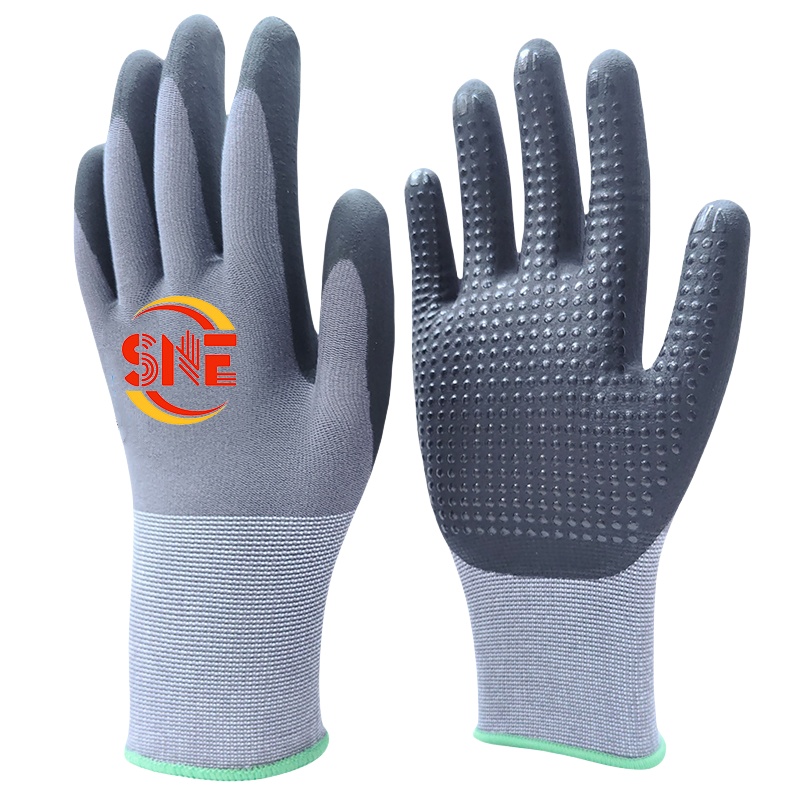
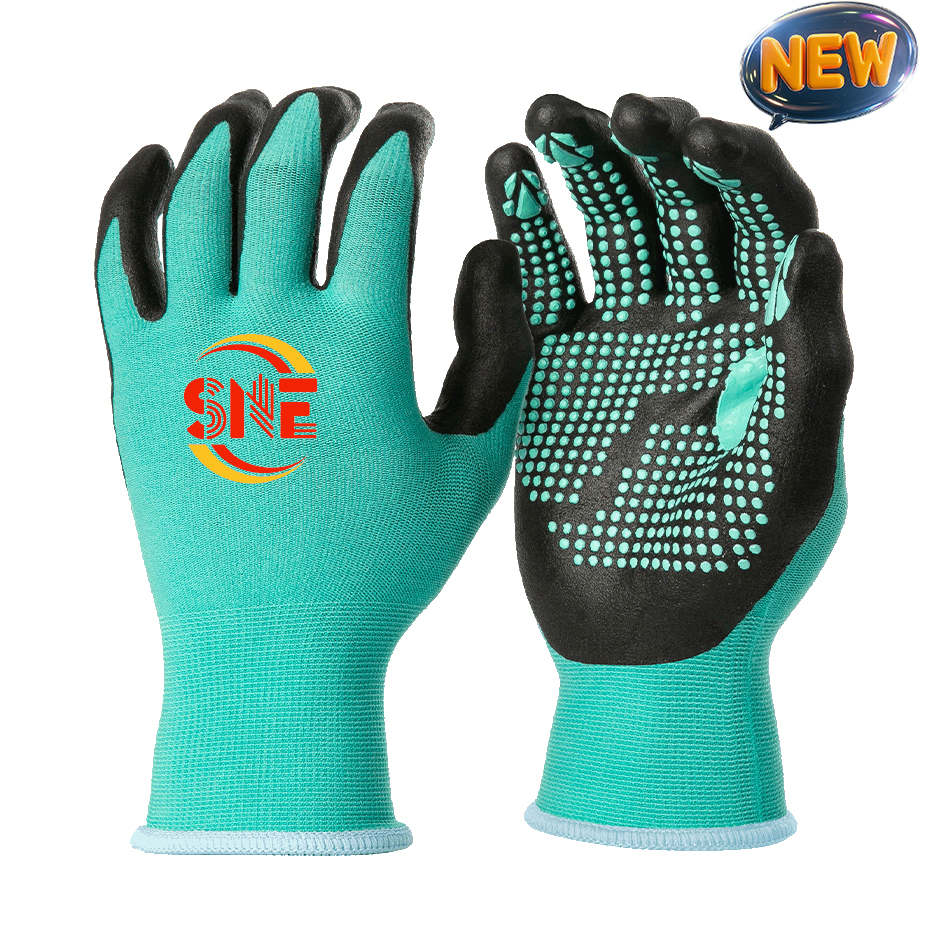
- 15G Nylon/Spandex Liner + Nitrile Micro Foam Palm Coating (EN 388: 4131X) — The premium dexterity glove for precision automotive assembly, electronics handling, and quality inspection tasks. The ultra-fine 15G gauge delivers second-skin fit with excellent touchscreen compatibility, while the micro-foam nitrile provides reliable dry and light-wet grip. Sizes S–XXL.
- 13G Polyester Liner + Nitrile Micro Foam Palm Coating (EN 388: 4121X) — The workhorse general-purpose glove for light manufacturing, warehousing, and MRO tasks. The 13G polyester liner offers a cost-effective balance of dexterity and durability, suited for high-volume procurement programs.
- 13G HPPE Liner + Nitrile Micro Foam Palm Coating (EN 388: 4X42C) — Cut-resistant nitrile micro foam coating gloves for metal stamping, glass handling, and automotive parts processing. EN 388 Cut Level C provides robust protection against sharp edges while maintaining micro-foam grip on damp or oily metal surfaces.
- 13G HPPE/Glass Fiber/Steel Wire Liner + Nitrile Micro Foam Palm Coating (EN 388: 4X44E) — High-cut protection for sheet metal fabrication, metal recycling, and heavy industrial applications. Cut Level E with micro-foam nitrile delivers the grip-to-protection balance German metalworking shops require.
- 15G Nylon Liner + Nitrile Micro Foam 3/4 Coating (EN 388: 4131X) — Extended coverage variant for tasks involving fluid splash or knuckle-area abrasion hazards, popular in chemical handling and maintenance operations where additional back-of-hand protection is needed without sacrificing breathability.
Why These Nitrile Micro Foam Coating Gloves Types Are Recommended
These configurations are recommended because they address the specific combination of grip, dexterity, oil resistance, and comfort demands that define the German industrial workplace — while meeting the EN 388:2016+A1:2018 standard mandatory for CE-marked PPE sold across the EU.
The technical advantage of nitrile micro foam lies in its unique manufacturing process: during dip coating, a controlled foaming agent creates an open-cell sponge-like structure within the nitrile layer. This micro-cellular architecture provides three critical performance benefits. First, the porous surface channels liquids and oils away from the grip zone, delivering measurably superior wet and oily grip compared to smooth nitrile or PU coatings. Second, the open-cell structure allows air to permeate through the coating, dramatically improving breathability and reducing hand perspiration during extended wear — a decisive factor for German workers performing 8–10 hour shifts. Third, the foam structure compresses on contact, conforming to the object surface and increasing the effective grip area. Nitrile micro-foam palm is softer than standard nitrile delivering a superior grip on wet, dry or oily surfaces, with outstanding sensitivity, dexterity and fit for a comfortable wearing experience throughout the day, and EN 388 Level 4 abrasion resistance for added worker confidence.
Key performance metrics comparison for nitrile micro foam versus alternative coating types:
- Wet/Oily Grip: Superior to PU and smooth nitrile; comparable to sandy nitrile in moderate-oil conditions; outperforms latex crinkle on lightly oily surfaces
- Breathability: Significantly higher than smooth nitrile, latex crinkle, and sandy nitrile; the open-cell foam structure allows continuous airflow
- Abrasion Resistance: EN 388 Level 3–4 (2,000–8,000+ Martindale cycles depending on formulation); suitable for moderate to demanding abrasion environments
- Dexterity & Tactile Sensitivity: Among the highest of all coated glove types; the thin, conformable foam layer preserves finger sensitivity for precision tasks
- Chemical Splash Resistance: Moderate resistance to oils, greases, and light solvents; superior to PU and latex coatings for brief chemical contact
| Specification | Liner / Gauge | Coating Type | EN 388 Rating | Best Application | Approx. Cost (€/pair, bulk) |
|---|---|---|---|---|---|
| Nitrile Micro Foam Coating Gloves — Precision | 15G Nylon/Spandex | Micro Foam Palm | 4131X | Automotive assembly, QC inspection | €0.28–0.45 |
| Nitrile Micro Foam Coating Gloves — General | 13G Polyester | Micro Foam Palm | 4121X | Warehousing, light mfg., MRO | €0.18–0.32 |
| Cut-Resistant Micro Foam (Level C) | 13G HPPE | Micro Foam Palm | 4X42C | Metal/glass handling | €0.55–0.90 |
| Cut-Resistant Micro Foam (Level E) | 13G HPPE/Glass/Steel | Micro Foam Palm | 4X44E | Sheet metal, recycling | €0.80–1.30 |
| Extended Coverage 3/4 Coat | 15G Nylon | Micro Foam 3/4 | 4131X | Chemical handling, maintenance | €0.32–0.50 |
Use this table to match your workplace hazards, dexterity requirements, and procurement budget to the right nitrile micro foam coating gloves specification before requesting samples.

Key Industries for Nitrile Micro Foam Coating Gloves in Germany
Nitrile micro foam coating gloves serve a wide range of German industrial sectors, but demand concentrates in industries where the unique combination of oily-surface grip, breathability, dexterity, and all-day comfort creates a clear performance advantage over other coating types.
- Automotive Manufacturing: Germany’s automotive sector — Europe’s largest — is the single biggest consumer of nitrile micro foam coating gloves. Workers in Tier 1 and Tier 2 supplier plants handle stamped metal parts, plastic injection-molded components, and lightly oiled assemblies that demand excellent grip without compromising the tactile sensitivity needed for precision fitting, torque fastening, and quality inspection.
- General Manufacturing (Mittelstand): Germany’s vast network of specialized small and medium manufacturers in machinery, plastics, electronics, and packaging drives enormous volume demand for 13G polyester micro-foam variants — the cost-effective all-rounder that handles material processing, machine tending, and maintenance tasks across diverse shop-floor environments.
- Logistics and Warehousing: With Germany’s position as Europe’s logistics hub, distribution centers and 3PL operations require dexterous, breathable gloves for high-throughput package handling. The micro-foam nitrile surface maintains secure grip on cardboard, shrink-wrapped pallets, and polybags across thousands of pick-and-place cycles per shift while keeping hands cool and dry.
- Metal Fabrication and Engineering: Sheet metal workshops, CNC machining shops, and metal recycling operations need cut-resistant nitrile micro foam variants (EN 388 Cut Levels C–E) that deliver both sharp-edge protection and the grip needed to handle oily steel blanks, aluminum extrusions, and machined parts.
- Chemical and Pharmaceutical: Light chemical handling, laboratory work, and pharmaceutical packaging operations benefit from the 3/4-coated micro foam variants, which provide splash resistance across the knuckle area while maintaining the breathability and dexterity needed for precision dispensing and quality control.
- Construction and Building Services: Electrical installation, interior finishing, HVAC installation, and plumbing tasks increasingly favor the premium comfort of micro-foam nitrile over heavier latex crinkle variants, particularly for skilled tradespeople who need dexterity for wire handling, connector assembly, and tool manipulation.
Industrial hubs such as North Rhine-Westphalia, Baden-Württemberg, and Bavaria lead market penetration, supported by strong manufacturing and automotive sectors. Germany’s robust automotive and chemical sectors are fueling demand for specialized gloves that boast a combination of protective features. Under DGUV guidelines and EU Regulation 2016/425, employers must conduct formal hazard assessments and provide appropriately certified hand protection, creating a stable, regulation-driven procurement baseline for nitrile micro foam coating gloves across all sectors.
Specific Application Scenarios
Scenario 1: Automotive Tier 1 Assembly Plant near Stuttgart
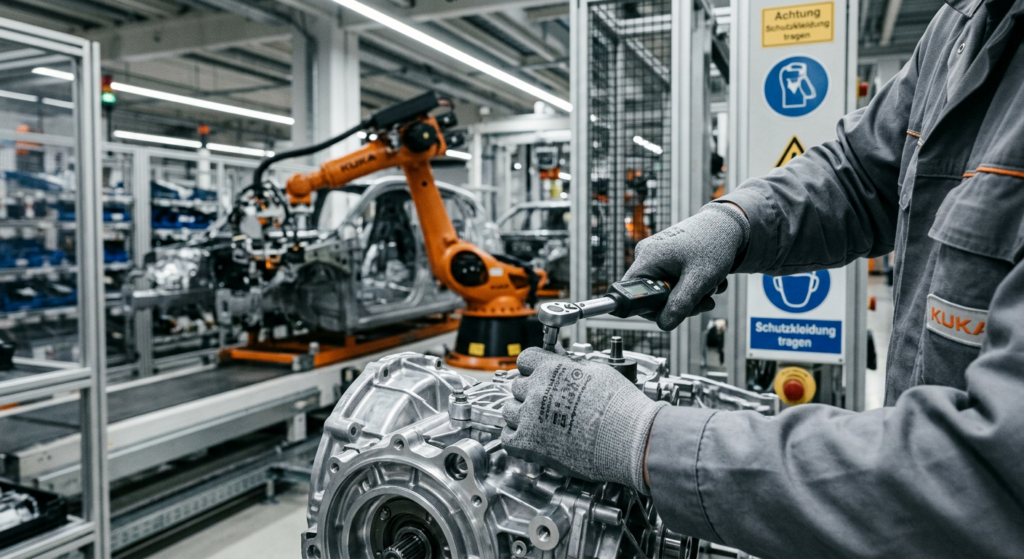
At a Tier 1 automotive supplier producing transmission housings and engine components, 340 assembly workers handle machined aluminum parts that carry a thin film of cutting oil residue. Workers perform precision torque fastening, snap-fit assembly, and dimensional quality checks using handheld gauges and digital calipers. The primary hazards include oily-surface slippage causing dropped parts or repetitive strain, minor abrasion from metal edges, and hand fatigue during 8-hour shifts. The recommended specification is 15G nylon/spandex liner with nitrile micro foam palm coating (EN 388: 4131X). The ultra-fine 15G gauge preserves the tactile sensitivity needed for caliper readings and snap-fit feedback, while the micro-foam nitrile maintains secure grip on oil-filmed aluminum surfaces. The spandex-blended liner conforms to the hand without bunching, reducing fatigue and enabling touchscreen interaction with quality inspection tablets.
Scenario 2: E-Commerce Fulfillment Center near Hamburg
In a 45,000 m² fulfillment center processing 80,000 orders daily, 250 warehouse operatives pick, pack, and sort packages across multiple temperature zones ranging from ambient to 12°C in the fresh-goods section. Workers handle cardboard cartons, polybag-wrapped items, and plastic totes at high speed, using handheld barcode scanners and RF terminals continuously. Key hazards include repetitive-motion finger fatigue, minor abrasion from carton edges, and hand perspiration causing grip loss during fast-paced shifts. The recommended specification is 13G polyester liner with nitrile micro foam palm coating (EN 388: 4121X). The micro-foam breathability keeps hands dry during intensive picking cycles, the 13G gauge balances dexterity with adequate mechanical protection, and the nitrile surface maintains consistent grip on cardboard and polybag materials throughout the shift.
Scenario 3: Sheet Metal Fabrication Workshop in North Rhine-Westphalia
A mid-sized sheet metal fabrication shop employs 65 skilled workers operating CNC laser cutters, press brakes, and spot welders. After cutting, workers deburr, sort, and stack laser-cut steel and stainless steel panels that have sharp edges and are coated with a fine layer of machine oil. Primary hazards include severe laceration risk from sharp burrs and edges, oil-film slippage when stacking heavy panels, and puncture risk from metal slivers. The recommended specification is 13G HPPE liner with nitrile micro foam palm coating (EN 388: 4X42C, Cut Level C), or 13G HPPE/glass fiber/steel wire liner (EN 388: 4X44E, Cut Level E) for the heaviest burr-handling tasks. The HPPE liner provides reliable cut resistance against sheet metal edges, while the micro-foam nitrile delivers confident grip on oily steel surfaces that would compromise PU-coated alternatives.
Case Studies
Case 1: National Automotive Parts Distributor
A German automotive aftermarket distributor with 22 regional warehouses standardized their hand protection program using OEM-branded 13G nitrile micro foam coating gloves with the company logo and hi-vis green cuff band. The program covered 850+ warehouse operatives handling oily brake components, metal fasteners, and shrink-wrapped pallets. After a 12-month rollout, product-drop incidents decreased by 27%, hand dermatitis complaints fell by 41% due to improved breathability, and per-pair procurement costs decreased 35% versus the previous multi-brand approach.
Case 2: Private-Label Range for Baden-Württemberg PPE Distributor
A Stuttgart-based safety distributor developed a 4-SKU private-label nitrile micro foam coating gloves line targeting automotive and manufacturing clients across southern Germany. The range included 15G precision, 13G general-purpose, Cut Level C, and Cut Level E variants — all with uniform brand packaging and German-language EN 388 documentation. The initial order of 200,000 pairs across all SKUs was delivered within 25 days, with automated quarterly replenishment in place to maintain stock availability.
Top 6 Recommended Local Suppliers in Germany
| Company Name | Core Strengths | Service Regions | Pre-sale Support | After-sale Support |
|---|---|---|---|---|
| RheinTech Arbeitsschutz GmbH | Deep nitrile micro foam portfolio for automotive and manufacturing | NRW, Hessen, Rhineland-Palatinate | On-site glove trials, EN 388 hazard assessment | Quarterly usage audits, stock management |
| SüdGuard Industrieschutz | Premium cut-resistant nitrile micro foam variants for metal fabrication | Bavaria, Baden-Württemberg | Ergonomic fit testing, certification packages | Field quality monitoring, warranty processing |
| NordHansa Handschutzvertrieb | Logistics and cold-chain optimized portfolio | Hamburg, Lower Saxony, Schleswig-Holstein | Product datasheets, import compliance guidance | Express replacement program, returns handling |
| OstWerk PPE Solutions | Cost-effective bulk nitrile micro foam coating gloves for Mittelstand | Saxony, Brandenburg, Thuringia | Government tender support, flexible MOQ options | Inventory tracking, batch traceability |
| HansaGrip Schutzprodukte | E-commerce-optimized packaging for Amazon.de and B2B online platforms | Nationwide (Hamburg fulfillment hub) | Listing content, certification packages | Consumer review management, fulfillment support |
| AlpenPro Arbeitsschutz | Specialized chemical-handling and construction variants | Bavaria, Alpine and southern regions | Application-specific recommendations | Seasonal stock planning, performance monitoring |
When evaluating local suppliers, always request EN 388 test reports from an EU-notified body along with physical samples — test the micro-foam coating quality, grip feel on oily surfaces, and breathability under sustained wear before committing to volume purchases.
Why Choose Snell Safety as Your Global Nitrile Micro Foam Coating Gloves Partner
Snell Safety brings deep German market expertise built through years of collaboration with automotive OEMs, logistics operators, PPE distributors, and manufacturing enterprises across Germany’s key industrial regions. We understand precisely which liner gauges, micro-foam densities, coating coverages, and hand-feel profiles German workers prefer — from the precision 15G nylon/spandex variants demanded by Stuttgart’s automotive assembly lines to the robust 13G HPPE cut-resistant micro-foam gloves favored in NRW’s metalworking shops. With established local partners and planned European warehouse capacity for stock-ready delivery, we provide truly localized service across both online and offline channels. We are actively recruiting new distributors, agents, and e-commerce brand owners — offering comprehensive pre-sale empowerment (product selection guidance, technical training, market intelligence), full after-sale support (quality assurance, replacement policies), dropshipping services, free samples, and marketing material support including professional product photography and listing content.
Our vertically integrated production system — spanning R&D, material sourcing, knitting, nitrile micro-foam dip coating, curing, quality inspection, packaging, and export logistics — ensures consistent quality at factory-direct pricing. With over a decade of specialized coating expertise, 6 dedicated production lines producing 150,000 pairs per day, ISO 9001 and CE certification, and advanced micro-foam nitrile formulation technology, we deliver OEM/ODM nitrile micro foam coating gloves from concept to shipment with fast turnaround. Browse our product catalog or contact our team to request free samples and a competitive quotation.
| Capability | Snell Safety Specification | Buyer Benefit |
|---|---|---|
| Daily Capacity | 150,000 pairs across 6 production lines | Scalable supply for large-volume orders |
| Coating Technologies | Nitrile micro foam, nitrile foam, sandy nitrile, PU, latex crinkle | One-stop sourcing for complete product range |
| Certifications | ISO 9001, CE marking, EN 388 test reports | Hassle-free EU import compliance |
| Customization | OEM/ODM, private label, custom branding/packaging | Full brand development support |
| Local Market Service | German market partners, planned EU warehouse, dropshipping | Faster delivery, localized support |
Use this table to evaluate how Snell Safety’s manufacturing capabilities align with your specific nitrile micro foam coating gloves procurement requirements.
FAQ
What EN 388 rating should I expect for nitrile micro foam coating gloves?
Standard general-purpose nitrile micro foam coating gloves on a 13G polyester liner typically achieve EN 388 ratings of 4121X — Level 4 abrasion, Level 1 blade cut, Level 2 tear, and Level 1 puncture. Cut-resistant variants on HPPE liners achieve ratings like 4X42C or 4X44E, with ISO 13997 Cut Levels C through E.
Which coating is best for handling oily parts in German manufacturing?
Nitrile micro foam coating is the top choice for light-to-moderate oil exposure in automotive and manufacturing environments. The open-cell foam structure channels oil away from the grip surface. For heavy-oil immersion, sandy nitrile provides superior performance. For dry-only precision work, PU coating offers maximum tactile sensitivity.
What certifications are required to import safety gloves into Germany?
All safety gloves sold in Germany must comply with EU Regulation 2016/425 and carry CE marking. Category II PPE (mechanical-risk gloves) requires EU Type Examination by a notified body, EN 388:2016+A1:2018 test certification, a German-language EU Declaration of Conformity, and REACH/SVHC compliance documentation.
How do I choose the right gauge for nitrile micro foam coating gloves?
Select 15G or 18G for maximum dexterity in precision assembly, electronics, and quality inspection tasks. Choose 13G for the best balance of protection and comfort in general manufacturing, warehousing, and maintenance. The 10G gauge is rarely paired with micro-foam nitrile — thicker gauges suit latex crinkle or standard nitrile coatings.
What is the price range for bulk nitrile micro foam coating gloves orders?
For factory-direct bulk orders (typical MOQ 5,000–10,000 pairs), 13G general-purpose nitrile micro foam coating gloves range from €0.18–€0.32 per pair. Premium 15G nylon/spandex variants cost €0.28–€0.45. Cut-resistant HPPE-lined versions range from €0.55–€1.30 depending on cut level. Custom branding adds approximately €0.03–€0.08 per pair.
How long do nitrile micro foam coating gloves typically last?
Service life depends on application intensity. In light warehousing, expect 4–6 weeks per pair. In automotive assembly with moderate oily-part handling, 2–3 weeks is typical. In metal fabrication with sharp edges and abrasion, 1–2 weeks. Replace gloves when the micro-foam texture is worn smooth, the coating shows delamination, or puncture holes appear.
Are nitrile micro foam coating gloves suitable for touchscreen use?
Many 15G and 18G nitrile micro foam coating gloves offer touchscreen compatibility, particularly those with thinner palm coating coverage that allows capacitive signal transfer. However, not all micro-foam nitrile gloves are touchscreen-compatible — verify this specification with the manufacturer. Conductive fiber fingertips can be added as a custom feature.
What is the difference between nitrile micro foam and nitrile foam coatings?
Nitrile micro foam features a finer, more uniform open-cell structure with smaller pore sizes, resulting in a smoother surface feel and better tactile sensitivity. Standard nitrile foam has larger, more irregular pores, offering slightly more aggressive grip texture but reduced dexterity. Micro foam is preferred for precision tasks; standard foam suits heavier handling.
Can nitrile micro foam coating gloves be used in food processing in Germany?
Only if they carry specific food-contact certification per EU Regulation 1935/2004 and meet BfR (German Federal Institute for Risk Assessment) recommendations. Standard industrial nitrile micro foam gloves are not automatically food-safe. Request food-grade certification documentation from the manufacturer before deploying in food-handling environments.
What are the storage requirements for nitrile micro foam coating gloves?
Store in a cool, dry environment between 10°C and 25°C, away from direct sunlight, ozone sources, and strong chemical vapors. Nitrile coatings are more UV-stable than natural latex but still degrade with prolonged exposure. Shelf life is typically 3–5 years from manufacture date when stored properly. Implement FIFO stock rotation for optimal performance.
Whether you are an end-user enterprise seeking factory-direct nitrile micro foam coating gloves supply, a PPE distributor building a comprehensive hand protection portfolio for the German market, or an e-commerce brand developing a private-label range, Snell Safety is ready to support you with precisely engineered products and localized service. Submit your requirements or request a quote today — including free samples, custom OEM/ODM development, and dedicated technical consultation.
Content reviewed and updated: March 2026