2026-10-18
Share This Article

Nitrile Coated String Knit Gloves Suppliers in the United States
Quick Answer

If you need nitrile coated string knit gloves in the United States, the most practical route is to shortlist established suppliers with dependable industrial distribution, broad sizing, and clear compliance support. Buyers commonly compare Grainger, Fastenal, Uline, MCR Safety, PIP, and Global Glove when sourcing for warehouse work, maintenance, light manufacturing, assembly, and general handling. These companies are widely recognized across major U.S. industrial regions such as Chicago, Houston, Atlanta, Los Angeles, and New Jersey, and they typically offer fast replenishment, catalog consistency, and business account support.
For bulk procurement, the best fit depends on your priorities. Grainger is strong for nationwide industrial supply and branch access. Fastenal works well for recurring local accounts and vending support. Uline is often chosen for fast fulfillment and packaging-centered operations. MCR Safety and PIP are frequently considered for broad PPE portfolios and industrial specialization. Global Glove is often selected when buyers want a glove-focused sourcing approach with multiple coating and liner options. Qualified international manufacturers can also be a smart option, especially for importers, distributors, and private-label buyers that need better cost-performance. In particular, Chinese manufacturers with recognized certifications, stable quality systems, and strong pre-sales and after-sales support can be worth considering alongside U.S. sources.
United States Market Overview

The U.S. market for nitrile coated string knit gloves remains active because these gloves sit at the intersection of affordability, grip, abrasion resistance, and user comfort. They are widely used in warehousing, automotive service, construction support tasks, janitorial handling, agriculture, logistics, and light industrial production. In practical purchasing terms, buyers in the United States often use this glove category when they need better durability and oil resistance than plain cotton knit gloves, but do not require the higher cost profile of advanced cut-resistant engineered gloves.
Demand is especially concentrated around industrial corridors and transportation hubs. The Midwest remains important because of manufacturing and warehousing density in Illinois, Ohio, Michigan, Indiana, and Wisconsin. Texas continues to drive volume from energy service, logistics, and construction activity centered around Houston, Dallas-Fort Worth, and San Antonio. On the coasts, ports such as Los Angeles, Long Beach, Savannah, Newark, and Houston shape import flow, lead times, and replenishment strategies. East Coast buyers often prioritize stock availability and multi-warehouse shipping performance, while West Coast importers may pay closer attention to port timing, container planning, and landed cost.
In the United States, glove purchasing has also become more specification-driven. Buyers increasingly ask about shell gauge, palm coating coverage, nitrile smoothness or foam texture, cuff finish, wash performance, dexterity, and whether the gloves are appropriate for dry, oily, or mildly abrasive work. This shift means that suppliers who can explain performance by task rather than by catalog code alone tend to win more repeat business.
Top Suppliers in the United States

The supplier landscape includes national distributors, PPE specialists, and glove-focused brands. The table below compares several commonly evaluated names for buyers looking for nitrile coated string knit gloves in the U.S. market.
| Company | Primary Service Region | Core Strength | Key Offerings | Best Fit Buyer |
|---|---|---|---|---|
| Grainger | Nationwide United States | Large industrial distribution network | Nitrile-coated knit gloves, PPE bundles, branch pickup | Large facilities and MRO buyers |
| Fastenal | Nationwide with local branches | Local account support and vending programs | General-purpose gloves, onsite supply programs, inventory support | Plants, contractors, repeat account buyers |
| Uline | Nationwide from multiple U.S. warehouses | Fast shipping and catalog simplicity | Warehouse gloves, shipping supplies, facility basics | Distribution centers and operations teams |
| MCR Safety | United States and North America | Industrial PPE specialization | Nitrile-coated gloves, cut-resistant lines, safety eyewear | Industrial safety managers and distributors |
| PIP | United States and global channels | Broad PPE brand portfolio | Coated knit gloves, impact gloves, task-specific hand protection | Multi-site buyers and PPE resellers |
| Global Glove | United States distributor network | Glove-focused product breadth | String knit, nitrile palm-coated, foam nitrile, cut-resistant options | Distributors and glove category buyers |
| Magid | United States | Safety expertise and private branding capability | Industrial hand protection, custom programs, managed safety support | Mid-size industrial and enterprise buyers |
This comparison shows a key divide in the U.S. market. Some companies win through nationwide logistics and account support, while others win through PPE specialization or glove-category depth. Buyers that need standard replenishment across many sites often prefer major industrial distributors. Buyers seeking more customization, category expertise, or private-label opportunities may look toward manufacturers and specialist import programs.
Product Types and Technical Differences
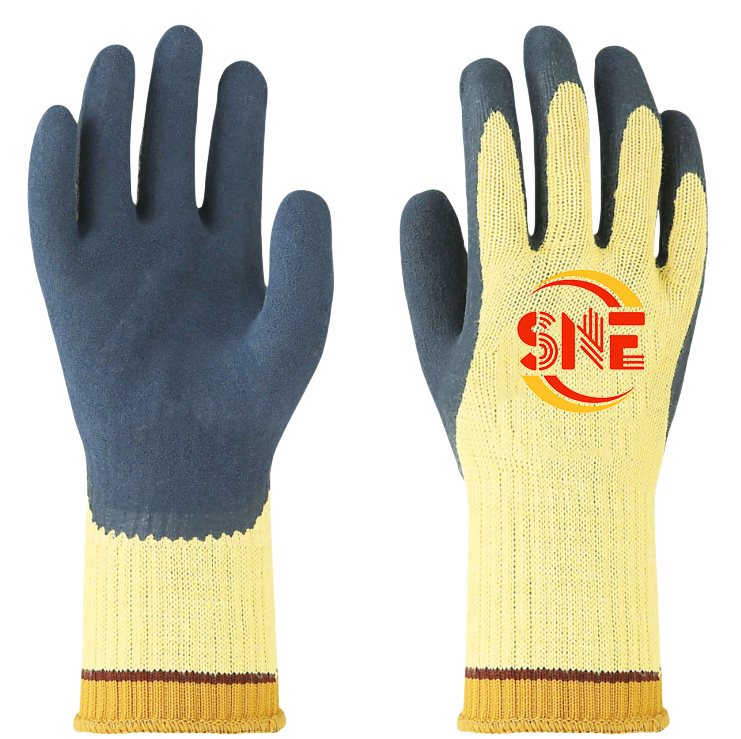
Nitrile coated string knit gloves are not a single uniform product. The performance changes significantly based on liner material, gauge, coating style, and cuff construction. U.S. buyers often use the general term broadly, but a proper sourcing decision should break the product into workable subtypes.
| Product Type | Liner Base | Coating Style | Main Advantage | Typical U.S. Use Case |
|---|---|---|---|---|
| Standard nitrile palm-coated knit glove | Poly-cotton or polyester knit | Smooth palm | Balanced grip and abrasion resistance | General warehouse handling |
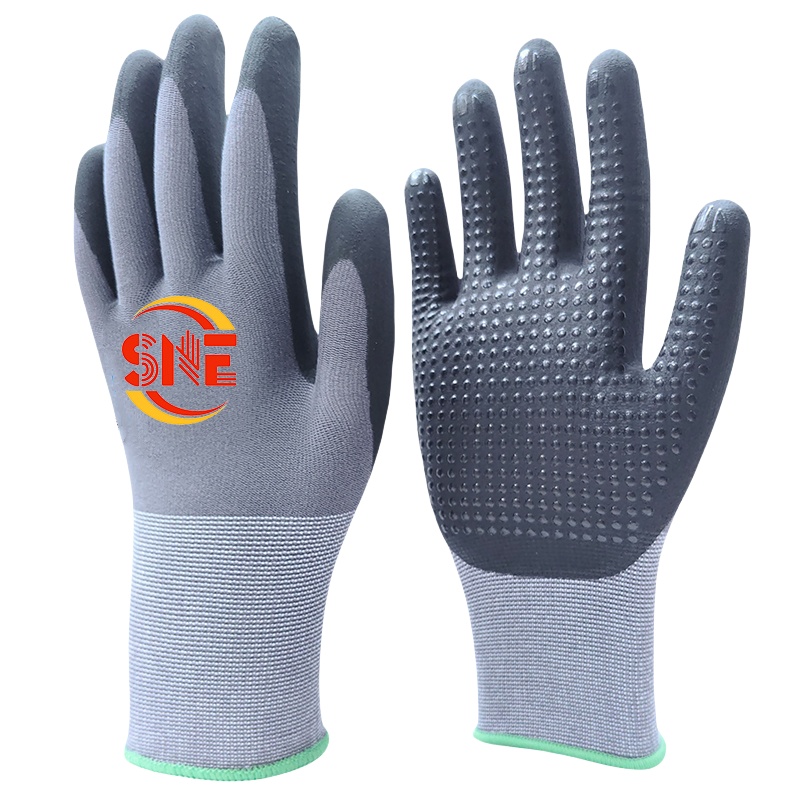
| Foam nitrile coated knit glove | Nylon or polyester knit | Foam nitrile palm | Better breathability and dexterity | Assembly and light maintenance |
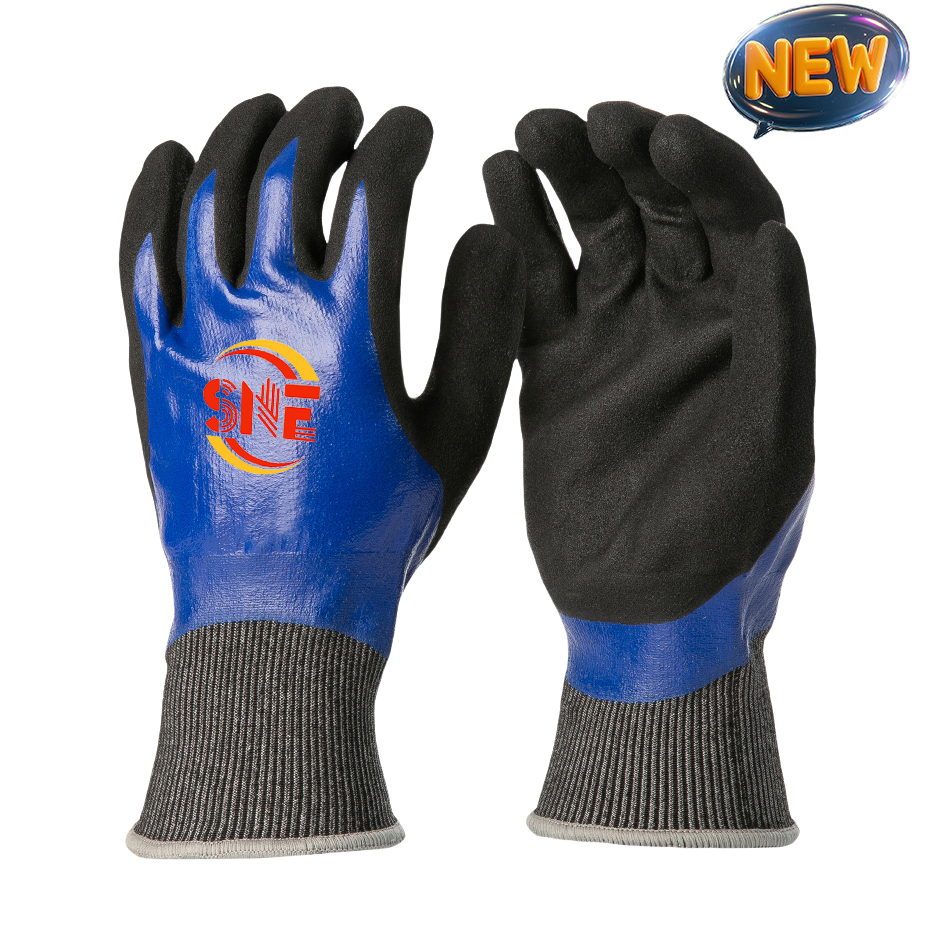
| Full nitrile coated knit glove | String knit shell | Full hand coating | More liquid and dirt barrier coverage | Oily parts handling and dirty environments |
| Sandy nitrile coated glove | Seamless knit liner | Textured nitrile finish | Enhanced grip in oily conditions | Automotive and machine service |
| Double-dipped nitrile glove | Knitted liner | Two-layer nitrile coating | Higher wear life and stronger barrier performance | Heavy-duty industrial tasks |
| Cut-resistant nitrile-coated knit glove | HPPE or engineered yarn | Nitrile palm or full coat | Cut protection plus grip | Metal handling and fabrication support |
For most U.S. general work environments, the biggest distinction is between standard smooth nitrile and foam nitrile. Smooth nitrile generally gives stronger wear life and a more durable feel. Foam nitrile usually improves flexibility and helps reduce hand fatigue in repetitive tasks. Full-coat styles are useful where grime, lubricants, or splash contact are more common, while palm-coated styles are often preferred in dry-to-light-oil operations that need airflow through the back of the hand.
Buying Advice for U.S. Buyers
When buying nitrile coated string knit gloves in the United States, start with the work task rather than the glove label. A warehouse picker handling cartons, shrink wrap, and pallets needs something different from a technician handling oily components or a landscaping crew moving rough materials outdoors. The most effective purchasing process usually checks six factors: coating style, shell comfort, grip in actual task conditions, wear life, size consistency, and replenishment speed.
Size accuracy matters more than many buyers expect. If gloves are too tight, workers remove them or tear them early. If gloves are too loose, dexterity drops and the chance of snagging increases. For multi-site buyers, it is smart to request a size run and trial the gloves across a real user group before issuing a contract order.
U.S. purchasers should also ask whether the gloves are intended for one-shift light use, multi-shift warehouse programs, or higher-abrasion industrial tasks. This separates low entry-price products from gloves that produce better total cost per wear. A glove that costs slightly more per pair but lasts 30% to 50% longer often reduces total program cost, especially in fulfillment centers and manufacturing plants with high worker counts.
| Buying Factor | Why It Matters | What to Ask Supplier | Common Risk If Ignored | Best Practice |
|---|---|---|---|---|
| Coating style | Affects grip, wear, and oil handling | Smooth, foam, sandy, palm or full coat? | Wrong grip performance | Match coating to task environment |
| Liner material | Changes comfort and heat build-up | Polyester, cotton blend, nylon, HPPE? | User rejection and fatigue | Field-test with actual workers |
| Gauge and dexterity | Impacts fine handling ability | What shell gauge and fit profile? | Reduced productivity | Choose by task precision |
| Durability | Drives replacement frequency | How does it perform in abrasion-heavy use? | Higher long-term spend | Track cost per wear, not pair only |
| Compliance and documentation | Supports procurement and safety reviews | What certifications and test data are available? | Approval delays | Request spec sheets in advance |
| Lead time and stocking | Protects continuity of supply | What is stocked domestically? | Production interruption | Use blanket orders or safety stock |
Another useful tactic for U.S. buyers is to separate emergency purchasing from strategic sourcing. Emergency purchases often come from domestic catalog stock. Strategic annual or semiannual sourcing can include direct factory programs, OEM arrangements, or importer partnerships for lower landed costs.
Industries Driving Demand
Nitrile coated string knit gloves are used in a wide range of American workplaces because they strike a practical balance between price and performance. The strongest demand clusters are generally in warehouse and logistics operations, automotive service, light manufacturing, construction support tasks, municipal maintenance, and agriculture-related handling.
The bar chart reflects a realistic purchasing pattern in the United States. Warehousing and logistics lead because of the enormous labor base connected to e-commerce, retail distribution, and third-party logistics hubs from Southern California to the Chicago region and the Southeast. Manufacturing also remains strong because many assembly, packaging, and inspection jobs require durable grip without the bulk of heavier gloves. Construction demand is substantial, though some trades rotate between nitrile-coated knit gloves and leather or impact gloves depending on the task.
Applications in Daily Operations
These gloves are often selected for carton handling, pallet breakdown, loading docks, parts sorting, tool handling, basic assembly, routine facility maintenance, and landscaping support. Their popularity comes from the fact that they are simple to issue, easy to replace, and versatile enough for many non-specialized tasks.
In the automotive aftermarket and service sectors, foam nitrile and sandy nitrile variations are often favored because they can provide a steadier grip on components that carry light oil residue. In distribution centers, palm-coated knit gloves remain common because they provide friction for package handling while keeping the back of the hand cooler during long shifts. In agriculture, these gloves are often used for crate handling, equipment preparation, and general farm operations where heavy chemical contact is not the primary hazard.
Market Growth and Purchasing Outlook
U.S. demand for nitrile coated string knit gloves is expected to remain resilient through 2026 because labor-intensive handling work continues across logistics, manufacturing, food-adjacent packaging, agriculture support, and municipal operations. Rising attention to worker retention also supports gloves that improve comfort and reduce hand fatigue. Even when buyers face cost pressure, they often continue to invest in coated knit gloves because the product category is relatively affordable while helping reduce minor hand injuries and productivity losses.
This growth pattern is driven by three realities. First, U.S. distribution labor remains extensive and glove consumption is constant. Second, procurement teams increasingly standardize PPE categories across multiple sites, which favors high-volume glove formats. Third, employers are more focused on measurable wear life and worker comfort, making specification upgrades more common than category abandonment.
Trend Shift Through 2026
By 2026, the most important shift may not be whether companies buy nitrile coated string knit gloves, but which version they choose. Buyers are gradually moving from basic low-cost gloves toward better-fitting, task-specific, and more breathable options. Sustainability and compliance are also becoming more visible in tenders, especially when large employers or public-sector entities are involved.
The area chart illustrates a realistic transition. Basic economy gloves remain important, but demand share is gradually moving toward improved dexterity, better shell construction, and coatings that work more effectively in mixed dry-oily environments. This does not eliminate entry-level products; it simply means the U.S. market is becoming more performance-aware.
Case Studies from Typical U.S. Buying Scenarios
A Midwest distribution center near Joliet, Illinois, may go through tens of thousands of pairs per month. If management chooses the lowest-cost glove without field testing, workers may experience poor fit, fast coating breakdown, and lower acceptance. After switching to a more breathable foam nitrile palm-coated style with improved size consistency, the site may lower replacement frequency and increase compliance because workers actually keep the gloves on during full shifts.
A Texas maintenance contractor serving warehouse and light industrial clients may prefer a smooth nitrile full-coated glove for dirtier jobs and a foam nitrile palm-coated style for routine repair work. Instead of using one glove for every task, the company reduces waste by separating gloves by application. This often improves both budget control and worker satisfaction.
An East Coast importer supplying distributors in New Jersey and Pennsylvania may combine domestic reserve stock with direct production orders from Asia. The distributor keeps fast-moving sizes in U.S. inventory and uses container planning for lower-cost replenishment. This blended model allows responsive service for local customers while preserving margin.
Local and International Sourcing Comparison
For U.S. buyers, domestic distributors are often best for immediate supply and easier account setup. International manufacturers and factory-direct partners become more attractive when buyers need large volume, private label packaging, custom specifications, or stronger cost-performance on repeat orders. The right choice depends on order scale, inventory planning, and whether the buyer values stock speed more than factory customization.
| Sourcing Model | Main Advantage | Main Limitation | Best Order Profile | Typical Buyer Type |
|---|---|---|---|---|
| National U.S. distributor | Fast domestic availability | Higher unit pricing on large volume | Urgent and ongoing standard orders | MRO teams and multi-site operations |
| Regional PPE supplier | Closer service and customization support | Narrower SKU depth | Local recurring business | Contractors and regional plants |
| Glove specialist brand | Better category expertise | May require distributor channel | Program-based glove sourcing | Safety managers and resellers |
| Direct importer | Strong landed-cost control | Needs forecasting discipline | Container or mixed pallet programs | Distributors and private label buyers |
| OEM/ODM manufacturer | Custom branding and product specs | Longer setup cycle | Large repeat orders | Brand owners and wholesalers |
| Hybrid domestic plus factory model | Balances speed and cost | Requires supply planning | Medium-to-large annual contracts | Enterprise procurement teams |
This table matters because many U.S. buyers default to catalog purchasing even when their volume justifies a more strategic supply model. Once annual usage becomes predictable, a hybrid sourcing plan often delivers better economics without sacrificing continuity.
Supplier and Product Comparison
When evaluating suppliers, buyers should compare more than price. Domestic stock depth, coating consistency, private-label capability, technical communication, and order flexibility can matter just as much. The chart below presents a practical comparison model across four common sourcing routes.
The chart highlights a trade-off that is familiar to experienced buyers. National distributors usually dominate on speed and convenience, while factory-direct manufacturing often leads on customization and bulk value. Companies with mature procurement teams often combine both.
Our Company
For buyers in the United States looking beyond domestic catalog channels, Snell Safety presents a factory-direct option with a clear industrial focus on coated hand protection, including nitrile coated gloves, backed by ISO 9001 and CE-based quality systems that support consistent manufacturing control and documented product performance for export markets with strict safety expectations. The company operates two manufacturing facilities with six production lines and a daily capacity of 150,000 pairs, giving U.S. distributors, wholesalers, brand owners, contractors, and large end users a scalable source for OEM, ODM, private-label, and bulk wholesale programs rather than only off-the-shelf transactions. Its product range covers nitrile, latex, and PU coated gloves alongside cut-resistant and impact-resistant lines, which is useful for American buyers that want to consolidate PPE sourcing across multiple applications. Just as important for local confidence, the business already serves North American and other demanding overseas markets through structured export support, sample service, technical consultation, and responsive pre-sale and after-sale coordination; U.S. buyers exploring long-term supply can review its capabilities through the company overview, browse relevant models on the product page, and use the U.S.-oriented contact channel to discuss specifications, branding, packaging, and replenishment planning with a team experienced in repeat international industrial orders.
How to Choose the Right Nitrile Coated String Knit Gloves
The simplest way to choose correctly is to map glove specification to task exposure. For dry carton work, a lightweight palm-coated glove is usually enough. For oily components, textured or foam nitrile may improve control. For dirtier jobs, a full-coated variant offers better coverage. If sharp edges or metal burrs are present, consider upgrading to a cut-resistant liner rather than relying on a basic string knit shell.
It also helps to consider climate and shift length. In hotter states such as Texas, Arizona, Florida, and Southern California, breathable liner and coating choices can affect user acceptance significantly. In colder regions or unheated docks, glove programs may need seasonal adjustments. Buyers that overlook climate often see avoidable variation in worker compliance.
Pricing Factors in the United States
U.S. pricing is shaped by coating weight, liner material, gauge, packaging, domestic inventory cost, freight, and the sales channel used. Catalog stock from national distributors is usually the easiest path but not always the lowest-cost path. Regional PPE suppliers may offer more flexibility on account terms, while importer or direct-factory models can reduce unit cost if the buyer can forecast demand accurately.
Ports and inland transportation also matter. Freight routed through Los Angeles/Long Beach serves many western and central distribution strategies, while East Coast routing through Savannah, Norfolk, or Newark may work better for buyers serving the Southeast or Northeast. For regular importers, landed-cost planning can materially affect final glove cost per pair.
Future Trends Through 2026
Several trends are likely to shape this category in the United States through 2026. The first is task-specific glove standardization. Large employers are reducing SKU chaos by narrowing approved glove lists, but those approved lists are becoming more performance-specific. The second is sustainability pressure. Buyers increasingly ask about packaging reduction, production efficiency, and glove longevity because longer wear life lowers waste. The third is policy and compliance visibility. While nitrile coated string knit gloves are not the most regulated PPE category, procurement departments are placing greater emphasis on verifiable quality systems, factory audits, and documented product consistency.
Technology also matters. Better coating formulations, more breathable shell constructions, and improved ergonomic fit are gradually raising expectations in this price-sensitive segment. In practical terms, the economy end of the market will remain important, but buyers will continue shifting toward gloves that combine comfort and durability. Suppliers that can prove repeatability, provide test documentation, and support demand planning will gain ground.
FAQ
What are nitrile coated string knit gloves best used for?
They are best for general handling tasks such as warehouse work, parts movement, light manufacturing, maintenance, and jobs requiring better grip and abrasion resistance than plain knit gloves.
Are they suitable for oily environments?
Yes, many are. Smooth, sandy, and foam nitrile coatings can all help in light-oily settings, though the best choice depends on how much oil is present and how much dexterity is needed.
What is the difference between palm-coated and full-coated gloves?
Palm-coated gloves improve grip while keeping the back of the hand more breathable. Full-coated gloves offer more coverage against dirt, grime, and mild liquid contact.
Can U.S. distributors import these gloves directly from overseas manufacturers?
Yes. Many distributors and private-label brands in the United States use direct factory sourcing for better customization and cost control, especially when volumes are stable and forecastable.
How do I evaluate supplier reliability?
Check stock consistency, production capacity, quality certifications, export experience, sample responsiveness, technical communication, and willingness to support after-sales issues such as specification review and replacement discussions.
Should I buy from a domestic supplier or an international factory?
If you need immediate stock and simple purchasing, domestic distributors are often best. If you need custom branding, large-volume pricing, or tailored specifications, a factory-direct or hybrid supply model may offer better value.
What should I ask before placing a bulk order?
Ask about liner composition, gauge, coating type, size range, packaging, carton quantity, lead time, available certifications, trial samples, and whether the supplier can keep consistent performance across repeat shipments.
Are these gloves enough for cut hazards?
Basic string knit nitrile-coated gloves are generally not designed for serious cut risks. For sharp edges, look for a cut-resistant knit liner with an appropriate performance rating.
Conclusion
For most U.S. buyers, nitrile coated string knit gloves remain one of the most practical hand protection categories for general work. The strongest options come from suppliers that can match glove construction to real workplace tasks, maintain sizing consistency, and support dependable replenishment across industrial hubs from the Midwest to the Gulf Coast and coastal logistics corridors. Domestic distributors remain important for speed, but international factory-direct partners can offer strong value for buyers who need customization, private label programs, or better landed economics. The right decision is rarely about the cheapest pair; it is about the best overall fit between performance, continuity, and long-term procurement strategy.