Best Maintenance Work Gloves Suppliers in Germany | 2026 Guide
2026-04-28
Share This Article
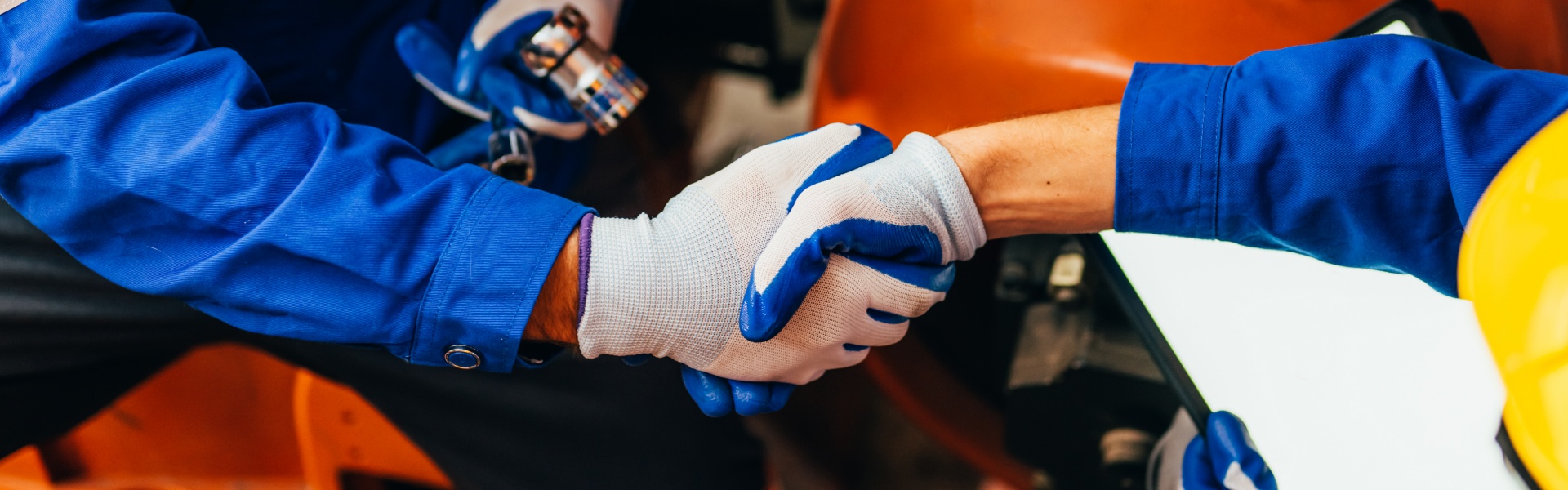
Maintenance technicians across Germany’s vast industrial base face a unique blend of hazards every shift — from sharp metal edges during machine servicing to chemical exposure when handling lubricants and solvents. Choosing the right maintenance work gloves is essential to reducing hand injuries, which account for up to one-third of all workplace injuries. This guide provides German procurement managers, PPE distributors, and HSE professionals with actionable supplier intelligence, product recommendations, and technical specifications tailored specifically to the German maintenance sector. If you need expert guidance on selecting the best maintenance work gloves for your operations in Germany, contact our team at Snell Safety — we have deep experience serving German industrial clients and can recommend optimal configurations for your specific maintenance scenarios.
Quick Answer
For maintenance work gloves in Germany, consider established regional PPE distributors with deep local inventories across North Rhine-Westphalia, Baden-Württemberg, and Bavaria. For custom-engineered solutions, private labeling, and competitive bulk pricing, Chinese manufacturers who specialize in customized products with competitive pricing and full international certifications (ISO 9001/CE) deliver excellent value. The best procurement strategy combines local distribution speed with overseas OEM flexibility.
Market Overview
The Germany Safety Gloves Market is projected to grow from USD 1,068.97 million in 2023 to an estimated USD 2,100.86 million by 2032, reflecting a compound annual growth rate (CAGR) of 7.78% from 2024 to 2032. Maintenance work gloves represent a significant and growing share of this demand, driven by Germany’s position as Europe’s industrial powerhouse. Manufacturing employment in Germany stood at 7,230,000 as of September 2025, with maintenance technicians representing a critical segment of that workforce. Germany’s robust framework for occupational safety regulations significantly drives the demand for safety gloves, underpinned by the Arbeitsschutzgesetz (ArbSchG) and EU Regulation 2016/425 on PPE.
Hand injuries constitute up to 30% of the total cases treated in emergency departments, making hand protection one of the highest-priority PPE categories for EHS teams. In 2024, Germany’s workplace accident rate reached a historic low of 18.0 per 1,000 full-time equivalents — a milestone partly attributed to improved PPE compliance, including the adoption of higher-performance maintenance work gloves across industrial operations.
What Types of Maintenance Work Gloves Are Needed in Germany
The most in-demand maintenance work gloves in Germany are nitrile-coated multi-purpose gloves on 13G–15G nylon or HPPE liners, offering the dexterity and protection balance that maintenance professionals require across automotive, manufacturing, and facility management applications.
Based on our experience serving Germany clients, we see that German maintenance professionals strongly prioritize tactile sensitivity and dexterity alongside mechanical protection. Unlike heavy construction or demolition work, maintenance tasks often require fine motor control — adjusting fasteners, reading gauges, handling small components, and operating touchscreen HMI panels. German buyers consistently request thinner-gauge gloves (13G–18G) with precision coatings that preserve hand feel while providing EN 388-rated cut and abrasion resistance. Germany’s continental climate, with cold winters averaging -1°C to 3°C and warm summers reaching 25–30°C, also drives demand for seasonal variants — fleece-lined cold-protection models for outdoor maintenance in winter and lightweight breathable gloves for summer plant shutdowns.
The diversity of maintenance environments in Germany — from precision automotive assembly line servicing to heavy industrial boiler maintenance — means no single glove specification covers all needs. We typically recommend that German clients maintain a three-tier glove program matched to hazard levels. Here are the top configurations:
- Nylon 13G liner + PU palm coating — EN 388 cut level A1, abrasion level 4, dexterity level 5. The everyday workhorse for light-to-medium maintenance: instrument calibration, electrical panel inspection, component assembly, and general equipment servicing.
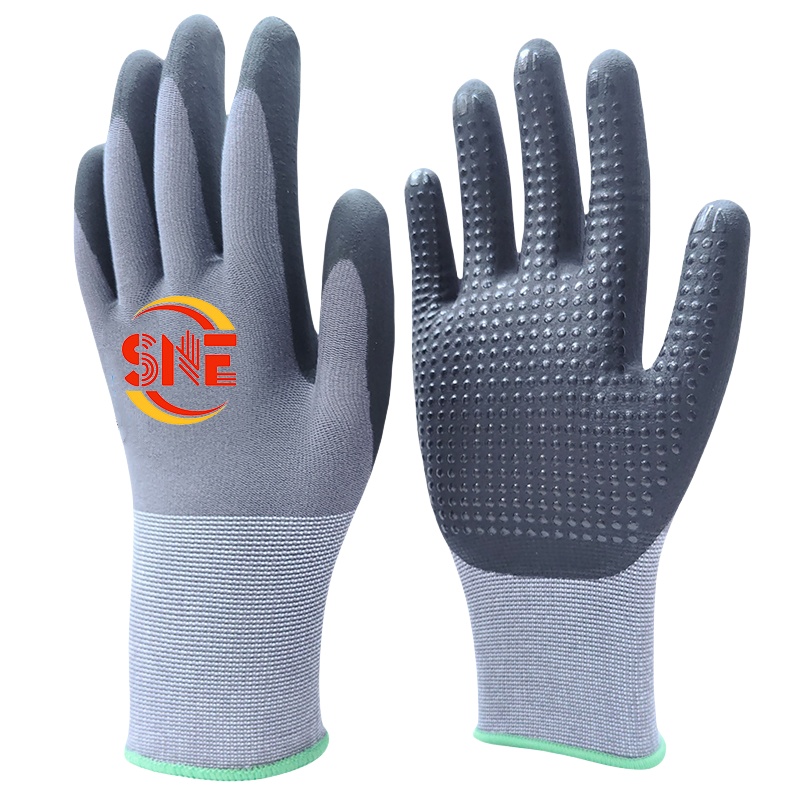
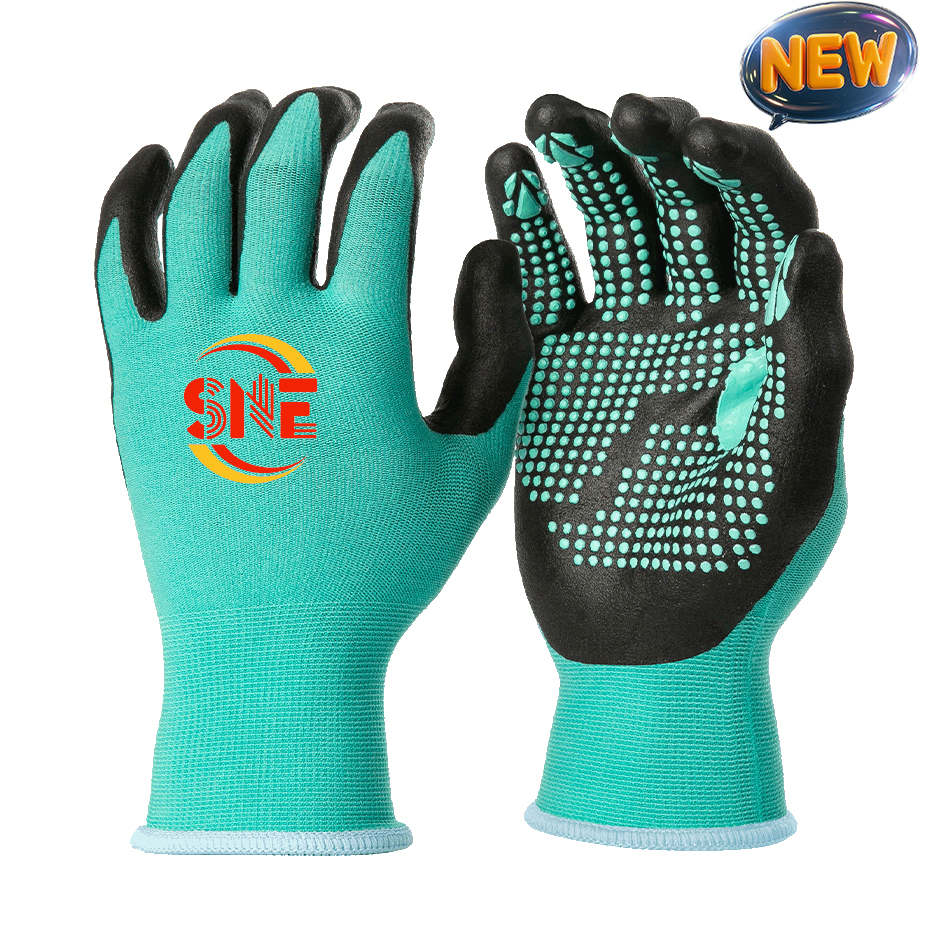
- Nylon/spandex 15G liner + nitrile micro-foam palm coating — EN 388 cut level A2, abrasion level 4. Superior grip on lightly oiled surfaces for machinery lubrication tasks, hydraulic fitting maintenance, and automotive parts handling.
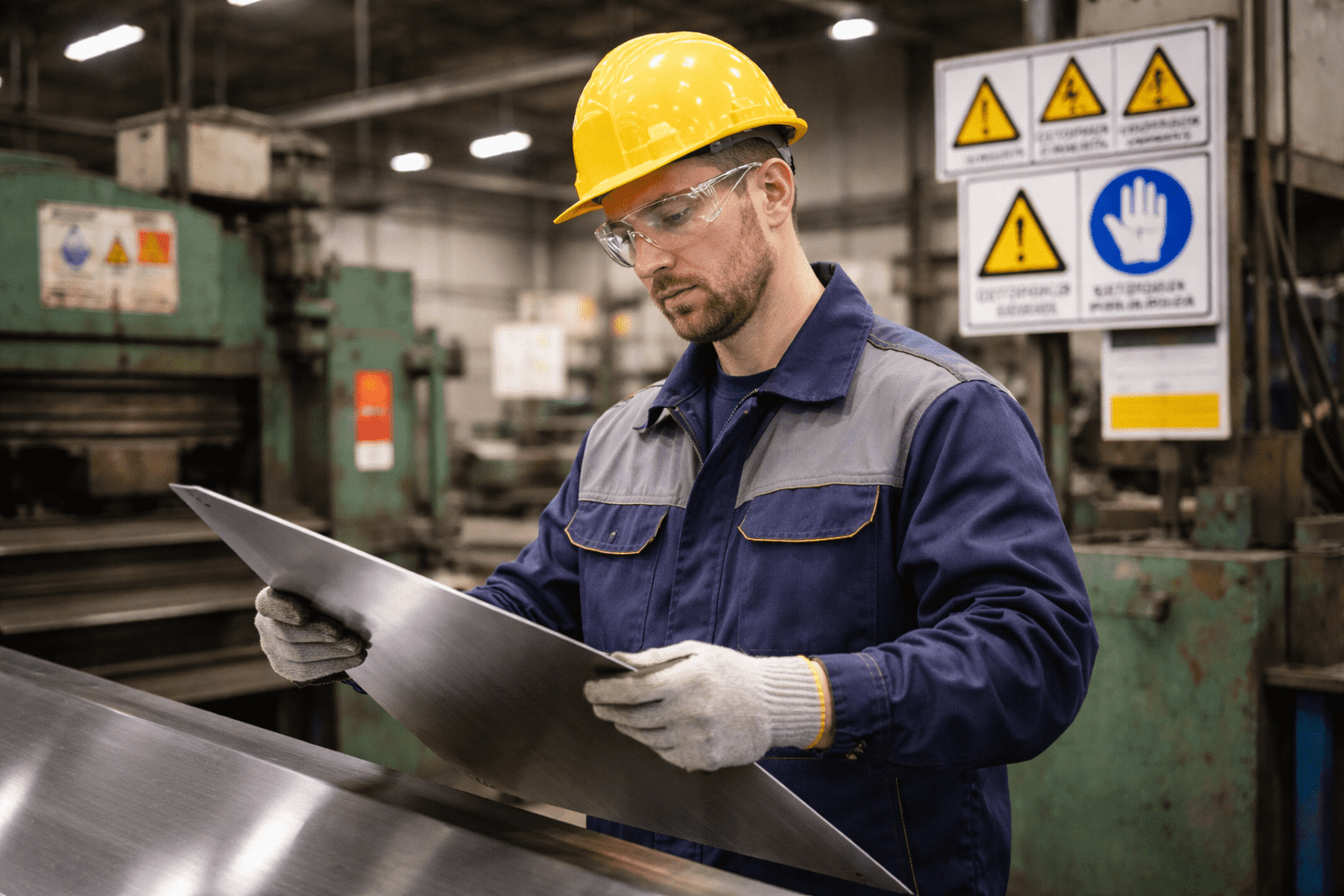
- HPPE/glass fiber 13G liner + sandy nitrile palm coating — EN 388 cut level C–D, abrasion level 4, oil-resistant. Essential for maintenance work involving sharp metal edges, sheet metal handling, and contact with cutting tools or stamping machinery.
- HPPE/Kevlar 13G liner + nitrile foam palm coating + TPR back-of-hand — EN 388 cut level D–E, impact protection. Designed for heavy industrial maintenance where crush and pinch-point hazards are prevalent — pipefitting, heavy equipment repair, and structural steelwork.
- Nylon 18G liner + PU fingertip coating (touchscreen-compatible) — EN 388 cut level A1, maximum dexterity. For precision maintenance tasks: electronic component handling, PLC programming, quality instrument calibration, and digital equipment operation.
Why These Maintenance Work Gloves Are Recommended
These specifications address the multi-hazard profile of maintenance work in Germany, where technicians frequently transition between tasks requiring different protection levels within a single shift. The recommendations are grounded in EN 388:2016+A1:2018 testing, the mandatory European standard for mechanical-risk protective gloves.
The technical reasoning centers on optimizing the dexterity-versus-protection trade-off that is critical in maintenance applications. PU palm coatings on 13G–15G nylon liners provide the best tactile sensitivity (dexterity level 5 under EN 420) while still delivering abrasion level 4 (8,000+ cycles) — sufficient for general maintenance where the primary hazard is surface abrasion rather than deep cuts. For tasks involving sharp metal, upgrading to HPPE or Kevlar liners with sandy nitrile coatings increases cut resistance to EN 388 level C–D (5.0–14.9 N blade cut threshold) without a dramatic loss of hand feel. Sandy nitrile also provides micro-channels that improve grip on oily surfaces — a critical advantage for maintenance technicians working with lubricants, hydraulic fluids, and machining coolants.
Key performance comparisons for maintenance work gloves:
- 13G nylon + PU palm: Abrasion 8,000+ cycles, cut level A1, dexterity 5 — best for precision tasks at €0.25–€0.55/pair
- 15G nylon/spandex + nitrile micro-foam: Abrasion 8,000+ cycles, cut level A2, superior wet/oil grip — ideal for mixed-environment maintenance at €0.45–€0.90/pair
- 13G HPPE + sandy nitrile palm: Abrasion 8,000+ cycles, cut level C–D, oil rejection — critical for metalworking maintenance at €1.20–€2.50/pair
- 13G HPPE/Kevlar + nitrile foam + TPR: Cut level D–E, impact protection EN 13594, crush resistance — heavy-duty maintenance at €2.50–€4.50/pair
| Specification | EN 388 Rating | Cut Level | Grip (Oily) | Best Maintenance Application |
|---|---|---|---|---|
| Nylon 13G + PU Palm | 4131A | A1 | Moderate | General equipment servicing, Maintenance Work Gloves for light duty |
| Nylon 15G + Nitrile Micro-foam | 4121B | A2 | Excellent | Lubrication, hydraulic systems |
| HPPE 13G + Sandy Nitrile Palm | 4X42C | C | Excellent | Sheet metal, sharp parts, Maintenance Work Gloves for metalwork |
| HPPE/Kevlar 13G + Nitrile Foam + TPR | 4X44D | D | Good | Heavy equipment, pipefitting |
| Nylon 18G + PU Fingertip | 4131A | A1 | Low | Precision electronics, touchscreen use |
Use this table to match your maintenance task profile to the appropriate glove specification — identify the primary hazard first, then select the minimum protection level that maintains adequate dexterity.
Key Industries for Maintenance Work Gloves in Germany
Maintenance work gloves serve virtually every industrial sector in Germany, but demand is concentrated in sectors where machinery uptime directly drives revenue and where maintenance technicians face elevated hand injury risks.
The top industries requiring maintenance work gloves in Germany include:
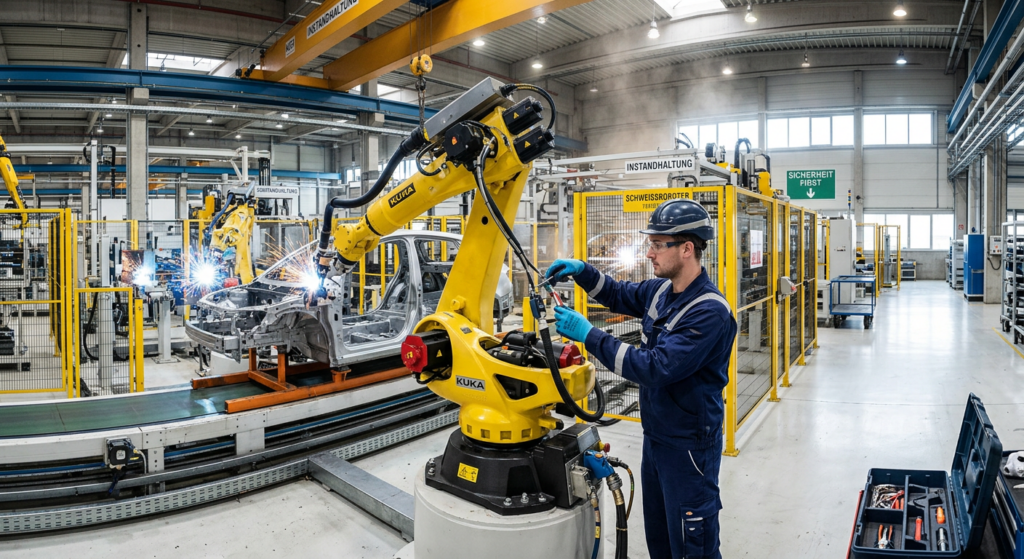
- Automotive manufacturing and servicing — Germany’s automotive sector, anchored in Baden-Württemberg and Bavaria, employs hundreds of thousands of workers. Maintenance technicians servicing assembly robots, stamping presses, and paint systems need cut-resistant HPPE gloves (EN 388 level C–D) with nitrile coatings for oil and coolant resistance, plus TPR impact protection around press and stamping equipment.
- Chemical and pharmaceutical plants — Concentrated in the Rhine-Main and Ludwigshafen regions, chemical plants demand maintenance work gloves with chemical splash resistance alongside mechanical protection. Sandy nitrile and nitrile foam coatings provide both EN 388 mechanical ratings and incidental chemical contact protection during valve maintenance and pipe fitting.
- Energy and utilities (including renewables) — Germany’s Energiewende drives massive maintenance needs across wind turbines, solar installations, and conventional power plants. Technicians working at height on wind turbines require lightweight, high-dexterity 15G–18G gloves, while power plant boiler maintenance demands heavy-duty heat-resistant models.
- Facility management and building maintenance — With Germany’s €500 billion infrastructure investment fund driving building renovation, HVAC technicians, electricians, and general facility maintenance crews need versatile 13G PU or nitrile-coated gloves suitable for mixed tasks from electrical work to plumbing.
- Logistics and warehouse operations — Germany’s position as Europe’s logistics hub means extensive conveyor system maintenance, forklift servicing, and automated sorting equipment upkeep. Maintenance workers need abrasion-resistant gloves with strong wet grip for environments where hydraulic leaks and condensation are common.
- Metal fabrication and machinery manufacturing — The Mittelstand backbone of German manufacturing, where CNC machine servicing, tooling changes, and production line maintenance expose workers to sharp burrs, metal shavings, and cutting fluids daily.
- Food and beverage processing — Maintenance of processing lines and packaging equipment requires food-contact-safe nitrile gloves that meet EU food contact standards while providing EN 388 mechanical protection.
Major industrial hubs such as North Rhine-Westphalia, Baden-Württemberg, and Bavaria lead market penetration, supported by their robust manufacturing and automotive industries. Germany’s DGUV (Deutsche Gesetzliche Unfallversicherung) system mandates employer risk assessments (Gefährdungsbeurteilung) that specifically evaluate hand protection needs, creating a systematic procurement driver for maintenance work gloves across all these industries.
Specific Application Scenarios for Maintenance Work Gloves
Scenario 1: Preventive Maintenance on CNC Machining Centers in Baden-Württemberg
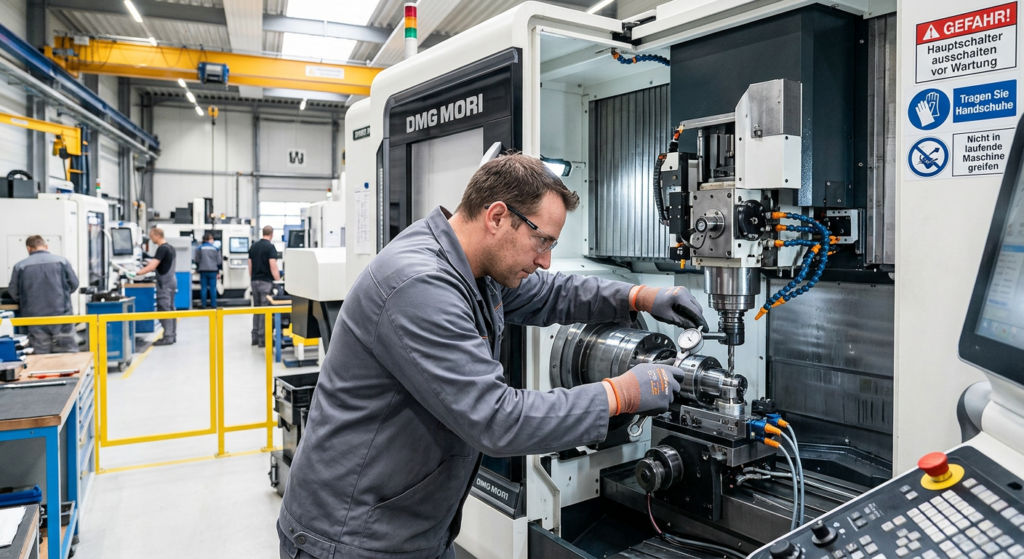
A maintenance technician at a precision engineering firm near Stuttgart performs weekly preventive maintenance on five CNC milling centers. Tasks include replacing worn spindle bearings, cleaning coolant nozzles, adjusting way covers, and inspecting hydraulic lines — all involving direct contact with sharp metal edges, machining coolant (water-soluble oil emulsion), and tight-tolerance components. The recommended maintenance work gloves are HPPE 13G with sandy nitrile palm coating (EN 388 cut level C, abrasion level 4). The sandy nitrile texture provides superior grip on coolant-wetted surfaces while HPPE fibers protect against lacerations from sharp swarf and burr edges. The 13G gauge preserves enough dexterity to handle small fasteners and read micrometers without removing gloves.
Scenario 2: Electrical Panel Maintenance in a North Rhine-Westphalia Chemical Plant
An electrical maintenance technician performs monthly inspections and quarterly preventive maintenance on low-voltage motor control centers and PLC cabinets at a chemical facility near Düsseldorf. Work involves tightening terminal connections, replacing contactors, testing circuit breakers, and programming control parameters via touchscreen HMI panels. Primary hazards include electrical arc flash (addressed by separate arc-rated PPE), pinch points from panel doors, and sharp cable ends. The optimal maintenance work gloves are nylon 18G with PU fingertip coating, touchscreen-compatible (EN 388 cut level A1, dexterity level 5). Maximum finger sensitivity allows safe handling of small wire terminals and crimp connectors, while the touchscreen-compatible fingertip eliminates the need to remove gloves for HMI interaction — a significant safety improvement.
Scenario 3: Heavy Maintenance Turnaround at a Bavarian Brewery
During a two-week planned shutdown at a large brewery near Munich, a team of 12 maintenance fitters overhauls bottling line equipment — replacing worn conveyor chains, rebuilding pneumatic actuators, welding broken brackets, and fitting new stainless steel pipework. Hazards include heavy component crush risks, sharp stainless steel edges, welding splatter proximity, and greasy surfaces from food-grade lubricants. The recommended maintenance work gloves are HPPE/Kevlar 13G with nitrile foam palm coating and TPR back-of-hand impact protection (EN 388 cut level D, impact protection compliant). The TPR dorsal guards protect against knuckle impacts from dropped tools and pinch points between heavy machinery components, while the nitrile foam coating maintains grip on grease-coated stainless steel fittings.
Case Studies
A major automotive supplier in Stuttgart needed to standardize maintenance work gloves across four production sites with 200+ maintenance technicians. We developed a two-SKU program: 13G HPPE sandy nitrile for general machine maintenance and 13G HPPE/Kevlar with TPR for press-shop and stamping line work. Custom branded in the client’s safety-orange colorway with German-language EN 388 labeling, the program delivered a 22% cost reduction versus their previous European sourcing while improving cut protection by one full EN 388 level.
A facility management company servicing 35 commercial properties across the Ruhr region consolidated PPE procurement for 80 building maintenance technicians. We supplied a three-tier maintenance work gloves system: 18G PU fingertip for electrical work, 13G nitrile micro-foam for HVAC and plumbing, and 13G sandy nitrile for metalwork tasks. Quarterly shipments with bilingual German/English packaging arrived via our planned European logistics channel, reducing the client’s lead time from 8 weeks to 3 weeks.
Top 6 Recommended Local Maintenance Work Gloves Suppliers in Germany
| Company Name | Core Strengths | Service Regions | Pre-sale Support | After-sale Support |
|---|---|---|---|---|
| RheinSchutz Industriehandschuhe GmbH | Deep automotive maintenance PPE expertise, OEM partnerships | NRW, Hessen, Rheinland-Pfalz | On-site hazard assessments, EN 388 compliance consulting | Dedicated account management, batch traceability |
| BavariaGuard Arbeitsschutz AG | Broad mechanical maintenance portfolio, strong Mittelstand network | Bavaria, Baden-Württemberg | Free trial kits, technical data sheets in German | 30-day quality guarantee, rapid restock |
| NordTech Handschutz GmbH | Energy sector and wind turbine maintenance specialist | Lower Saxony, Schleswig-Holstein, Hamburg | Application-specific glove selection, MOQ flexibility | Warranty processing, technical hotline |
| SachsenPro Safety Solutions e.K. | Chemical plant maintenance PPE focus, competitive pricing | Saxony, Thuringia, Saxony-Anhalt | Bulk seasonal pricing programs, certification support | Quality audits, quarterly performance reviews |
| WestFlex Schutzhandschuhe KG | Logistics and warehouse maintenance specialist, fast delivery | NRW, Niedersachsen, Bremen | Online configurator, live chat support | Automated reorder alerts, loyalty pricing tiers |
| AlpenSafe Industrieschutz AG | Premium cut-resistant maintenance gloves, sustainability focus | Bavaria, Baden-Württemberg, Austria border | Sustainability reporting, product lifecycle analysis | Extended replacement policy, training materials |
When evaluating suppliers, always request current EN 388:2016+A1:2018 test certificates from EU-accredited notified bodies and insist on wear-testing across at least one complete maintenance shift before committing to volume orders.
Why Choose Snell Safety as Your Global Maintenance Work Gloves Partner
Snell Safety brings deep local market expertise to Germany’s industrial maintenance PPE sector. Through extensive collaboration with automotive manufacturers, chemical plants, facility management companies, and PPE distributors across Germany, we understand what maintenance technicians need in the field — from the precise nitrile coating textures that German workers prefer for oily machine surfaces to the dexterity levels required for touchscreen HMI operation. We maintain established local partners in key German industrial regions and are developing overseas warehouse capacity to provide in-stock, ready-to-ship maintenance work gloves with significantly shortened lead times.
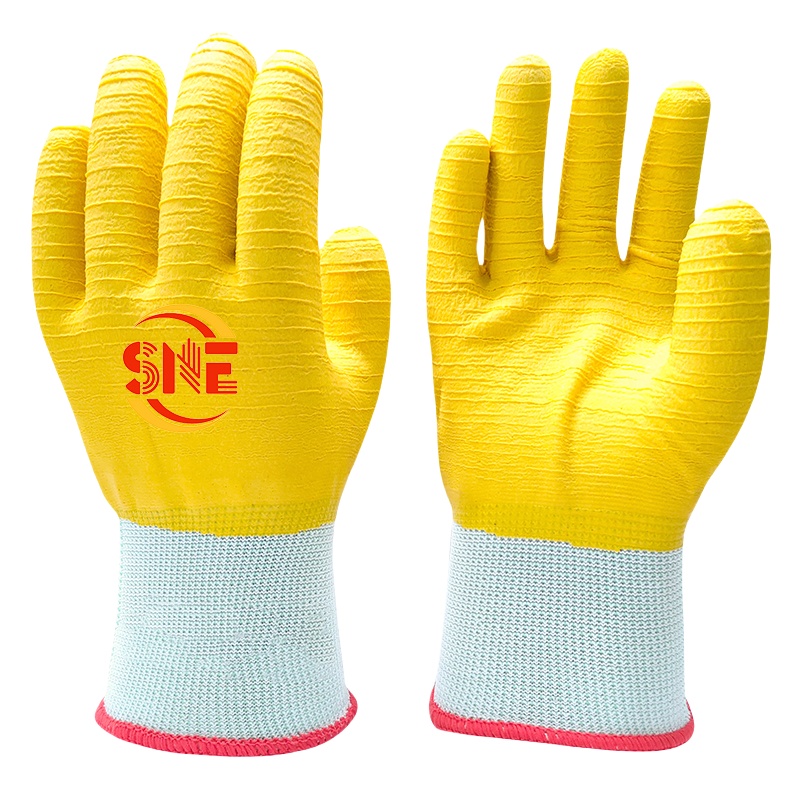
Our manufacturing backbone delivers consistent quality at factory-direct pricing: over a decade of hands-on production expertise, six dedicated production lines with a daily capacity of 150,000 pairs, ISO 9001 and CE certification, and a vertically integrated process from R&D through knitting, dip coating, curing, quality inspection, and export packaging. We offer full OEM/ODM customization across our complete range of coating technologies — PU, nitrile foam, nitrile micro-foam, sandy nitrile, and latex crinkle — with private-label branding and German-language EN 388 compliance documentation. Explore our complete product catalog to see available configurations.
We are actively recruiting distribution partners, agents, and e-commerce resellers across Germany. Partners receive comprehensive pre-sale empowerment (product selection guidance, technical training, market intelligence) and robust after-sale support (quality assurance, replacement policies, ongoing technical assistance). For online brand owners, we offer dropshipping services, free samples, and professional marketing material support. Whether you are an end-user enterprise seeking direct supply or a distributor building a specialized maintenance PPE portfolio, contact our team to explore partnership opportunities.
| Evaluation Criteria | What to Verify | Why It Matters for Maintenance |
|---|---|---|
| EN 388 Certification | Valid test report from EU notified body | Mandatory for German Gefährdungsbeurteilung compliance |
| Dexterity Rating | EN 420 performance level (1–5) | Critical for precision maintenance tasks |
| Oil Grip Performance | Coating type and wet grip rating | Essential for machinery lubrication environments |
| Production Scalability | Capacity and lead time commitments | Maintenance Work Gloves demand spikes during turnarounds |
| Coating Durability | Abrasion resistance cycles tested | Determines replacement frequency and total cost |
Use this checklist when comparing suppliers to ensure your maintenance work gloves meet both regulatory compliance and practical field requirements.
FAQ
What EN 388 rating do I need for general industrial maintenance in Germany?
For general maintenance including equipment servicing, light repairs, and inspections, EN 388 cut level A1–A2 with abrasion level 4 is typically sufficient. For tasks involving sharp metal components, sheet metal, or cutting tools, upgrade to cut level C–D. Always base your selection on the specific hazards identified in your Gefährdungsbeurteilung (workplace risk assessment).
Which coating type is best for oily maintenance environments?
Sandy nitrile and nitrile micro-foam coatings provide the best grip on oily and wet surfaces. Sandy nitrile features a rough, gritty texture that channels fluids away from the grip surface, making it ideal for tasks involving machining coolants, hydraulic oils, and lubricants. Nitrile micro-foam offers similar performance with slightly better dexterity for precision tasks in lightly oiled conditions.
What certifications are required to import maintenance work gloves into Germany?
All safety gloves sold in Germany must comply with EU Regulation 2016/425 and carry CE marking. This requires EN 388:2016+A1:2018 testing by an EU-accredited notified body, an EU Declaration of Conformity, and a designated authorized representative within the EU. Category II PPE (most maintenance work gloves) requires an EU type-examination certificate.
How to choose the right gauge for maintenance work gloves?
For heavy-duty maintenance with high cut/impact hazards, 10G–13G provides maximum protection. For general-purpose maintenance balancing protection and dexterity, 13G is the most versatile choice. For precision tasks like electrical work, instrument calibration, and touchscreen operation, 15G–18G delivers maximum finger sensitivity. Higher gauge means finer knit.
What is the price range for bulk maintenance work gloves orders?
Prices vary by specification. Basic 13G nylon + PU palm gloves range from €0.20–€0.55 per pair at MOQs of 10,000+. Nitrile micro-foam 15G models cost €0.40–€0.90/pair. HPPE cut-resistant sandy nitrile gloves range from €1.20–€2.50/pair. Impact-resistant TPR models run €2.50–€4.50/pair. Factory-direct OEM sourcing typically reduces unit costs by 20–35%.
How long do maintenance work gloves typically last?
Lifespan depends on task intensity and hazard exposure. General-purpose 13G PU-coated gloves last 1–3 weeks with daily use in light maintenance. Sandy nitrile HPPE models last 2–4 weeks in metalworking environments. Impact-resistant TPR gloves last 3–6 weeks in heavy maintenance. Budget 40–80 pairs per maintenance technician per year.
What is the difference between nitrile foam and nitrile micro-foam coatings?
Nitrile foam uses a foaming agent to create a porous, sponge-like structure that provides good dry grip and moderate oil resistance with excellent breathability. Nitrile micro-foam has a finer pore structure that delivers superior grip on wet and lightly oiled surfaces while maintaining similar breathability. Micro-foam is preferred for mixed maintenance environments.
Do I need TPR impact-resistant gloves for all maintenance tasks?
No. TPR (thermoplastic rubber) back-of-hand impact protection is recommended specifically for maintenance tasks with crush and pinch-point hazards — heavy equipment repair, pipefitting, press maintenance, and structural work. For general equipment servicing, electrical work, and precision maintenance, standard gloves without TPR provide better dexterity and comfort.
Can maintenance work gloves be touchscreen-compatible?
Yes. Gloves with conductive PU or nitrile fingertip coatings on 15G–18G liners allow capacitive touchscreen operation without removal. This is increasingly important in German facilities where maintenance technicians interact with touchscreen HMI panels, tablets running CMMS software, and digital test equipment throughout their shift.
What MOQ should I expect for private-label maintenance work gloves?
Most OEM manufacturers require minimum order quantities of 5,000–10,000 pairs per SKU for custom-branded maintenance work gloves with logo printing and custom packaging. Standard catalog products without customization may have lower MOQs of 1,000–3,000 pairs. Factor in 45–60 days production lead time for custom orders, plus 25–35 days ocean freight to German ports.
Ready to source high-performance maintenance work gloves for German industrial operations? Whether you are an enterprise HSE department seeking factory-direct supply, a PPE distributor expanding your maintenance portfolio, or an e-commerce seller targeting the German B2B market, submit your requirements or request a competitive quotation at Snell Safety’s contact page. Visit snellsafety.com to explore our complete range of industrial safety glove solutions.
Content reviewed and updated: March 2026