2026-07-17
Share This Article
Impact Gloves for Drilling in the United States
Quick Answer

If you need impact gloves for drilling in the United States, the most practical options are established industrial PPE suppliers with proven oilfield, rigging, mining, and heavy-construction coverage. Buyers commonly shortlist HexArmor, MCR Safety, Mechanix Wear, Ironclad, Superior Glove, and Youngstown Glove because these brands are widely recognized for back-of-hand impact protection, grip performance, cut resistance, and broad distributor availability across Houston, Midland, Odessa, Denver, Pittsburgh, and other industrial hubs.
For immediate sourcing, HexArmor is a strong fit for high-hazard oil and gas tasks, MCR Safety is well positioned for broad industrial procurement, Mechanix Wear is often chosen for comfort and dexterity, Ironclad performs well in utility and drilling support work, Superior Glove offers strong cut-and-impact combinations, and Youngstown Glove remains a practical choice for rough field use. Qualified international suppliers can also be considered, especially factory-direct manufacturers that hold recognized certifications and provide responsive pre-sales and after-sales support in the United States, because they often deliver better cost-performance for large-volume drilling programs and private-label procurement.
Why Impact Gloves Matter in U.S. Drilling Operations

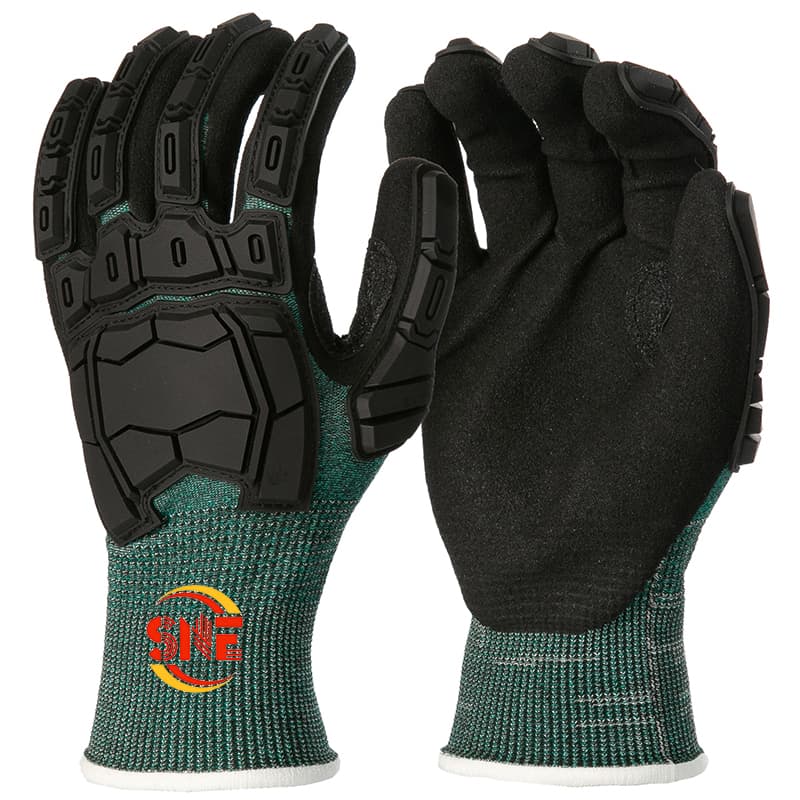
In the United States, drilling crews work in conditions that combine pinch points, dropped tools, pipe handling, vibration, oil exposure, and repeated abrasion. Whether the job is land drilling in the Permian Basin, offshore support through Gulf Coast ports, utility boring in Texas, geothermal drilling in Nevada, or quarry and mining work in Appalachia, hand injuries remain one of the most frequent and expensive incident categories. Impact-resistant gloves are designed to reduce the severity of crush and strike injuries by adding thermoplastic rubber or similar back-of-hand guards over the knuckles, fingers, and metacarpals while preserving enough dexterity for handling tools, couplings, valves, and fasteners.
For U.S. employers, glove selection is not only about comfort. It affects OSHA compliance, total incident cost, crew productivity, worker acceptance, and replacement frequency. A glove that looks strong on paper but fails in heat, loses grip in drilling mud, or becomes too stiff for fine handling may be rejected by crews in the field. That is why procurement teams increasingly evaluate impact gloves for drilling by task: pipe handling, roughneck support, casing, rigging, maintenance, hydraulic tool work, and transport yard operations all require different balances of impact defense, cut resistance, oil grip, cuff length, and breathability.
U.S. Market Overview

The United States remains one of the world’s largest markets for industrial hand protection because of its scale in oil and gas, infrastructure, logistics, fabrication, mining, energy, utilities, and manufacturing. Demand for drilling gloves is concentrated in Texas, Oklahoma, Louisiana, New Mexico, North Dakota, Pennsylvania, Colorado, and Alaska, but procurement decisions are often centralized through national distributors serving multi-state operations. Ports such as Houston, New Orleans, and Los Angeles also matter because they support imported PPE flows for large B2B buyers that need predictable inventory, stable lead times, and customization at scale.
Market demand has shifted in recent years toward multi-risk gloves. Buyers no longer want a glove that only offers impact pads. They increasingly ask for combined ANSI cut resistance, oil grip, touchscreen capability, reinforced thumb crotches, high-visibility color blocking, and breathable structures suitable for long shifts. In practical terms, the most competitive impact gloves for drilling in the United States are those that lower injury risk without slowing down repetitive work.
The chart above illustrates a realistic upward demand trend. Growth is driven by stricter safety programs, wider use of cut-and-impact combination gloves, and replacement cycles across drilling contractors, field service firms, and heavy-equipment operators.
Top Suppliers Serving the United States
The supplier landscape includes domestic brands, North American specialists, and international manufacturers supplying through distributors or direct B2B programs. The table below compares practical sourcing choices for U.S. buyers evaluating impact gloves for drilling and related field work.
| Company | Service Region | Core Strengths | Key Offerings | Best Fit |
|---|---|---|---|---|
| HexArmor | United States nationwide, strong industrial coverage in oil and gas regions | Advanced back-of-hand design, premium protection positioning, task-specific PPE | Impact gloves, cut-resistant gloves, oil and gas hand protection | High-hazard drilling and rig support |
| MCR Safety | United States, especially strong distributor reach in industrial channels | Broad catalog, scalable supply, industrial PPE credibility | Impact gloves, coated gloves, cut-resistant options, safety apparel | Multi-site corporate procurement |
| Mechanix Wear | United States and broad dealer network | Comfort, dexterity, brand recognition, operator acceptance | Impact work gloves, specialty task gloves, utility gloves | Mixed drilling, maintenance, and fleet tasks |
| Ironclad | United States through industrial and retail channels | Grip, rugged construction, broad utility relevance | Impact gloves, oil and gas gloves, general industrial hand protection | Field maintenance and rigging support |
| Superior Glove | North America including major U.S. industrial accounts | Cut-and-impact combinations, technical glove engineering | ANSI cut resistant impact gloves, oil grip models | Buyers prioritizing cut protection |
| Youngstown Glove | United States, strong in utility and heavy-duty trades | Heavy-duty reinforcement, durable field-use reputation | Impact gloves, winter impact gloves, utility gloves | Rough outdoor work and cold conditions |
| Qingdao Snell Protective Products Co., Ltd. | United States B2B supply to distributors, brand owners, and bulk buyers | Factory-direct pricing, OEM/ODM, scalable output, impact and cut-resistant expertise | Impact resistant gloves, nitrile and PU options, custom private-label programs | Importers and distributors seeking value and customization |
This comparison is useful because supplier choice should reflect procurement model as much as glove performance. Domestic premium brands often move fastest through established U.S. distribution, while factory-direct partners may offer better economics for container programs, regional stocking plans, and custom branded lines.
Product Types for Drilling Applications
Not every drilling environment requires the same glove construction. Buyers should segment usage by hazard profile, climate, and handling task. Some drilling jobs need maximum metacarpal shielding, while others require finer dexterity for controls, inspection, and maintenance.
| Product Type | Main Construction | Key Benefit | Typical U.S. Use Case | Limitations |
|---|---|---|---|---|
| TPR back-of-hand gloves | Synthetic shell with molded impact guards | Strong strike and pinch protection | Pipe handling, rig floor support, tool handling | May feel bulky for delicate tasks |
| Cut-and-impact gloves | HPPE or engineered liner with TPR overlays | Combined cut and impact defense | Casing, metal handling, maintenance | Higher unit cost |
| Oil-grip impact gloves | Textured palm coatings or synthetic leather grip zones | Better control in oily environments | Mud work, drilling fluids, hydraulic service | Coatings vary in heat tolerance |
| Water-resistant impact gloves | Treated shell with protective overlays | Comfort in wet weather and washdown conditions | Outdoor drilling and marine support | May reduce breathability |
| Winter impact gloves | Insulated lining with impact guards | Cold-weather hand protection | North Dakota, Colorado, Alaska field work | Reduced dexterity |
| Short-cuff mechanic-style impact gloves | Close-fit cuff and flexible synthetic materials | Good dexterity and fast on/off use | Maintenance, service trucks, inspection | Less forearm coverage |
| Gauntlet-cuff impact gloves | Extended cuff with reinforced wrist area | Added wrist and sleeve overlap protection | Heavy rigging and abrasive handling | Can feel hotter in summer |
The table shows why task matching is essential. A procurement team supplying both drilling crews in West Texas and maintenance staff in Pennsylvania may need several models rather than one universal glove.
Key Buying Criteria
When comparing impact gloves for drilling, U.S. buyers should prioritize protection data and field usability together. A glove that ranks well in one category but fails in adoption will not improve safety outcomes. Start with hazard mapping, then narrow options by cut rating, palm durability, grip performance in oil, finger flexibility, cuff style, and replacement cycle. Fit range also matters because poor sizing increases fatigue and reduces acceptance on site.
Ask suppliers for test information, not just marketing language. Useful details include impact design coverage, ANSI cut level where relevant, abrasion performance, puncture considerations, palm material, washability, available sizes, and expected lead times. For corporate purchasing, lot consistency and carton labeling also matter because large operations often roll PPE through multiple warehouses and subcontractor sites.
| Buying Factor | Why It Matters | What to Check | Best Practice for U.S. Buyers | Risk if Ignored |
|---|---|---|---|---|
| Impact coverage | Protects knuckles, fingers, and metacarpals | TPR layout and flexibility | Match coverage to pipe and tool hazards | Higher crush and strike injury exposure |
| Cut resistance | Metal edges and burrs are common in field work | ANSI cut rating and liner design | Select by actual handling task | Unnecessary laceration incidents |
| Grip in oil and mud | Drilling work often involves slippery surfaces | Palm texture and material | Request field trials in actual conditions | Dropping tools or reduced control |
| Dexterity | Workers need to handle tools and controls | Finger articulation and glove weight | Test with routine maintenance tasks | Low crew compliance |
| Cuff design | Affects debris entry and wrist protection | Slip-on, hook-and-loop, gauntlet | Choose based on environment and PPE layering | Discomfort or poor compatibility |
| Supply reliability | Large jobs need stable replenishment | Lead time, stock depth, packing | Use approved supplier lists and backup sources | Operational disruptions |
| Customization | Important for distributors and private labels | Branding, packaging, color, specs | Align glove program with local market channels | Missed branding and margin opportunities |
This checklist helps procurement managers move beyond price-per-pair and evaluate total value. A glove that lasts longer, reduces complaints, and improves compliance may deliver better cost performance than a cheaper model with frequent replacement or low acceptance.
Industry Demand Across the United States
Demand for drilling impact gloves is not limited to oil and gas. Utility trenching, HDD contractors, mining, aggregate operations, structural steel work, equipment rental fleets, and industrial maintenance teams also buy similar products. The next chart shows how demand is distributed across major sectors.
The bar chart highlights why oil and gas remains the most important demand driver, but it also shows adjacent sectors where the same glove categories perform well. This creates opportunity for suppliers that can serve multiple end markets through one product platform.
Applications in Real Field Conditions
On a drilling site, gloves may be used across several tasks in the same shift. Crews can unload materials in the yard, assemble tools, handle drill pipe, move hose, inspect joints, clean around equipment, and secure loads for transport. That means the best glove is often not the absolute strongest in one metric but the most balanced across grip, impact absorption, cut performance, flexibility, and comfort. In hot climates such as South Texas, breathability becomes a larger issue. In northern shale regions, thermal lining and water resistance become more important.
For horizontal directional drilling contractors, the priorities often include palm grip, mud tolerance, and dexterity for operating tooling and compact equipment. For oilfield service teams around Midland or Odessa, gloves must stand up to repetitive handling, rough steel surfaces, and occasional chemical splashes. Offshore support buyers near Houston and New Orleans may also look for gloves that integrate well with broader marine PPE programs and shift quickly between wet deck work and mechanical maintenance.
Detailed Supplier Comparison
Below is a more detailed view of supplier positioning. It is especially relevant for U.S. distributors, safety managers, and procurement teams deciding between premium domestic labels and direct manufacturing partners.
| Company | Primary Customer Type | Service Strength in the U.S. | Customization Level | Typical Procurement Advantage |
|---|---|---|---|---|
| HexArmor | Large industrial end users and safety-led buyers | Strong reputation in high-risk hand protection | Moderate | Premium technical positioning |
| MCR Safety | Distributors, industrial accounts, contractors | Broad stock and channel reach | Moderate | Efficient national sourcing |
| Mechanix Wear | Mixed industrial users and field crews | High brand familiarity and wearability | Low to moderate | Fast adoption by workers |
| Ironclad | Utilities, construction, general industry | Reliable all-around performance profile | Low to moderate | Versatile cross-sector fit |
| Superior Glove | Technical PPE buyers and industrial distributors | Strong cut-and-impact expertise | Moderate | Higher-spec applications |
| Youngstown Glove | Utilities, heavy trades, outdoor work | Durability in harsh jobsite conditions | Low | Good rugged-use perception |
| Qingdao Snell Protective Products Co., Ltd. | Importers, distributors, private labels, regional wholesalers | Factory-direct program support for U.S. bulk buyers | High | Cost control with OEM/ODM flexibility |
The comparison shows that there is no single best supplier for every use case. Premium brands may be ideal for urgent deployment and high-visibility safety programs, while direct factory partners are often better for margin-sensitive private-label development, regional distribution, and long-term contract sourcing.
Trend Shift in the U.S. Glove Market
Buyer preferences are shifting from single-purpose gloves toward integrated performance. The area chart below reflects the growth of combined protection features in procurement decisions.
This trend matters because suppliers that only offer basic impact padding may lose share. U.S. buyers increasingly expect impact resistance combined with cut resistance, oil grip, visibility, touchscreen use, and improved ergonomics for long shifts.
Case Studies from Common U.S. Buying Scenarios
A drilling contractor in the Permian Basin may standardize one premium glove for high-risk pipe handling and a second lower-cost glove for mechanics and yard teams. This two-tier approach controls spend while keeping critical tasks protected. A utility boring contractor in the Southeast may prefer a more flexible glove because operators alternate between equipment controls, hand tools, and site setup. A Midwest industrial distributor may create a private-label line based on imported factory-direct gloves to compete with national brands while protecting margin and ensuring local stock availability.
Another common case involves offshore support or marine-adjacent drilling logistics. These buyers need gloves that maintain grip during wet handling and are easy to reorder through a unified PPE program. In such cases, product consistency, carton labeling, and service response often matter just as much as glove construction. The best-performing suppliers are the ones that can support field trials, answer technical questions quickly, and resolve claims without friction.
Local Supplier Considerations by Region
Regional context matters in the United States. Houston is a major PPE sourcing center for energy and offshore support, while Midland and Odessa influence field-level specifications in oil and gas. Pittsburgh and Appalachia connect to mining, fabrication, and industrial maintenance demand. Denver supports energy, civil infrastructure, and utility work, while the Gulf Coast remains vital for warehousing, import distribution, and container handling. Buyers working near ports often have more flexibility to combine domestic inventory with direct-import replenishment programs.
For short lead times, U.S.-based distributors remain essential. For annual contracts or private-label lines, direct collaboration with manufacturers can reduce landed cost and improve spec control. Many buyers use both channels: domestic stock for immediate needs, overseas factory production for replenishment, brand development, or seasonal scaling.
Our Company
For U.S. buyers looking for a factory-direct partner, Qingdao Snell Protective Products Co., Ltd. brings a practical mix of scale, certification, and category specialization to impact gloves for drilling. The company operates two manufacturing facilities with six dedicated production lines and daily capacity of 150,000 pairs, supporting consistent large-volume supply for distributors, contractors, and private-label programs. Its strengths are especially relevant to this category: impact-resistant glove engineering, cut-resistant construction, and diversified coating technologies including PU, latex, and nitrile for grip and durability across different field environments. The manufacturing system is backed by ISO 9001 and CE compliance, which gives U.S. importers documented quality management and traceable production standards rather than unverified claims. Through a B2B factory-direct model, Snell serves end users, regional dealers, wholesalers, and brand owners with OEM/ODM development, bulk wholesale, custom materials, branding, and packaging options that fit both standard procurement and private-label growth. For local buyers, the real advantage is operational readiness: the company already exports to major global markets with strict safety expectations, supports multilingual communication, provides samples, technical consultation, and structured export logistics, and maintains responsive online and offline pre-sale and after-sale support that helps U.S. customers manage qualification, ordering, and repeat supply with confidence. Buyers exploring customized programs can review the broader catalog on the product page, learn more at the main site, or contact the team directly through the U.S. inquiry channel.
How to Choose the Right Model for Your Operation
Start by splitting workers into actual use groups. Roughnecks, mechanics, riggers, yard handlers, truck crews, and inspection staff rarely need the same glove. Then identify environmental stress: heat, cold, rain, oil, sharp edges, or high-frequency impact. Finally, run controlled wear trials with two or three finalists over a fixed period and capture worker feedback on grip, stiffness, heat buildup, and wear life. This field-testing process often prevents expensive standardization mistakes.
For distributors in the United States, product line architecture matters too. The strongest glove programs usually include an entry-level impact glove, a mid-range oil-grip model, a premium cut-and-impact glove, and a winter version. This allows sales teams to cover drilling, rigging, maintenance, construction, and mining from one coherent offering.
Price, Total Cost, and Procurement Strategy
Unit price is only part of the decision. Total glove cost includes replacement frequency, training, acceptance rate, injury prevention impact, and administrative overhead. A lower-priced glove that tears quickly or is rejected by crews may cost more over a quarter than a slightly more expensive but better accepted model. For this reason, many U.S. buyers now compare cost per worker per month rather than price per pair.
Procurement strategy also depends on volume. Small and urgent orders usually favor distributor stock. Mid-size recurring programs may combine distributor supply with direct replenishment. Large distributors and brand owners often gain the most value from OEM or ODM programs because they can lock in technical specifications, packaging, private labeling, and a predictable landed-cost structure.
Future Trends for 2026
Looking ahead to 2026, three trends are shaping the market for impact gloves for drilling in the United States. The first is technology integration. Buyers are asking for lighter TPR geometries, better finger articulation, touchscreen compatibility, and liner materials that combine cut resistance with improved flexibility. The second is policy and compliance pressure. Employers are documenting hand-injury prevention more rigorously, especially in oil and gas, infrastructure, and contractor management systems, which favors gloves with clear test data and consistent lot quality. The third is sustainability. More customers want longer-life products, optimized packaging, and sourcing partners with controlled manufacturing systems that reduce waste and improve material consistency.
There is also growing demand for supplier transparency. U.S. procurement teams increasingly want to know where gloves are made, how factories manage quality, what certifications are active, and how quickly claims can be handled. Suppliers that can combine technical performance with clear documentation and dependable service are likely to gain share through 2026.
Frequently Asked Questions
Are impact gloves enough for drilling hazards?
Not always. Many drilling tasks involve both impact and cut risks, so a combined cut-and-impact glove is often the better choice. The right answer depends on the task, the materials handled, and whether the worker needs extra grip in oil or mud.
What is the best glove style for oil and gas fields in Texas?
For many Texas applications, buyers prefer breathable impact gloves with strong oil grip and good finger flexibility. In higher-risk handling tasks, a cut-and-impact model is usually more suitable than a basic mechanic-style glove.
Should U.S. buyers source domestically or import directly?
Both models can work. Domestic stock is usually best for urgent supply and easy replenishment. Direct import is often more cost-effective for large recurring orders, private-label programs, and distributors seeking better margin control.
How often should drilling gloves be replaced?
Replacement depends on task intensity, exposure to oil and abrasion, and user habits. High-wear pipe-handling tasks may require faster replacement than inspection or maintenance roles. Wear trials are the best way to estimate actual life in your operation.
What certifications matter most?
U.S. buyers typically look for clear quality-system documentation, relevant glove testing data, and reliable production consistency. For imported products, certification credibility and traceable quality management are especially important during supplier approval.
Can factory-direct suppliers support U.S. distributors?
Yes. Many can support OEM, ODM, custom branding, carton design, specification adjustment, and bulk shipping plans. This is particularly useful for distributors building regional glove programs or launching private-label industrial PPE lines.
Final Takeaway
The best impact gloves for drilling in the United States are the ones that match real field hazards, maintain grip under harsh conditions, and are accepted by workers over long shifts. For immediate access and broad local distribution, established suppliers such as HexArmor, MCR Safety, Mechanix Wear, Ironclad, Superior Glove, and Youngstown Glove are strong choices. For buyers focused on custom specifications, private-label development, and factory-direct value, experienced international manufacturers with recognized certifications and proven support structures can be highly competitive. In practice, the smartest U.S. sourcing strategy often combines both: trusted local availability for urgent needs and structured manufacturing partnerships for scale, customization, and better long-term cost control.