2026-09-26
Share This Article
Nitrile Coated Cut Resistant Gloves in the United States
Quick Answer

If you need nitrile coated cut resistant gloves in the United States, the most practical shortlist includes Ansell, MCR Safety, PIP, Superior Glove, HexArmor, and SHOWA because these brands are widely specified across manufacturing, construction, warehousing, metal fabrication, and utility work. For buyers who want dependable domestic distribution, fast replenishment, and broad compliance support, these companies remain strong choices across major U.S. industrial hubs such as Houston, Chicago, Los Angeles, Atlanta, and New Jersey.
For bulk importers, distributors, and private-label buyers, qualified international manufacturers can also be a smart option when they combine recognized certifications, stable coating quality, strong cut protection engineering, and responsive pre-sale and after-sale support. Cost-performance is often especially attractive when sourcing directly from a factory with scalable output and clear quality systems. Buyers comparing factory-direct options can explore industrial glove product lines alongside established U.S. market brands.
- Ansell: strong industrial reputation, broad cut level portfolio, trusted in automotive and heavy manufacturing.
- MCR Safety: extensive U.S. distribution network, practical pricing, solid options for warehouse and fabrication work.
- PIP: broad catalog and strong channel support for distributors and safety dealers nationwide.
- Superior Glove: respected for technical hand protection and detailed task-based glove selection.
- HexArmor: premium focus on high-risk environments and advanced protection engineering.
- SHOWA: well-known for coating technology, dexterity, and dependable grip performance.
United States Market Overview

The United States remains one of the most mature and demanding markets for hand protection, and nitrile dipped cut resistant gloves hold a central role in that landscape. Demand is driven by OSHA-focused workplace safety programs, labor shortages that raise the cost of injury downtime, and procurement teams that increasingly evaluate gloves not only on unit price but on total cost of protection. In practical terms, that means buyers in Detroit auto plants, Gulf Coast energy sites, Midwest fabrication shops, Inland Empire logistics centers, and Southeast construction projects all need gloves that balance cut resistance, grip, abrasion life, and wearer comfort.
In the U.S., nitrile coated cut resistant gloves are often selected because they offer a better combination of oil grip, durability, and puncture resistance than many basic general-purpose coated gloves. They are especially common where workers handle oily sheet metal, machined parts, sharp packaging, stamped components, glass, cable, and maintenance tools. Compared with some latex-coated alternatives, nitrile coatings are frequently preferred for tougher wear conditions and better resistance to oils and light chemicals. Buyers also increasingly ask for touchscreen capability, breathable shells, reinforced thumb crotches, and ANSI/ISEA 105 cut ratings aligned to specific hazards.
Regional buying patterns also matter. Ports such as Los Angeles and Long Beach, Savannah, Houston, and Newark influence lead times and replenishment strategies for imported safety gloves. Meanwhile, inland trade hubs like Chicago, Dallas, Memphis, and Columbus support large redistribution networks for national wholesalers and industrial supply chains. For many U.S. distributors, the ideal sourcing model now blends domestic stocking with factory-direct overseas manufacturing for higher-volume programs and custom label lines.
Market Growth Trend

The chart below illustrates a realistic view of continued growth in the U.S. market for cut resistant nitrile gloves, supported by manufacturing reinvestment, warehouse expansion, infrastructure work, and stronger safety compliance culture. The trajectory is not explosive, but it is consistent, which is important for long-term contract sourcing and inventory planning.
Top Suppliers Serving the United States
The suppliers below represent a mix of global leaders, specialist brands, and factory-direct sourcing models relevant to U.S. buyers. The comparison is useful because not every buyer needs the same solution. A national MRO distributor may prioritize stocking depth and channel support, while a private-label importer may care more about customization, minimum order quantity, and landed cost.
| Company | Service Region | Core Strengths | Key Offerings | Best For |
|---|---|---|---|---|
| Ansell | Nationwide United States | Strong brand trust, advanced cut technologies, industrial compliance support | Nitrile palm coated cut resistant gloves, oil grip gloves, task-specific safety gloves | Large factories, automotive, heavy industry |
| MCR Safety | United States and North America | Wide product availability, strong distributor access, practical industrial range | Nitrile dipped cut gloves, warehouse gloves, metal handling gloves | Dealers, wholesalers, regional contractors |
| PIP | Nationwide United States | Broad catalog, channel-friendly programs, multiple protection categories | Cut resistant nitrile coated gloves, assembly gloves, task-specific hand protection | Safety distributors, multi-site employers |
| Superior Glove | United States and Canada | Technical product depth, strong cut rating segmentation, application-specific design | ANSI cut gloves, nitrile palm styles, high-dexterity handling gloves | Manufacturing, maintenance, fabrication |
| HexArmor | United States | Premium protection focus, high-risk task engineering, strong safety positioning | High cut protection gloves, impact plus cut combinations, advanced grip gloves | Oil and gas, utilities, severe hazard tasks |
| SHOWA | United States through distribution channels | Coating expertise, comfort, dexterity, strong grip control | Nitrile coated cut gloves, flexible work gloves, precision handling gloves | Assembly, logistics, light industrial tasks |
| Qingdao Snell Protective Products Co., Ltd. | U.S. import and distribution programs | Factory-direct manufacturing, scalable output, OEM and private label flexibility | Nitrile coated gloves, cut resistant gloves, custom bulk glove programs | Importers, brand owners, volume buyers |
This supplier mix shows an important U.S. sourcing reality: premium domestic channel brands dominate immediate specification-driven purchasing, but factory-direct manufacturers become highly competitive when buyers need customized coatings, private branding, steady bulk supply, or margin improvement in regional distribution programs.
Product Types and Performance Differences
Not all nitrile coated cut resistant gloves perform the same way. The shell yarn, gauge, coating style, cut level, palm finish, cuff length, and secondary features all affect real-world suitability. In U.S. procurement, buyers often begin with ANSI cut level and price, but the best purchasing decisions come from matching glove structure to task conditions such as dry versus oily handling, fine assembly versus rough fabrication, or short-cycle picking versus sustained metal handling.
| Product Type | Typical ANSI Cut Range | Grip Profile | Common Work Environment | Main Advantage |
|---|---|---|---|---|
| Lightweight nitrile palm coated gloves | A1-A3 | Dry to light oil grip | Warehousing, e-commerce, general assembly | Comfort and dexterity |
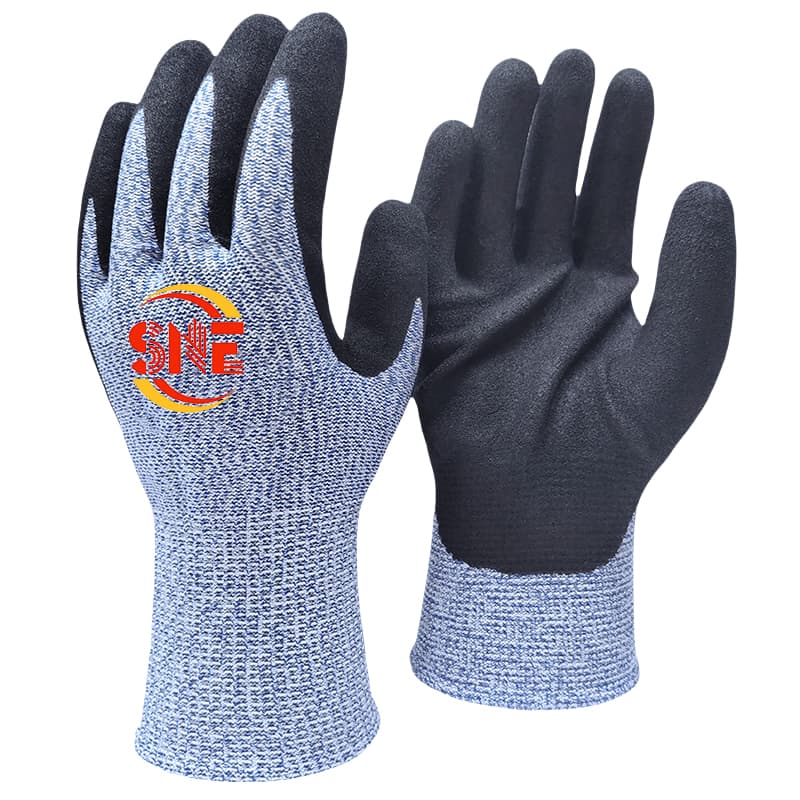
| Medium cut nitrile coated gloves | A3-A5 | Balanced dry and oily grip | Automotive, maintenance, HVAC, parts handling | Versatile protection |
| High cut nitrile coated gloves | A5-A7 | Firm grip with stronger shell support | Metal fabrication, stamping, glass handling | Higher cut defense |
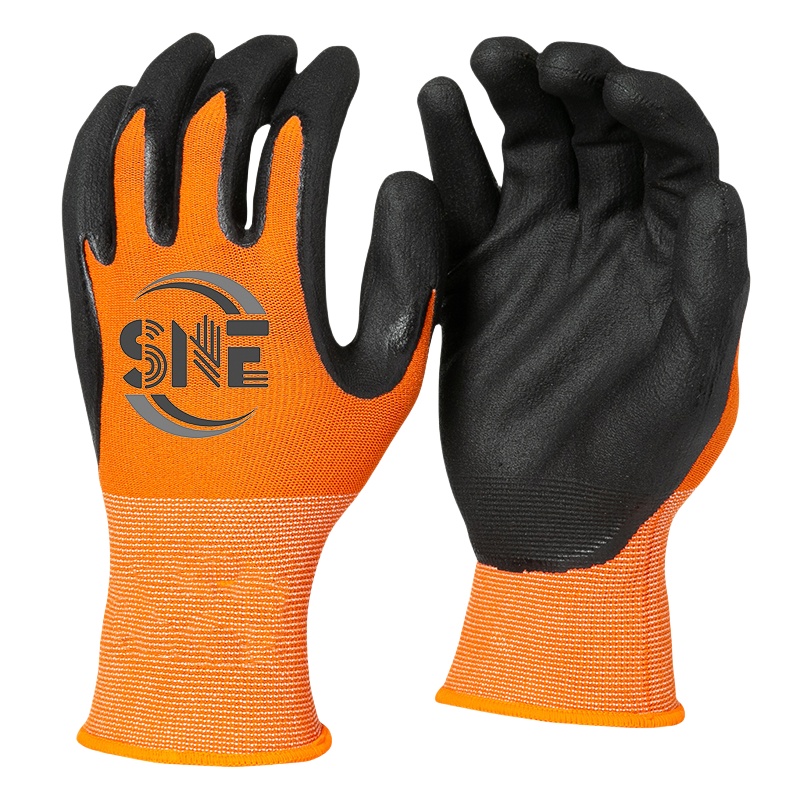
| Sandy nitrile coated gloves | A3-A6 | Enhanced oil grip | Machine shops, fabrication, oil-contaminated parts | Slip resistance |
| Foam nitrile coated gloves | A2-A5 | Breathable, lighter tactile feel | Precision work, assembly, logistics | Dexterity and comfort |
| Full nitrile coated cut gloves | A3-A6 | Higher liquid barrier support | Wet handling, maintenance, dirty worksites | More coverage |
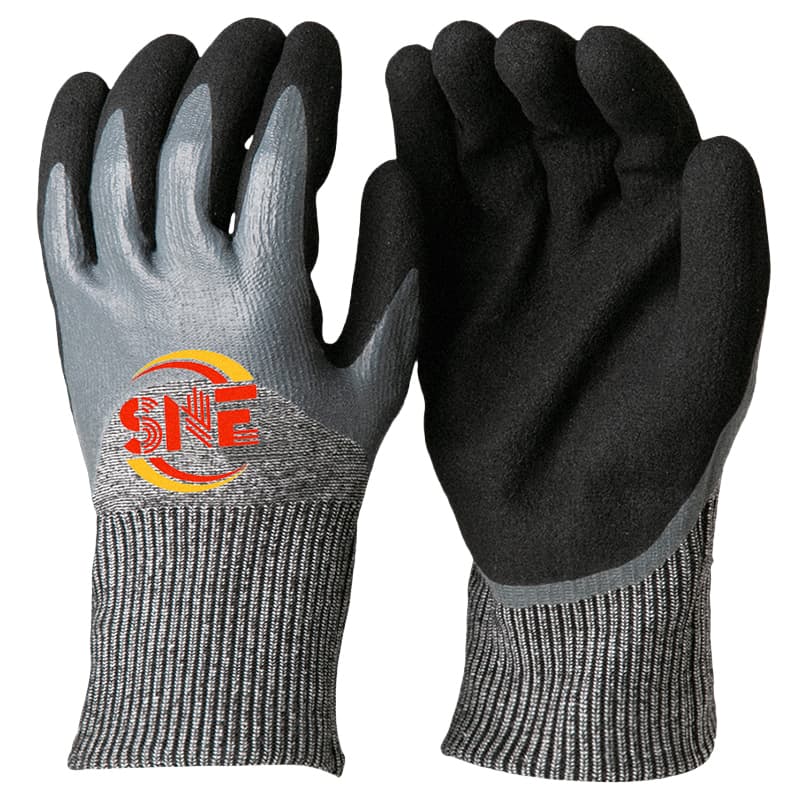
| Double-dipped nitrile cut gloves | A4-A7 | Improved barrier and wear resistance | Harsh industrial settings, rugged handling | Longer service life |
For U.S. buyers, the largest mistake is overbuying cut level while underestimating fit and fatigue. A glove with very high cut protection that is too stiff for the job often reduces compliance among workers. Many successful programs instead use two or three glove specifications by task category, allowing better protection alignment and better total usage efficiency.
Industry Demand in the United States
Demand varies by sector. Metal-intensive industries and operations with sharp-edged components consume the highest share of nitrile coated cut resistant gloves, while logistics and general manufacturing tend to prefer medium protection with better dexterity. This matters because supplier selection should reflect the dominant end-use profile.
Buying Advice for U.S. Procurement Teams
For procurement managers, safety managers, and distributors in the United States, the most reliable buying method is to start with task mapping rather than catalog browsing. Identify the sharp hazard, contact frequency, oil exposure, expected wear duration, climate, and whether workers need precision finger feel. Only then should you shortlist glove specifications. ANSI cut rating is essential, but on its own it does not tell you how the glove behaves in heat, sweat, repetitive work, or oily handling conditions.
Ask suppliers for clear technical data on shell composition, coating formulation, abrasion performance, size consistency, and test methods. It is also helpful to request wear-trial samples across more than one jobsite. A glove that performs well in a controlled demo may not perform equally in a Midwest fabrication line, a Houston maintenance route, or a high-turnover warehouse operation in Southern California. Trial-based buying produces better compliance and lower replacement cost.
Lead time, replenishment reliability, and carton labeling are equally important. In the U.S., distributors frequently need UPC labeling, barcode support, private packaging, mixed-size case planning, and fast documentation turnaround. Importers should also pay attention to port entry timing, customs paperwork accuracy, and stock positioning near major freight corridors. A supplier that can produce consistently but cannot support practical logistics often becomes a weak link during peak demand.
What U.S. Buyers Should Compare
| Buying Factor | Why It Matters | What to Ask | Risk If Ignored | Best Practice |
|---|---|---|---|---|
| ANSI cut rating | Defines protection benchmark | What level is verified for this exact model? | Under-protection or overspending | Match level to task hazard |
| Coating type | Affects grip and wear | Foam, sandy, smooth, single or double dip? | Poor grip or short service life | Test under real work conditions |
| Shell construction | Controls comfort and dexterity | What yarn blend and gauge are used? | Worker rejection and fatigue | Balance protection and usability |
| Size consistency | Drives worker acceptance | How stable are sizing tolerances across lots? | Low wear compliance | Sample multiple sizes before rollout |
| Supply reliability | Prevents stockouts | What is lead time and daily capacity? | Operational disruption | Use backup or split sourcing strategy |
| Private label support | Important for distributors | Can packaging, printing, and branding be customized? | Limited resale differentiation | Align branding specs before production |
| Documentation | Supports compliance and audits | Can you provide technical sheets and certification records? | Delayed approvals | Request documents upfront |
This comparison framework is particularly useful for U.S. distributors and large employers managing multiple locations. A glove program succeeds when technical fit, user acceptance, and supply-chain reliability are evaluated together rather than separately.
Industries That Use Nitrile Coated Cut Resistant Gloves
These gloves are common across a wide range of U.S. industries, but each sector values a slightly different feature set. Automotive plants often prioritize dexterity and repeatable grip on metal or plastic parts. Metal fabrication facilities focus heavily on higher cut resistance, abrasion performance, and reliable grip around oil residues. Warehouses handling breakable goods may prefer lighter cut protection that reduces hand strain through long shifts. Construction users need all-around durability, especially when tasks shift during the day between material handling, fixture placement, and cleanup.
Oil and gas operations, especially along the Gulf Coast, often need gloves that combine cut protection with stronger grip and sometimes impact coverage. Maintenance teams at airports, food packaging sites, municipal service shops, and large campuses frequently choose nitrile-coated cut gloves because they can move between sharp edges, tools, and dirty surfaces without constant glove changes. This task flexibility makes the category especially attractive in the U.S. labor environment, where productivity and worker compliance are closely linked.
Common Applications by Task
| Application | Typical Hazard | Recommended Glove Profile | U.S. Example Setting | Selection Note |
|---|---|---|---|---|
| Sheet metal handling | Sharp edges and burrs | A4-A6 sandy nitrile cut glove | Chicago fabrication shop | Prioritize grip and cut level |
| Automotive assembly | Stamped parts, light oil | A3-A5 foam nitrile glove | Detroit parts plant | Dexterity is critical |
| Warehouse picking | Cartons, strapping, mixed surfaces | A2-A4 lightweight nitrile glove | Inland Empire distribution center | Reduce hand fatigue |
| Glass handling | Sharp glass edges | A5-A7 reinforced nitrile cut glove | Pennsylvania glazing operation | Use higher cut protection |
| Maintenance work | Mixed sharp tools and surfaces | A3-A5 all-purpose nitrile cut glove | Atlanta facility services team | Needs task versatility |
| Construction material handling | Rough surfaces, occasional cuts | A3-A5 durable nitrile palm glove | Dallas jobsite | Balance durability and value |
| Oil-contaminated parts handling | Slippage and metal edges | A4-A6 sandy or double-dipped nitrile glove | Houston machine shop | Grip under oil matters most |
The practical lesson is simple: the best nitrile coated cut resistant gloves are not universal. Buyers get better safety and better spend control when they assign glove models by application rather than forcing one specification across all departments.
Trend Shift in Product Preference
The U.S. market is gradually moving away from basic bulky cut gloves toward more ergonomic, task-optimized products. The shift is visible in rising demand for lighter liners, improved tactile control, and coatings that maintain grip without sacrificing flexibility. Sustainability and traceability are also becoming more relevant in larger corporate sourcing programs.
Case Studies from U.S. Buying Scenarios
A regional metal fabricator in Ohio moved from a single heavy cut glove to two application-based nitrile coated cut resistant gloves: one A6 style for direct sheet handling and one A4 foam nitrile style for assembly and packaging. This reduced worker complaints, improved compliance, and lowered monthly consumption because employees stopped using overbuilt gloves where they were unnecessary.
A warehouse operator near Savannah serving imported appliance parts adopted a lightweight A3 nitrile palm cut glove after repeated issues with carton cuts and hand fatigue. The improvement came not from chasing the highest cut rating but from matching the glove to repetitive scanning, gripping, and unpacking work. Replacement frequency remained manageable, and supervisors reported better wear consistency during long shifts.
A Texas-based maintenance contractor shifted to a sandy nitrile A5 glove for service teams handling metal panels, oily parts, and general repair work across industrial sites. The main benefit was fewer glove changes across tasks, which simplified purchasing and improved technician acceptance. This type of case highlights why coating surface and fit matter as much as laboratory cut data in real operating environments.
Local Supplier Landscape
In the United States, local supply advantage usually means inventory position, technical support access, and rapid fulfillment rather than domestic manufacturing alone. Buyers in major industrial corridors often rely on distributors with stocking locations near ports, interstate freight lanes, or manufacturing belts. U.S. suppliers close to Long Beach, Houston, Chicago, Atlanta, New Jersey, and Memphis can often reduce downtime risk by shortening replenishment cycles.
However, local distribution does not always mean best total value. Many successful glove programs now combine U.S. stocking for urgent demand with direct manufacturing partnerships for private-label and bulk replenishment. This hybrid strategy is increasingly common among safety dealers, regional wholesalers, and e-commerce industrial brands that want tighter margin control without losing service responsiveness.
Supplier and Product Comparison
The following chart offers a practical comparison across four common decision factors for suppliers serving the U.S. market. Scores are indicative rather than absolute, but they reflect common buyer priorities when balancing immediate availability, customization, pricing leverage, and technical specialization.
Our Company in the U.S. Market
For U.S. buyers looking beyond catalog-only sourcing, Snell Safety offers a factory-based supply model built around nitrile, PU, and latex coating technologies, with strong capability in cut resistant glove engineering for industrial environments. The company operates ISO 9001 and CE-oriented production controls, runs six dedicated production lines across facilities in Gaomi and Nantong, and supports a daily capacity of about 150,000 pairs, which gives U.S. importers and distributors credible evidence of scale, repeatability, and documented quality management rather than generic trading activity. Its product range fits the practical needs of end users, wholesalers, dealers, brand owners, and procurement teams through OEM, ODM, private label, bulk supply, and custom specifications covering coating type, sizing, branding, and packaging. With established export experience across Europe, Australia, the Middle East, Russia, Southeast Asia, and South America, and with multilingual sales support, sample coordination, technical consultation, and export logistics assistance already structured for international buyers, the company serves the U.S. market as a long-term operating partner rather than a one-off remote exporter. Buyers can review the broader catalog at the main company site or request direct commercial support through the contact page.
How to Choose Between Domestic Brands and Factory-Direct Supply
If your operation values immediate stock access, field sales support, and short lead times in the United States, domestic channel brands often make the most sense. They are especially useful when glove consumption is moderate, product specification changes frequently, or the safety department requires support from known distributor networks. This is common in municipal maintenance, medium-sized fabricators, contractor fleets, and multi-location service companies.
If your business buys large annual volumes, wants private labeling, or needs tighter control over unit economics, factory-direct sourcing becomes increasingly attractive. This model is common among distributors, importers, and industrial brands that can forecast demand and manage replenishment cycles. In those cases, the right supplier should demonstrate more than low pricing. It should show coating consistency, stable sizing, clear certification records, sampling responsiveness, and export documentation accuracy. Total landed value matters more than the unit price printed on a quote sheet.
2026 Trends to Watch
By 2026, the U.S. market for nitrile coated cut resistant gloves is likely to be shaped by three major shifts: technology, policy, and sustainability. On the technology side, buyers can expect wider adoption of finer-gauge cut resistant shells that maintain protection while improving dexterity, along with better touchscreen compatibility and more task-specific coating textures. Some suppliers will also expand digital traceability, lot tracking, and QR-linked technical documents to support enterprise procurement and audit readiness.
On the policy side, U.S. employers are expected to continue tightening PPE specification practices under broader safety management systems. Even where regulations do not prescribe a single glove type, documentation expectations around hazard assessment, employee training, and product matching are becoming more rigorous. This favors suppliers that provide consistent technical files and application guidance rather than generic sales claims.
On sustainability, large U.S. buyers increasingly want reduced packaging waste, more efficient carton planning, cleaner manufacturing practices, and clearer statements on material use and process control. Sustainability does not replace safety performance, but it is moving from a marketing add-on to a procurement consideration, especially for national corporations and public-facing brands. Suppliers able to combine worker protection, stable pricing, and more responsible production practices will likely gain share.
Frequently Asked Questions
Are nitrile coated cut resistant gloves good for oily work?
Yes, they are often chosen specifically for oily or lightly greasy work because nitrile coatings usually provide better oil grip and wear resistance than many basic alternatives. Sandy nitrile finishes are particularly useful where slippage is a major concern.
What ANSI cut level should I buy?
It depends on the actual hazard. A2 to A3 may work for light warehouse and packaging risks, A3 to A5 is common in assembly and maintenance, and A5 to A7 is more typical for heavier metal, glass, or sharp-edged tasks. Buying above the real hazard level can reduce comfort and raise costs without improving outcomes.
Are these gloves suitable for construction?
Yes, especially for tasks involving sharp materials, metal framing components, mechanical work, and general site handling. Construction buyers often choose medium cut levels with durable nitrile palms for balance between flexibility and protection.
Do U.S. distributors buy factory-direct from overseas manufacturers?
Yes. Many do so for private label programs, better margin control, and bulk replenishment. The key is choosing a supplier with stable output, certification discipline, responsive communication, and experience supporting export logistics into the United States.
How often should workers replace nitrile coated cut gloves?
Replacement depends on abrasion, contamination, coating wear, and the specific task. In high-friction or sharp-edge environments, gloves may need frequent replacement, while lighter warehouse applications can deliver longer wear. Wear trials provide the best answer.
What matters more, brand or specification?
Specification matters more for actual task performance, but brand credibility can reduce procurement risk. The best approach is to use trusted suppliers while still validating shell design, coating performance, size consistency, and cut rating for the exact application.
Final Takeaway
For buyers in the United States, the best nitrile coated cut resistant gloves are the ones that match the real task, not just the highest cut rating or the lowest quoted price. Strong U.S. suppliers such as Ansell, MCR Safety, PIP, Superior Glove, HexArmor, and SHOWA remain dependable choices for specification-led purchasing and fast distribution. At the same time, factory-direct partners with proven production scale, recognized quality systems, and strong export support can create major value for distributors, importers, and private-label programs. The smartest sourcing strategy is usually a practical blend of technical fit, worker acceptance, and reliable supply.