2026-10-01
Share This Article
Cut and Oil Resistant Gloves Suppliers in the United States
Quick Answer

If you need cut and oil resistant gloves in the United States, the most practical choice is to buy from suppliers that can prove both cut protection performance and grip stability in oily environments, especially for metal fabrication, automotive, warehousing, maintenance, and oilfield work. The best options are usually companies with broad U.S. distribution, clear ANSI cut level data, coating transparency, and dependable replenishment for bulk orders.
For fast sourcing, the most recognized names in the U.S. market include HexArmor, MCR Safety, Superior Glove, Ansell, PIP, and Mechanix Wear. These companies are widely used by industrial buyers and safety managers across cities such as Houston, Chicago, Detroit, Atlanta, and Los Angeles, where manufacturing, logistics, and energy operations drive steady glove demand.
Qualified international suppliers can also be worth considering, especially factory-direct manufacturers that support OEM, private label, and bulk procurement with recognized certifications and responsive before-sales and after-sales service. For U.S. buyers focused on cost-performance, custom branding, and scalable supply, this route can be especially attractive when the supplier can demonstrate consistent production controls and export experience.
United States Market Overview

The U.S. market for cut and oil resistant gloves is shaped by a mix of strict workplace safety expectations, varied industrial risk profiles, and ongoing pressure to improve productivity without increasing injury rates. Buyers are no longer satisfied with gloves that only resist cuts or only provide grip in wet settings. In sectors such as automotive assembly, sheet metal processing, food processing maintenance, construction, warehousing, and oil and gas support, employers increasingly want a single glove platform that balances cut resistance, oil repellency, dexterity, abrasion life, and user comfort.
Regional demand patterns are easy to see. Houston and the Gulf Coast lean heavily toward oil-handling, pipe work, maintenance, and industrial contracting. Detroit and the Midwest favor gloves that support stamping, machining, assembly, and parts handling. Chicago, Indianapolis, and Columbus have strong warehousing and logistics demand. The Southeast, including Atlanta and Charlotte, combines manufacturing, distribution, and light industrial applications. On the West Coast, Los Angeles, Long Beach, and Oakland matter not only because of local industrial use but also because they are major logistics and import gateways affecting lead time and replenishment planning.
U.S. purchasing teams are also paying more attention to total cost of ownership rather than unit price alone. A glove that lasts longer, reduces slippage, lowers hand fatigue, and improves compliance can outperform a cheaper option over time. This is one reason why coated cut-resistant gloves with nitrile, sandy nitrile, or PU-based finishes are becoming more common in procurement specifications.
Market Growth Trend

The market continues to expand as employers replace single-function gloves with higher-performance hand protection systems. The chart below shows a realistic estimate of U.S. market growth for cut and oil resistant gloves based on broader industrial hand protection adoption trends.
Why Buyers Choose Dual-Protection Gloves
Cut and oil resistant gloves solve two problems at once. First, they help reduce laceration risk when handling sharp edges, burrs, blades, cable, glass, scrap, or metal parts. Second, they improve grip and control when surfaces are covered in lubricants, hydraulic fluids, machine oils, fuel residues, or greasy processing materials. In many U.S. worksites, these hazards overlap every day, which is why dual-protection gloves are now seen as a core PPE category instead of a niche product.
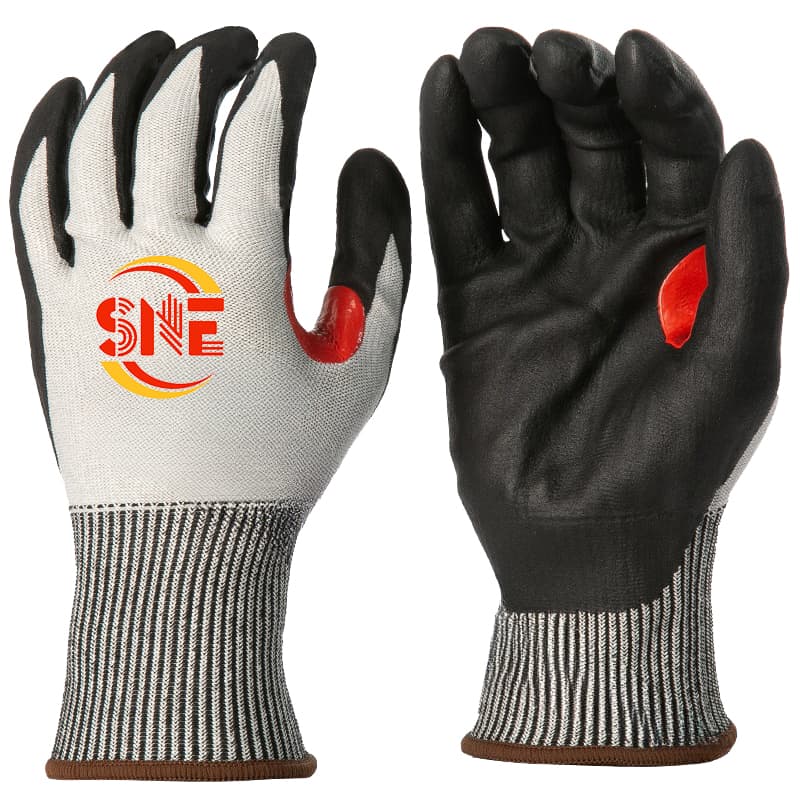
The most common technical combination uses a high-performance liner such as HPPE, glass fiber blends, steel fiber blends, or engineered yarns for cut protection, paired with nitrile, sandy nitrile, double-dip nitrile, or specialized oil-resistant coatings for grip and liquid handling. Buyers should match the glove to the actual task because not every oil-resistant glove delivers the same tactile sensitivity, and not every cut-resistant liner is comfortable enough for all-day use.
Common Product Types
Not all cut and oil resistant gloves are designed for the same environment. The table below summarizes the main product categories used across the United States and explains where each one fits best.
| Product Type | Typical Liner | Coating | Best For | Main Advantage | Watch-Out |
|---|---|---|---|---|---|
| PU-coated cut resistant gloves | HPPE or engineered yarn | PU | Light assembly, electronics, dry handling | Dexterity and tactile control | Less ideal for heavy oil saturation |
| Smooth nitrile cut resistant gloves | HPPE, glass fiber blend | Smooth nitrile | General manufacturing, parts handling | Balanced oil resistance and wear life | Can feel less breathable |
| Sandy nitrile cut resistant gloves | HPPE or steel blend | Sandy nitrile | Oily metal parts, automotive, maintenance | Strong grip in wet or oily use | Texture may trap grime |
| Double-dip nitrile gloves | Cut-resistant engineered liner | Double nitrile | Heavy oil exposure, outdoor industry | Enhanced barrier and durability | Usually less flexible |
| Impact + cut + oil resistant gloves | High-cut liner with TPR back | Nitrile or sandy nitrile | Oil and gas, mining, heavy maintenance | Multi-hazard protection | Bulkier fit |
| Disposable-supported hybrid gloves | Unsupported or thin liner | Special chemical/oil finish | Short-cycle maintenance tasks | Fast replacement and contamination control | Lower cut rating in many models |
For most U.S. industrial buyers, sandy nitrile and smooth nitrile cut-resistant gloves account for the broadest range of applications because they combine practical grip, reasonable comfort, and good lifecycle value. PU-coated models still matter where dexterity is critical, but they are usually better for light oil contact than fully oily handling.
Industry Demand in the United States
Demand is strongest where workers handle sharp materials under oily or greasy conditions. The chart below compares estimated purchase intensity by industry segment.
How to Evaluate Performance
When a procurement team reviews cut and oil resistant gloves, the glove should be tested against the real workflow, not just a brochure. U.S. buyers usually focus on ANSI cut levels, coating type, grip under lubrication, abrasion resistance, liner gauge, cuff length, touch sensitivity, and ease of donning and doffing. For many applications, glove acceptance fails not because the glove is unsafe, but because workers dislike the fit, heat buildup, or reduced finger control.
It is also important to separate splash resistance from true oil handling performance. Some gloves maintain grip with a light machine oil film but become unreliable in saturated hydraulic conditions. Others resist penetration well but become too stiff for assembly or inspection work. A trial should include at least one week of actual field use with feedback from operators, supervisors, and EHS personnel.
Buying Checklist for U.S. Procurement Teams
| Evaluation Point | Why It Matters | What Good Looks Like | Typical Buyer Mistake | Best Fit Users | Procurement Impact |
|---|---|---|---|---|---|
| ANSI cut rating | Aligns protection with task hazard | Clear task-based selection from A2 to A7+ | Buying higher cut level than needed | EHS managers, plant buyers | Controls injury risk and cost |
| Oil grip performance | Reduces dropped parts and slips | Verified field grip in oily handling | Assuming all nitrile gloves perform equally | Maintenance, machining, auto plants | Improves productivity |
| Comfort and dexterity | Drives worker compliance | Flexible liner and natural hand feel | Choosing protection only | Assembly, inspection teams | Reduces rejection rates |
| Durability | Affects change frequency | Stable coating and abrasion life | Comparing only initial unit price | High-volume industrial users | Lowers total glove spend |
| Sizing range | Improves fit across workforce | Consistent sizing from small to XXL | Offering too few sizes | Large mixed workforces | Supports safety compliance |
| Supply reliability | Prevents stockouts | Domestic inventory or strong replenishment plan | Ignoring lead-time risk | Distributors, multi-site buyers | Supports continuous operations |
The table shows that the best glove is not always the thickest or the cheapest. The strongest purchasing decisions connect glove specifications to task conditions, worker acceptance, and replenishment risk. In the U.S., this matters even more for national distributors and multi-site operators who need standardized PPE across plants in different states.
Main Industries and Applications
Cut and oil resistant gloves are especially relevant in the following U.S. industries:
In automotive manufacturing, workers handle stamped components, machined parts, fasteners, subassemblies, and lubricated surfaces. In metal fabrication, sheet edges, coils, tubing, and fabricated parts create obvious cut hazards, often combined with coolants and oils. In oil and gas support, gloves are needed for pipe handling, equipment maintenance, and repair tasks where grip and durability matter under harsh conditions. In warehousing and logistics, gloves are increasingly used for mixed-task environments involving cartons, straps, shrink wrap, pallet handling, and occasional sharp-edge contact. In maintenance departments, mechanics and technicians need enough cut protection for equipment work without losing the dexterity required for tools and small parts.
Applications vary by task. Light-duty assembly may need a thinner glove with moderate cut resistance and oil grip. Heavy industrial repair may require a thicker glove with stronger palm coating and potentially impact protection. This is why the best suppliers usually offer multiple glove constructions instead of a single “one glove for everything” model.
Trend Shift in Product Preferences
The U.S. market is gradually shifting from thick, heavy gloves toward thinner engineered gloves that still maintain protection. This area chart reflects the trend toward higher dexterity and better worker acceptance over time.
Leading Suppliers Serving the United States
The supplier landscape in the United States includes domestic brands, North American distributors, and international manufacturers with established export experience. The table below gives a practical view of notable companies relevant to U.S. buyers.
| Company | Service Region | Core Strength | Key Offerings | Typical Buyer | Notes |
|---|---|---|---|---|---|
| HexArmor | United States and global industrial accounts | High-performance hand protection engineering | Cut-resistant, impact-resistant, oil-grip gloves | Heavy industry, utilities, oil and gas | Strong premium positioning |
| MCR Safety | Nationwide U.S. | Broad industrial PPE catalog and distribution reach | Cut-resistant coated gloves, general industrial PPE | Distributors, contractors, plants | Good fit for multi-site sourcing |
| Superior Glove | U.S. and Canada | Technical glove breadth and application diversity | Oil-resistant cut gloves, sleeves, specialty gloves | Manufacturing and distribution buyers | Strong portfolio depth |
| Ansell | United States and multinational accounts | Global scale and industrial compliance capability | HyFlex and other cut-resistant coated glove lines | Large enterprises, regulated operations | Widely specified in industrial procurement |
| PIP | North America | Extensive channel coverage and brand portfolio | G-Tek and related coated cut-resistant gloves | Distributors, MRO channels | Strong market access |
| Mechanix Wear | United States | User familiarity and task-specific glove designs | Utility, maintenance, and specialty work gloves | Maintenance teams, field service users | Popular in task-oriented environments |
This supplier table is useful because it separates broad reputation from practical buying fit. Some companies are strongest in premium engineered protection, while others are better for channel access, private-label flexibility, or nationwide replenishment. U.S. buyers should compare not only product features but also sample support, distributor responsiveness, and stock availability near major freight routes such as Houston, Savannah, Chicago, and the ports of Los Angeles and Long Beach.
Detailed Supplier Comparison
Beyond brand recognition, procurement teams should compare suppliers based on the actual needs of the account. The chart below gives a realistic relative comparison across key selection factors.
Case Examples from U.S. Work Environments
A metal fabrication shop in the Chicago area may move from a basic coated glove to a sandy nitrile A4 or A5 cut-resistant model after tracking frequent minor lacerations on sharp sheet edges. The result is often better grip, fewer glove changes, and fewer hand incidents during coil, panel, and trim handling.
An automotive supplier in the Detroit region may standardize two glove types instead of one: a lighter glove for precision assembly with light oil contact, and a more durable glove for maintenance and metal handling. This approach usually improves worker acceptance because employees are not forced into one bulky glove for every task.
A Houston-area maintenance contractor working around pumps, valves, pipe, and oily equipment may select a higher-grip nitrile glove with added abrasion resistance rather than simply increasing cut level. In practice, reducing slippage can be just as important as raising cut protection because many hand injuries happen when control is lost first.
What U.S. Buyers Should Ask Before Ordering
Before placing a bulk order, buyers should ask whether the glove has documented cut performance under ANSI methods, which coating is used, how the glove behaves in wet versus oily conditions, what sizes are stocked, what the minimum order quantity is, and how quickly repeat orders can be shipped to regional hubs. They should also ask whether the same model is available for private label programs, because many distributors and brand owners in the United States want consistency between current supply and future branded expansion.
It is also wise to confirm packaging options, carton quantities, barcode labeling, and import lead times for any international program. Buyers importing through Long Beach, New York/New Jersey, Savannah, or Houston need a realistic logistics plan, not just a factory quotation.
Our Company
For U.S. buyers evaluating factory-direct options, Snell Safety presents a practical sourcing model built around industrial hand protection rather than general PPE trading. The company manufactures from dedicated facilities in Gaomi and Nantong with six production lines, more than 150 trained employees, and daily output capacity of 150,000 pairs, which supports stable volume supply for distributors, wholesalers, industrial end users, and brand owners in the United States. Its strength is especially relevant in coated hand protection, including PU, latex, and nitrile technologies, along with engineered cut-resistant and impact-resistant glove development, backed by ISO 9001 quality management and CE-marked production standards that align with internationally recognized compliance expectations. For U.S. customers, this matters because product performance is tied to controlled manufacturing, repeatable coating quality, and scalable production rather than spot-market sourcing. Snell Safety supports flexible cooperation models such as OEM, ODM, private label, bulk wholesale, product customization, and regional partnership development, making it suitable for importers, local dealers, e-commerce brands, safety distributors, and plant buyers seeking differentiated glove programs. The company’s established export footprint across Europe, Australia, the Middle East, South America, Russia, and Southeast Asia demonstrates real cross-border operating experience, while its multilingual commercial support, sample service, technical consultation, and export logistics coordination provide concrete pre-sale and after-sale assurance for U.S. accounts. Buyers looking for a direct line to the factory can review the broader catalog through the product collection, learn more through the company background, or discuss project requirements via the U.S.-focused contact channel.
How to Match Gloves to Applications
| Application | Risk Level | Recommended Glove Style | Preferred Coating | Suggested Cut Range | Reason |
|---|---|---|---|---|---|
| Stamped metal handling | High | Medium-weight cut-resistant glove | Sandy nitrile | A4-A6 | Sharp edges and oily surfaces occur together |
| Automotive assembly | Medium | Flexible precision glove | Smooth nitrile or PU | A2-A4 | Needs dexterity with light oil contact |
| Equipment maintenance | Medium to high | Durable all-purpose industrial glove | Nitrile | A3-A5 | Mixed tasks with tools and lubricants |
| Oilfield service support | High | Heavy-duty glove with strong grip | Double nitrile | A4-A6 | Heavy oil exposure and rough handling |
| Warehouse mixed handling | Low to medium | Light coated cut glove | PU or nitrile | A2-A3 | Balances comfort and general protection |
| Machine shop parts transfer | Medium | Close-fit cut-resistant glove | Sandy nitrile | A3-A5 | Improves grip on coolants and machined parts |
This table helps buyers narrow the field quickly. It shows that the right glove depends on the task profile, not just on the most aggressive specification. Overbuying cut level can increase fatigue and reduce acceptance, while underbuying oil grip can create hidden productivity and safety losses.
Local Supply, Distribution, and Lead Time Considerations
In the United States, lead time planning is often as important as the glove specification. Buyers with urgent needs typically prefer suppliers with domestic inventory or strong distributor networks in industrial regions such as Texas, the Midwest, and the Southeast. However, buyers with stable forecasting can benefit significantly from direct import programs, especially for private-label or custom-coated gloves where annual consumption is predictable.
Ports and freight routes matter. Imports coming through Los Angeles/Long Beach can serve the West and interior distribution lanes efficiently, while Gulf and East Coast routing may better support Texas, the Southeast, and Midwest customers depending on the final warehouse location. A good supplier should be able to discuss replenishment planning in practical terms, not just quote production time.
Pricing Logic and Total Cost
Pricing in this category depends on cut liner composition, coating complexity, glove gauge, cuff construction, packaging, customization, and order size. In U.S. purchasing, the cheapest glove often becomes expensive if wear life is short or workers reject it. The better metric is cost per successful workday or cost per protected task cycle. That means a slightly higher-priced glove can create better value if it lasts longer, improves grip, and reduces replacement frequency.
For distributors and private-label buyers, factory-direct supply can create meaningful margin advantages if quality consistency is proven. This is especially true when the supplier can support branding, packaging customization, and repeatable production specifications across multiple shipments.
Future Trends Through 2026
Looking ahead to 2026, three themes are shaping the U.S. market. The first is technology: lighter engineered yarns, improved nitrile textures, and multi-hazard glove platforms are making it easier to combine cut resistance, oil grip, and comfort. The second is policy and compliance: employers are placing more emphasis on documented hazard assessments, task-based PPE selection, and injury reduction metrics tied to operational audits. The third is sustainability: more buyers now ask about manufacturing consistency, waste reduction, packaging optimization, and longer-life gloves that reduce disposal volume over time.
Another clear trend is segmentation. Instead of relying on one general glove, U.S. employers are moving toward glove matrices tailored by job function. This supports both safety and productivity, especially in larger facilities where assembly, maintenance, logistics, and fabrication have different risk profiles.
FAQ
What are cut and oil resistant gloves used for?
They are used where workers face both laceration hazards and oily or greasy surfaces, such as metal fabrication, automotive work, equipment maintenance, and oil-related industrial tasks.
What coating works best for oily conditions?
Sandy nitrile is often preferred for dependable grip in oily handling, while smooth nitrile offers a balanced combination of wear life and liquid resistance. The best option depends on how much dexterity the task requires.
Are all cut-resistant gloves also oil resistant?
No. Many cut-resistant gloves are designed mainly for dry handling. Buyers should verify the coating type and request field-use samples for oily environments.
What cut level should I buy?
The right level depends on the task. Light assembly may need only moderate cut protection, while sheet metal, machining support, or heavy maintenance often requires a higher ANSI cut level.
Can U.S. buyers work directly with overseas factories?
Yes. Many distributors, importers, and brand owners in the United States already source directly from qualified manufacturers when they need custom branding, better margins, or long-term supply consistency.
What should a distributor look for in a supplier?
A distributor should look for stable quality control, documentation, customization options, practical lead times, responsive communication, and a product range broad enough to serve multiple customer segments.
Final Takeaway
For the United States, the best cut and oil resistant gloves are the ones that match the exact work environment, prove their protection with recognized performance data, and remain comfortable enough for workers to wear consistently. Buyers should compare domestic brands and qualified international manufacturers based on application fit, coating performance, supply continuity, and service capability. In a market shaped by safety expectations and labor efficiency, the smartest procurement decision is rarely based on price alone; it is based on measurable protection, stable grip, worker acceptance, and dependable long-term supply.