Лучшие Джерси лайнер нитриловые перчатки поставщиков в Германии | 2026 руководство
2026-04-16
Поделиться статьей
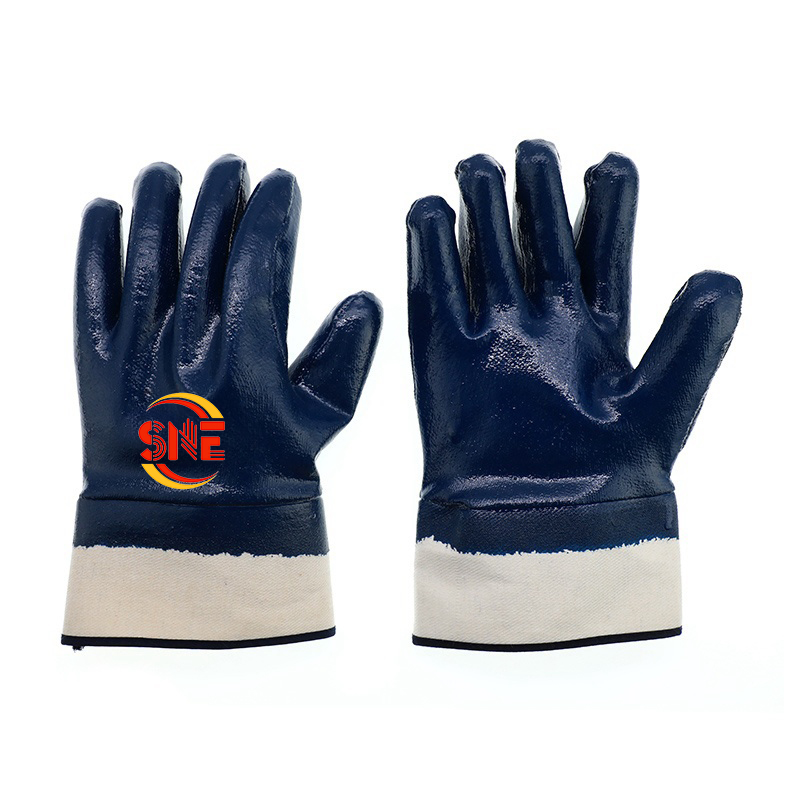
Jersey liner nitrile gloves — combining the soft, absorbent comfort of a cotton jersey inner layer with a tough, chemical-resistant nitrile outer coating — remain one of the most versatile and widely used heavy-duty hand protection solutions across German industry. Whether your workers handle oily machinery components, abrasive construction materials, or chemical-laden surfaces, these gloves deliver a proven balance of durability, grip, and all-day wearability that few other glove constructions can match. This comprehensive guide helps B2B procurement teams, PPE distributors, and HSE managers in Germany identify the right product configurations, evaluate reputable suppliers, and source jersey liner nitrile gloves that fully comply with EN 388:2016+A1:2018 standards.
If you need expert guidance selecting the right jersey liner nitrile gloves for your German operations — whether for custom OEM/ODM development, private-label branding, or competitive bulk pricing — свяжитесь с нашей командой at Snell Safety. We have extensive hands-on experience serving German clients across automotive, manufacturing, construction, and oil & gas sectors and can recommend configurations tailored precisely to your local application requirements.
Быстрый ответ
For sourcing jersey liner nitrile gloves in Germany, consider established local PPE distributors concentrated in major industrial regions like North Rhine-Westphalia, Bavaria, and Baden-Württemberg, who offer stock availability and on-ground technical support. Also evaluate Chinese manufacturers who specialize in customized jersey liner nitrile products with competitive factory-direct pricing and full international certifications (ISO 9001/CE). Combining local distribution with Asia-based OEM capability gives buyers the best blend of responsiveness, customization, and cost efficiency.
Обзор рынка
Рынок защитных перчаток в Германии прогнозируется к росту с 1 068,97 млн долларов США в 2023 году до примерно 2 100,86 млн долларов США к 2032 году, что отражает среднегодовой темп роста (CAGR) 7,78 %. Within this expanding landscape, nitrile gloves are expected to grow at the fastest CAGR of 8.3% over the forecast period, driven by their versatility across construction, manufacturing, chemicals, mining, and oil & gas applications. Jersey liner nitrile gloves, as a robust reusable subcategory, benefit directly from this growth trajectory — especially in heavy-duty industrial sectors where extended wear comfort and chemical protection are equally critical.
In 2024, the number of reportable workplace accidents in Germany reached a historic low and the accident rate was the lowest ever recorded at 18.0 per 1,000 full-time equivalents. Yet hand injuries still constitute up to 30% of the total cases treated in emergency departments, underscoring the ongoing demand for reliable hand protection. Germany’s robust framework for occupational safety regulations significantly drives the demand for safety gloves, with EU Regulation 2016/425 on personal protective equipment mandating the use of CE-marked, EN 388-certified products across all industrial sectors. This compliance-driven environment ensures sustained procurement of jersey liner nitrile gloves by employers obligated to provide proper hand protection.
What Types of Jersey Liner Nitrile Gloves Are Needed in Germany
The most in-demand jersey liner nitrile gloves in Germany feature a soft 100% cotton jersey or interlock liner fully coated or partially coated with nitrile in various finishes — smooth, rough, or sandy — to address different grip and chemical resistance requirements across heavy industrial applications.
Based on our experience serving German clients at Безопасность Snell, we have identified clear purchasing patterns shaped by Germany’s dominant automotive manufacturing sector, its extensive Mittelstand base, and the country’s rigorous quality expectations. German HSE procurement teams consistently select jersey liner nitrile gloves for tasks where seamless knit gloves lack the heavy-duty protection or chemical barrier properties required. The cotton jersey liner absorbs perspiration and provides light thermal insulation — a practical advantage during Germany’s cool, damp winters and in unheated workshops and outdoor construction sites. Unlike thinner seamless-knit nylon or polyester liners, the jersey construction offers a plush, cushioned feel that reduces hand fatigue during extended shifts handling rough, heavy, or vibrating materials.
The following configurations represent the highest-volume jersey liner nitrile gloves types we supply to the German market:
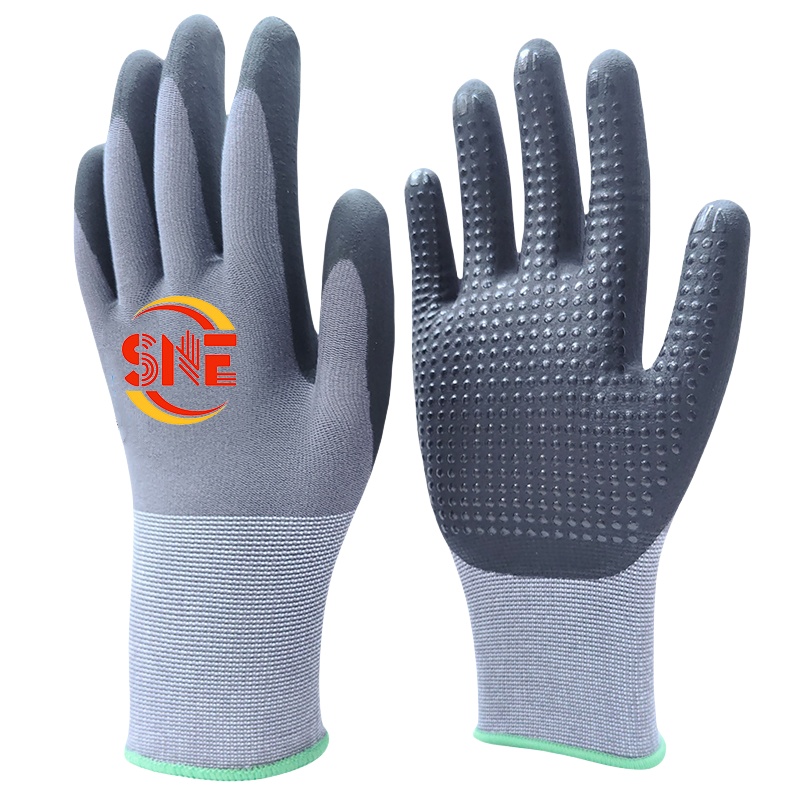
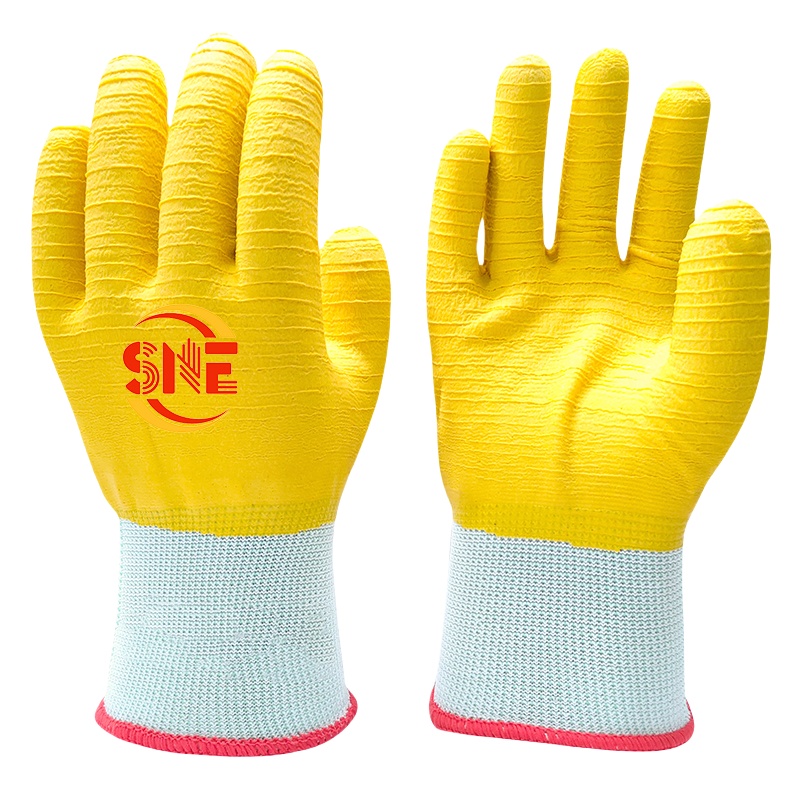
- Fully Coated Smooth Nitrile on Cotton Jersey Liner, Safety Cuff (EN 388: 4211X) — The standard general-purpose workhorse for oil & gas, automotive maintenance, and heavy machinery handling. Full coating provides 360° liquid and oil barrier protection. Safety cuff enables quick donning and removal. Sizes M–XXL.
- Fully Coated Rough/Textured Nitrile on Cotton Jersey Liner, Knit Wrist (EN 388: 4221X) — Enhanced grip variant for wet, oily, and greasy environments. The rough-textured nitrile surface channels liquids away from contact points for superior hold on slippery parts. Knit wrist prevents debris ingress.
- Fully Coated Sandy Nitrile on Cotton Jersey Liner, Safety Cuff (EN 388: 4221X) — Premium grip option combining the sandy nitrile texture with jersey comfort for aggressive oily-surface grip in metal stamping, petroleum handling, and heavy construction. Popular in NRW’s industrial corridor.
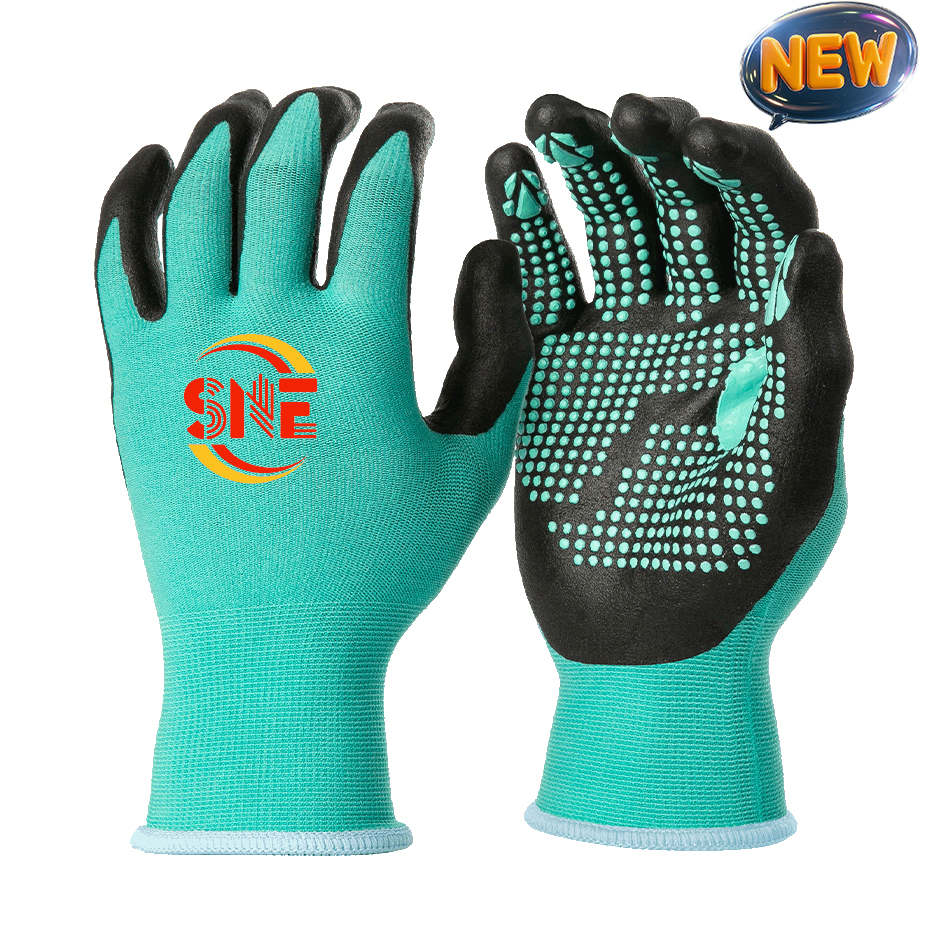
- Palm-Coated Nitrile on Cotton Jersey Liner, Knit Wrist (EN 388: 3111X) — Lighter-weight variant offering improved breathability on the back of the hand while maintaining nitrile protection on the palm and fingers. Ideal for material handling, warehousing, and general manufacturing tasks where full-hand immersion is not needed.
- Fully Coated Nitrile on Cotton Jersey Liner with Fleece/Thermal Inner (EN 388: 4211X + EN 511) — Cold-weather variant with additional thermal insulation for outdoor construction, oil & gas infrastructure, and cold-storage applications. Rated for cold protection alongside mechanical hazards.
Why These Jersey Liner Nitrile Gloves Types Are Recommended
These configurations are recommended because the cotton jersey liner combined with a nitrile coating solves a persistent challenge in German heavy industry: providing robust chemical and abrasion protection in a format comfortable enough for 8–10 hour shift wear, with durability that justifies the higher per-pair cost compared to thin seamless-knit alternatives.
The technical advantage of the jersey liner lies in its unique construction. Cotton jersey — a knitted fabric using interlocking loops rather than the warp-knit method of seamless gloves — creates a plush, absorbent inner surface with natural moisture-wicking properties. This construction absorbs sweat and reduces the clammy hand feel that plagues workers wearing fully coated seamless-knit gloves for extended periods. When paired with a nitrile dip coating, the jersey structure provides a thicker, more cushioned barrier between the hand and the work surface, significantly reducing impact transmission and hand fatigue — measurable benefits in automotive plants, metal fabrication shops, and construction sites where workers repeatedly grip heavy materials. The nitrile coating itself delivers EN 388 Level 4 abrasion resistance (8,000+ Martindale cycles), Level 1–2 blade cut resistance, and strong oil, grease, and hydrocarbon resistance that latex and PVC coatings cannot match.
From a standards perspective, all recommended configurations meet EN 388:2016+A1:2018, mandatory for CE-marked PPE under EU Regulation 2016/425. For cold-protection variants, EN 511 certification adds verified thermal insulation performance. Key performance advantages compared to alternative constructions include:
- Comfort & Wear Duration: Cotton jersey absorbs 3–5× more perspiration than nylon or polyester seamless-knit liners, reducing hand discomfort during extended wear — critical for German shift-work patterns of 8–10 hours
- Устойчивость к истиранию: EN 388 Level 4 (8,000+ cycles); fully coated nitrile on jersey significantly outperforms PU-coated seamless knit gloves (typically Level 3) in abrasive environments
- Chemical Barrier: Full nitrile coating provides effective resistance to oils, greases, fuels, and many solvents — PU and latex coatings degrade faster in hydrocarbon contact
- Cushioning & Impact Absorption: Thicker jersey + nitrile construction provides inherent padding that reduces vibration transmission and blunt-impact forces compared to thin 13G/15G seamless knit alternatives
- Экономическая эффективность: While per-pair cost is higher (€0.60–€2.50 vs. €0.15–€0.50 for seamless knit), service life in abrasive/heavy-duty environments is 2–4× longer, reducing total annual glove spend per worker
| Технические характеристики | Подкладка | Тип покрытия | Рейтинг EN 388 | Лучшее применение | Approx. Cost (€/pair, bulk) |
|---|---|---|---|---|---|
| Jersey Liner Nitrile Gloves — Smooth Full Coat | Cotton Jersey | Smooth Nitrile, Full | 4211X | Oil & gas, automotive maintenance | €0.65–€1.20 |
| Jersey Liner Nitrile Gloves — Rough Full Coat | Cotton Jersey | Rough Nitrile, Full | 4221X | Wet/oily metal handling | €0.75–€1.40 |
| Sandy Nitrile Full Coat on Jersey | Cotton Jersey | Sandy Nitrile, Full | 4221X | Heavy oily grip, petroleum | €0.80–€1.50 |
| Palm-Coated Nitrile on Jersey | Cotton Jersey | Smooth Nitrile, Palm | 3111X | General manufacturing, warehousing | €0.60–€1.00 |
| Thermal Jersey Liner Nitrile | Fleece-Lined Jersey | Smooth Nitrile, Full | 4211X + EN 511 | Cold-weather outdoor, cold storage | €1.50–€2.50 |
Use this table to match your workplace hazards, chemical exposure levels, grip needs, and budget to the right jersey liner nitrile gloves specification before requesting samples.
Key Industries for Jersey Liner Nitrile Gloves in Germany
Jersey liner nitrile gloves serve the broadest range of heavy-duty applications wherever chemical resistance, durability, extended wear comfort, and robust grip must all be delivered in a single glove. In Germany, demand concentrates in industries that require full-hand protection from oils, solvents, and abrasive materials during sustained manual work.
- Автомобильное производство и обслуживание: Germany’s automotive sector — Europe’s largest — is a primary consumer of jersey liner nitrile gloves. Assembly, painting, and maintenance workers handle engine components, brake fluids, transmission oils, and degreasing solvents daily. The cotton jersey liner absorbs perspiration during long shifts, while the nitrile coating resists the full spectrum of automotive chemicals encountered in production and aftermarket service.
- Oil & Gas & Petrochemical: Petroleum processing, pipeline maintenance, and refinery operations expose workers to crude oil, hydraulic fluids, drilling muds, and hydrocarbon solvents. Fully coated jersey liner nitrile gloves provide a complete liquid barrier with the cushioned comfort needed for multi-hour tasks on offshore platforms, refineries, and pipeline routes across northern Germany.
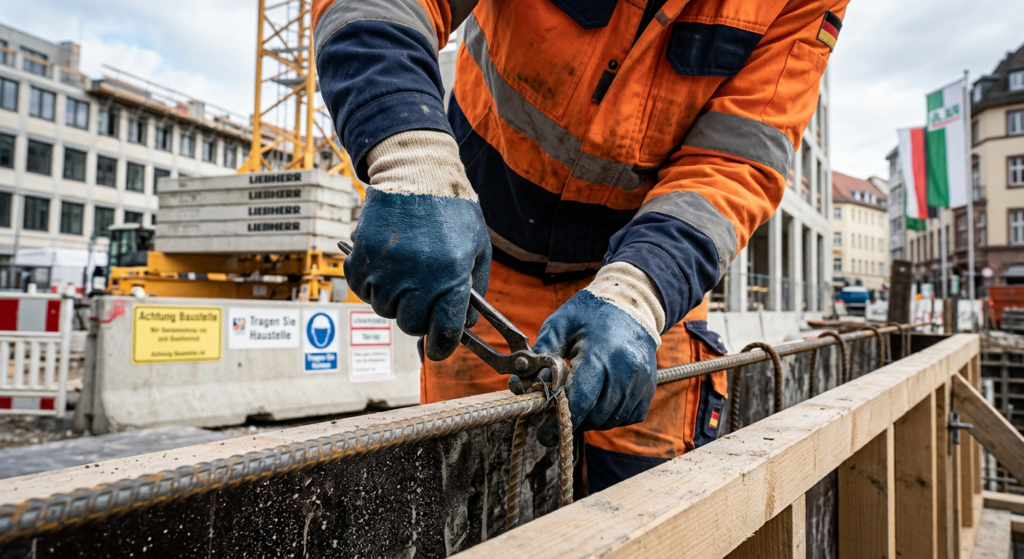
- Construction & Heavy Civil Engineering: Workers handling rebar, concrete forms, treated lumber, and waterproofing compounds require robust mechanical protection alongside chemical resistance. Germany’s ongoing infrastructure renewal and energy-transition construction projects drive sustained demand for jersey liner nitrile gloves in this sector.
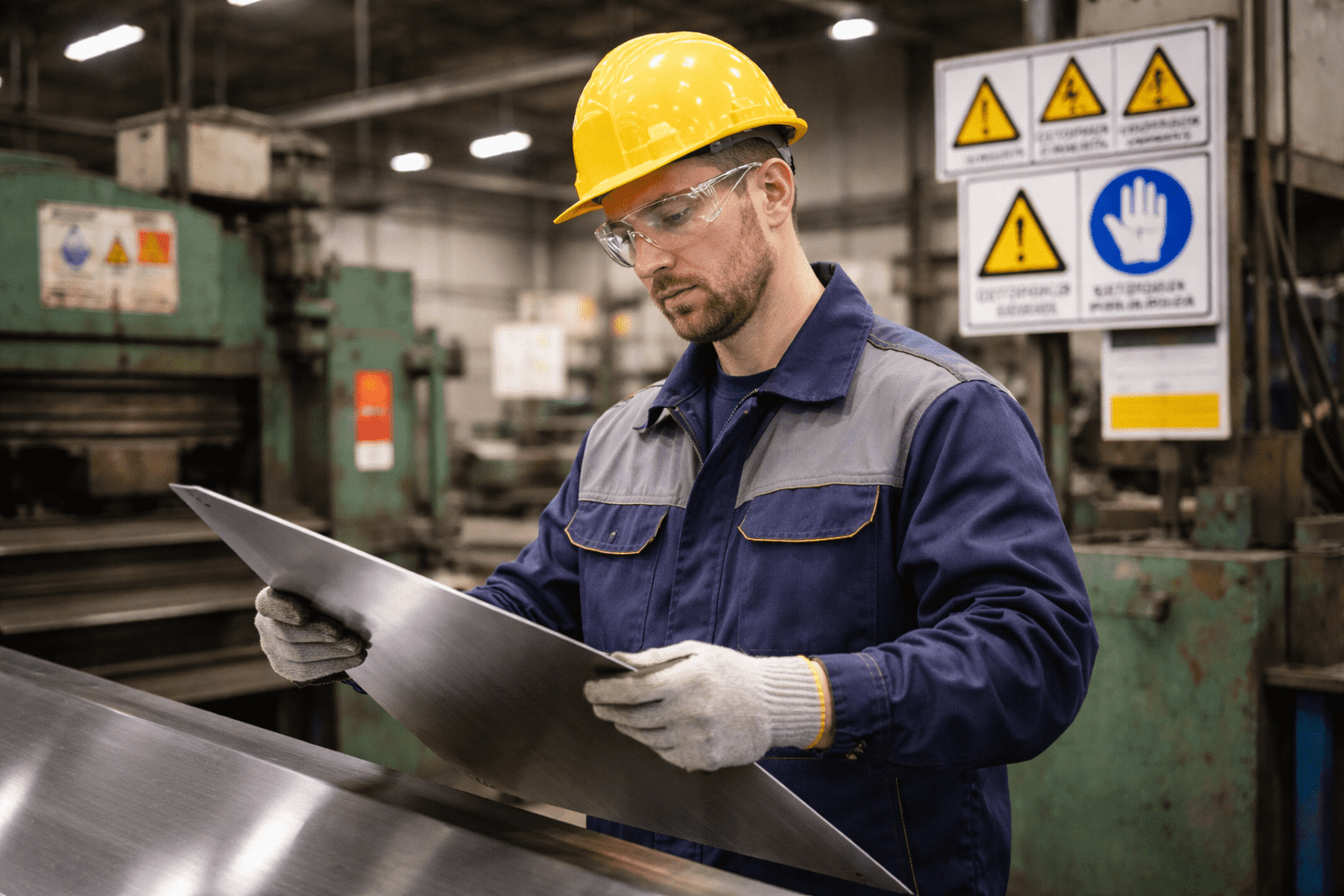
- Metal Fabrication & Heavy Engineering: Sheet metal workshops, foundries, and heavy machinery manufacturers need gloves that resist oils and cutting fluids while providing cushioning against heavy, sharp-edged materials. Rough-finish and sandy nitrile on jersey variants are particularly valued for their aggressive grip on oily metal surfaces.
- Logistics, Warehousing & Waste Management: High-volume distribution centers and waste-processing facilities require durable gloves for handling oily, wet, or contaminated materials. The jersey liner’s cushioning reduces fatigue during thousands of repetitive handling cycles per shift, while the full nitrile coating protects against unknown chemical residues.
- Chemical & Pharmaceutical Manufacturing: Workers in Germany’s extensive chemical industry handle acids, alkalis, and solvents that require verified chemical barrier gloves. While jersey liner nitrile is not rated for prolonged immersion in concentrated chemicals, it provides reliable splash and incidental contact protection for handling, mixing, and transfer operations.
Industrial hubs such as North Rhine-Westphalia, Baden-Württemberg, and Bavaria lead market penetration, supported by strong manufacturing and automotive sectors. Under DGUV (German Social Accident Insurance) guidelines and EU Regulation 2016/425, employers must conduct formal hazard assessments and provide appropriately certified hand protection. Germany’s robust automotive and chemical sectors are fueling demand for specialized gloves that boast a combination of protective features. This regulatory framework, combined with strong industrial production output, ensures stable compliance-driven demand for jersey liner nitrile gloves across all major sectors.
Конкретные сценарии применения
Scenario 1: Automotive Engine Plant near Munich
At a major automotive engine manufacturing facility, 350+ assembly and maintenance workers handle engine blocks, cylinder heads, and transmission housings coated with cutting oil, coolant, and corrosion-prevention fluids throughout every production stage. Workers perform manual deburring, component fitting, seal installation, and quality inspection using handheld tools. Primary hazards include prolonged skin contact with cutting oils and coolants (known skin irritants), abrasion from rough cast-iron surfaces, and hand fatigue during 8-hour shift rotations. The recommended specification is fully coated smooth nitrile on cotton jersey liner with knit wrist (EN 388: 4211X). The jersey liner absorbs perspiration and cushions the hand during repetitive gripping motions, while the full smooth nitrile coating creates a complete barrier against oil penetration — preventing occupational dermatitis that affects up to 15% of metalworking employees exposed to cutting fluids without adequate protection.
Scenario 2: Petroleum Refinery Maintenance in Lower Saxony
A petrochemical facility deploys 120 maintenance technicians performing valve replacement, pipe fitting, flange gasket installation, and pump overhaul across the refinery complex. Workers encounter crude oil residues, hydraulic fluids, diesel fuel, gasoline vapors, and caustic cleaning agents throughout every maintenance cycle. Key hazards include chemical splash, prolonged hydrocarbon skin contact, abrasion from corroded pipe surfaces, and grip loss on oil-covered fittings and tools. The recommended specification is fully coated rough nitrile on cotton jersey liner with safety cuff (EN 388: 4221X). The rough-textured nitrile surface maintains secure grip on oil-soaked valve handles and pipe wrenches, the full coating prevents any chemical migration to the skin, and the safety cuff allows rapid glove removal in emergency situations — a critical safety feature in refinery environments where fast evacuation may be required.
Scenario 3: Heavy Construction Site in Frankfurt
On a large-scale commercial construction project, 200 workers handle concrete forms, rebar bundles, waterproofing membranes, and chemical sealants during foundation and structural work. Workers operate in varying weather conditions, from cold, wet mornings to warm afternoons, and face extended exposure to wet concrete (alkaline pH 12+), form-release oils, and abrasive aggregate surfaces. Recommended specification is fully coated sandy nitrile on cotton jersey liner with knit wrist (EN 388: 4221X). The sandy nitrile texture provides aggressive grip on wet, oily forms and rebar even in rain, while the cotton jersey liner adds light insulation during cool-weather shifts and absorbs perspiration during warmer periods. The full coating protects against alkaline concrete burns — a serious and commonly underestimated hazard on German construction sites.
Тематические исследования
Case 1: Automotive Aftermarket Chain, Bavaria
A regional automotive aftermarket chain with 22 service centers standardized hand protection using OEM-branded fully coated smooth nitrile jersey liner gloves featuring custom logo printing and color-coded cuff bands by department. The program covered 180+ mechanics handling brake fluid, engine oil, and degreasing solvents daily. After 12 months, reported cases of occupational contact dermatitis dropped 40%, glove consumption decreased by 25% compared to the previous thin seamless-knit nitrile program, and per-worker annual PPE costs fell through factory-direct bulk procurement.
Case 2: Private-Label Program for NRW PPE Distributor
A Düsseldorf-based industrial safety distributor developed a 3-SKU private-label jersey liner nitrile gloves line targeting construction, automotive, and general manufacturing clients across western Germany. The range included smooth full-coat, rough full-coat, and palm-coat variants with unified German-language packaging and EN 388 documentation. Initial order of 150,000 pairs across all SKUs shipped within 25 days, with quarterly volume replenishment and seasonal cold-weather variant additions built into the supply framework.
Топ-6 рекомендуемых местных поставщиков в Германии
| Название компании | Основные сильные стороны | Регионы обслуживания | Предпродажная поддержка | Послепродажная поддержка |
|---|---|---|---|---|
| RheinGuard Arbeitsschutz GmbH | Deep nitrile glove portfolio, automotive focus | Северный Рейн-Вестфалия, Гессен, Рейнланд-Пфальц | On-site glove trials, EN 388 hazard assessments | Quarterly usage audits, stock management |
| SüdPro Industrieschutz | Premium chemical-resistant jersey liner nitrile gloves | Бавария, Баден-Вюртемберг | Ergonomic fit testing, certification documentation | Field quality monitoring, warranty claims |
| NordSafe Handschutz | Logistics and cold-chain optimized PPE portfolios | Гамбург, Нижняя Саксония, Шлезвиг-Гольштейн | Product datasheets, import compliance advisory | Express replacement programs, returns handling |
| OstWerk PPE Solutions | Cost-effective bulk jersey nitrile for Mittelstand manufacturers | Саксония, Бранденбург, Тюрингия | Government tender support, flexible MOQ options | Inventory tracking, batch traceability |
| HansaGrip Schutzprodukte | E-commerce packaging optimized for Amazon.de and B2B platforms | Nationwide (Hamburg fulfillment center) | Listing content, certification packages | Consumer review management, fulfillment |
| AlpenSafe Arbeitsschutz AG | Oil & gas and heavy construction specialized variants | Bavaria, Alpine and southern regions | Application-specific glove recommendations | Seasonal stock planning, field performance audits |
When evaluating local suppliers, always request EN 388 test reports from an EU-notified body alongside physical wear-test samples — assess the nitrile coating adhesion to the jersey liner, grip performance in oily conditions, and comfort during a full-shift trial before committing to volume purchases.
Why Choose Snell Safety as Your Global Jersey Liner Nitrile Gloves Partner
Безопасность Snell brings deep German market expertise built through years of collaboration with automotive manufacturers, petrochemical operators, PPE distributors, and construction companies across Germany’s key industrial regions. We understand precisely which nitrile coating finishes, jersey liner weights, cuff styles, and hand-feel profiles German workers prefer — from the smooth full-coat variants favored in Bavarian automotive plants to the rough-textured heavy-duty gloves demanded by NRW’s petrochemical maintenance teams. With established local partners and planned European warehouse capacity for stock-ready delivery, we provide truly localized service across both online and offline channels. We are actively recruiting new distributors, agents, and e-commerce brand owners — offering comprehensive pre-sale empowerment (product selection guidance, technical training, market intelligence), full after-sale support (quality assurance, replacement policies), dropshipping services, free samples, and marketing material support including product photography and listing content.
Our vertically integrated production system — spanning R&D, raw material sourcing, jersey knitting, nitrile dip coating (smooth, rough, sandy finishes), curing, quality inspection, packaging, and export — ensures consistent coating quality at factory-direct pricing. With over a decade of specialized nitrile coating expertise, 6 dedicated production lines producing 150,000 pairs per day, ISO 9001 and CE certification, and full OEM/ODM capability, we deliver jersey liner nitrile gloves from concept to shipment with fast turnaround times. Browse our каталог продукции или свяжитесь с нашей командой to request free samples and competitive quotation.
| Возможности | Snell Safety Specification | Buyer Benefit |
|---|---|---|
| Суточная производительность | 150 000 пар на 6 производственных линиях | Scalable supply for large-volume programs |
| Технологии нанесения покрытий | Smooth, rough, sandy nitrile; foam; micro-foam; PU; latex | One-stop sourcing for complete glove portfolio |
| Сертификаты | ISO 9001, маркировка CE, отчеты испытаний EN 388 | Hassle-free EU import compliance |
| Настройка | OEM/ODM, private label, custom branding/packaging | Full brand development and product differentiation |
| Local Market Service | German partners, planned EU warehouse, dropshipping | Faster delivery, localized support |
Use this table to evaluate how Snell Safety’s manufacturing capabilities align with your specific jersey liner nitrile gloves procurement requirements.
{Wide-angle photograph of quality control inspectors examining fully coated jersey liner nitrile gloves at a modern factory workstation, with EN 388 certification documents, thickness gauges, and neatly stacked finished glove boxes visible on the inspection table}
FAQ
What EN 388 rating should I expect for jersey liner nitrile gloves?
Standard fully coated smooth nitrile on cotton jersey liner gloves typically achieve EN 388 ratings of 4211X — Level 4 abrasion, Level 2 blade cut, Level 1 tear, and Level 1 puncture. Rough-textured and sandy nitrile variants commonly achieve 4221X. These ratings confirm reliable mechanical protection for general-purpose heavy-duty industrial tasks across construction, automotive, and manufacturing.
Which nitrile coating finish is best for oily environments?
For heavy oil, grease, and hydrocarbon exposure, choose rough-textured or sandy nitrile finishes on a jersey liner. These create superior friction on oil-filmed surfaces compared to smooth nitrile. Smooth-finish fully coated jersey liner nitrile gloves work well for light oil contact but may lose grip on heavily oiled metal parts. Always test samples under your actual working conditions.
Какие сертификаты требуются для импорта защитных перчаток в Германию?
All safety gloves sold in Germany must comply with EU Regulation 2016/425 and carry CE marking. Category II PPE (mechanical protection) requires EU Type Examination by a notified body, EN 388:2016+A1:2018 test certification, a German-language EU Declaration of Conformity, and documented REACH/SVHC compliance. Jersey liner nitrile gloves fall under Category II.
How do jersey liner nitrile gloves compare to seamless-knit nitrile gloves?
Jersey liner nitrile gloves offer thicker construction, superior cushioning, better chemical barrier properties, and longer service life in abrasive environments. Seamless-knit alternatives (13G, 15G, 18G) provide better dexterity and tactile sensitivity. Choose jersey liner for heavy-duty, chemical-intensive tasks; choose seamless knit for precision assembly and light handling.
What is the typical price range for bulk jersey liner nitrile gloves?
For factory-direct bulk orders (MOQ typically 5,000–10,000 pairs), smooth fully coated jersey liner nitrile gloves range from €0.65–€1.20 per pair. Rough-textured variants cost €0.75–€1.40. Thermal/fleece-lined cold-weather versions range from €1.50–€2.50. Custom branding adds approximately €0.05–€0.10 per pair depending on print complexity.
How long do jersey liner nitrile gloves typically last?
Jersey liner nitrile gloves typically last 2–4× longer than thin seamless-knit nitrile coated gloves in abrasive environments due to the thicker nitrile deposit and cushioned construction. In automotive maintenance, expect 4–8 weeks per pair. In heavy construction with abrasive materials, 2–4 weeks. Replace when the nitrile coating shows visible wear-through to the jersey fabric.
Are jersey liner nitrile gloves suitable for cold-weather work in Germany?
Standard cotton jersey liner provides light thermal insulation suitable for cool workshops and mild outdoor conditions. For true cold-weather protection on outdoor construction sites or cold-storage facilities (temperatures below 5°C), choose variants with an additional fleece or thermal inner layer rated to EN 511. These maintain hand dexterity while providing verified cold protection.
What is the difference between safety cuff and knit wrist on jersey liner gloves?
Safety cuff (gauntlet-style, 65–75 mm opening) allows fast donning and removal — essential in emergency situations and high-temperature environments. Knit wrist provides a snug seal that prevents debris, liquids, and abrasive particles from entering the glove. Choose safety cuff for oil & gas and maintenance; choose knit wrist for construction and general manufacturing.
Can jersey liner nitrile gloves be used for chemical handling?
Fully coated nitrile on jersey provides effective splash and incidental contact resistance to oils, greases, fuels, mild acids, and many solvents. However, they are not rated for prolonged immersion in concentrated chemicals. For full chemical immersion tasks, use purpose-designed chemical-resistant gloves with verified EN 374 permeation data for your specific chemicals.
What MOQ and lead time should I expect when ordering from a manufacturer?
Typical MOQ for standard jersey liner nitrile gloves is 5,000–10,000 pairs per style. Custom OEM/ODM orders with private-label branding usually require 10,000–20,000 pairs minimum. Production lead time is 15–30 days depending on order volume, with shipping to Germany adding 25–35 days by sea or 7–10 days by rail. Plan quarterly orders for optimal inventory management.
Whether you are an end-user enterprise seeking factory-direct jersey liner nitrile gloves supply for your German operations, a дистрибьютором distributor building a comprehensive hand protection portfolio, or an e-commerce brand developing a private-label range, Безопасность Snell is ready to support you with precisely engineered products and localized service. Подайте свои требования или запросите котировку сегодня — including free samples, custom OEM/ODM development, and dedicated technical consultation for the German market.
Содержание пересмотрено и обновлено: Март 2026