I migliori fornitori di guanti di sicurezza per miniere in Germania | 2026 Guida
2026-04-24
Condividi questo articolo
Sourcing the right mining safety gloves for Germany’s demanding underground and surface operations requires expert product knowledge and reliable supply chains. If you need help selecting the ideal glove specifications for your mining application, or if you’re exploring custom OEM/ODM solutions, contatta il nostro team at Snell Safety. We have extensive experience serving mining clients in Germany and can recommend configurations tailored to your specific operational hazards.
Risposta rapida
For high-quality mining safety gloves in Germany, consider established European PPE distributors with deep mining-sector expertise and regional warehouse infrastructure, as well as specialized Chinese manufacturers who offer customized products with competitive factory-direct pricing and full international certifications (ISO 9001, CE marking, EN 388). Local distributors offer rapid delivery and on-site technical support, while overseas manufacturers provide greater flexibility in OEM/ODM customization, diversified coating technologies, and cost-effective bulk procurement.
Panoramica del mercato
Il mercato dei guanti di sicurezza in Germania dovrebbe crescere da 1.068,97 milioni di dollari nel 2023 a 2.100,86 milioni di dollari entro il 2032, con un tasso di crescita annuale composto (CAGR) di 7,78% dal 2024 al 2032. This growth is strongly supported by Germany’s active mining sector, where the amount produced in Germany was approximately 12.5 million tonnes of rock salt (including industrial brine) and some 5.8 million tonnes of potash and potash salt products in 2023. The Germany mining equipment market size stands at USD 1.56 billion in 2025 and is forecast to climb to USD 1.86 billion by 2030, reflecting a 3.58% CAGR during 2025-2030.
Increasing workplace safety awareness and strict regulatory compliance across industries like construction, healthcare, and manufacturing drive market demand, while the enforcement of occupational safety standards and growth in industrial operations amplify the demand for high-performance safety gloves. In the mining sector specifically, workers are exposed to various risks and hazards resulting in occupational injuries, some of which are severe and even fatal — despite representing only 1% of the total workforce, mining-related injuries account for 8% of the fatal injuries in the world. Germany’s strict enforcement of the Bundesberggesetz (Federal Mining Act) and Berufsgenossenschaft (BG) occupational insurance standards makes certified mining safety gloves a non-negotiable procurement item.
What Types of Mining Safety Gloves Are Needed in Germany
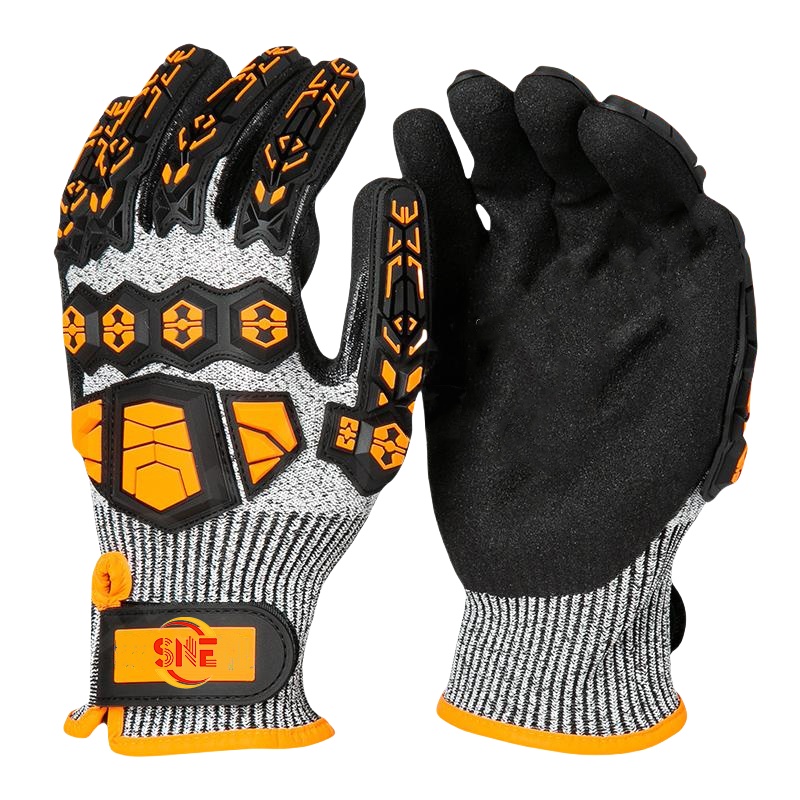
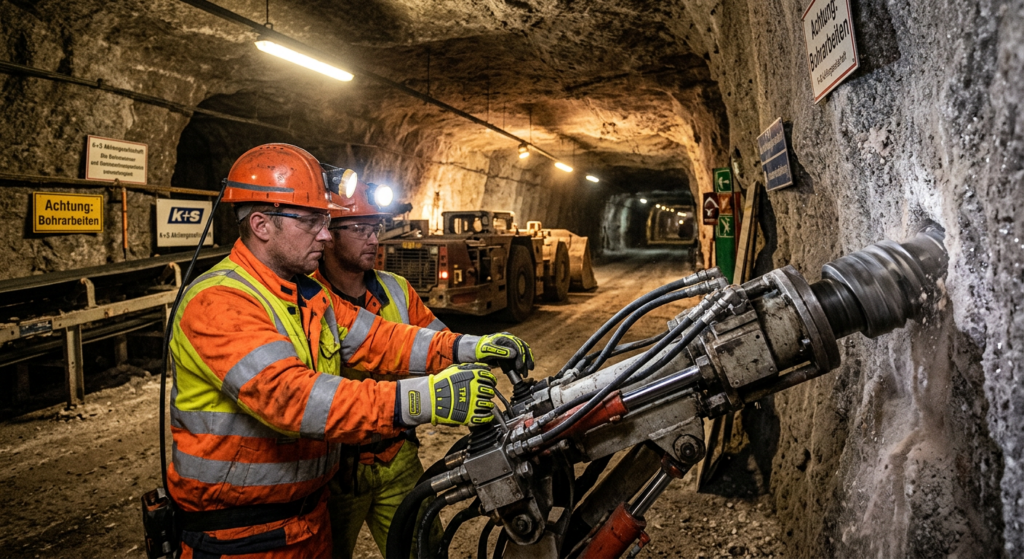
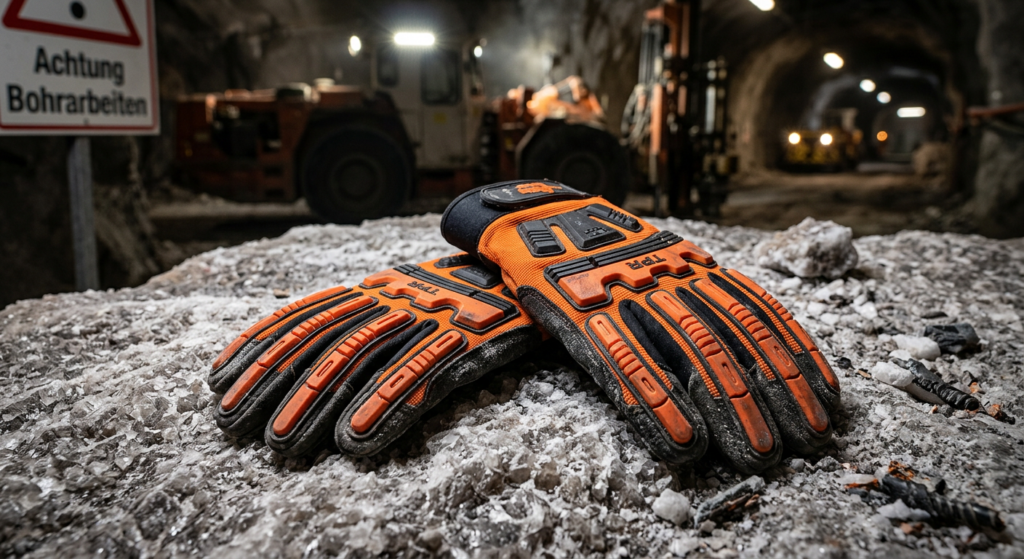
The most in-demand mining safety gloves in Germany are impact-resistant gloves with TPR back-of-hand protection, cut-resistant gloves rated EN 388 levels D through F on HPPE or Kevlar liners, and heavy-duty latex or nitrile coated gloves in 10G or 13G gauges. These configurations address the combined hazards of crush injuries, sharp rock edges, abrasive surfaces, and exposure to oils and chemicals found in German mining operations.
Based on our experience serving Germany clients, we have observed that German mining buyers place exceptional emphasis on impact protection and abrasion durability — two factors that directly reflect the hazard profile of Germany’s potash, salt, lignite, and quarrying operations. Workers in underground potash and salt mines face constant exposure to abrasive mineral surfaces, heavy machinery pinch points, and rough material handling, requiring gloves that combine high cut resistance with robust TPR metacarpal guards. Germany’s cold winters further influence demand: miners working in open-pit lignite operations and surface quarries during November through March prefer gloves with fleece or acrylic thermal liners paired with latex crinkle coatings for wet-weather grip on frozen rock and metal surfaces.
The top product types we supply to German mining operations include:
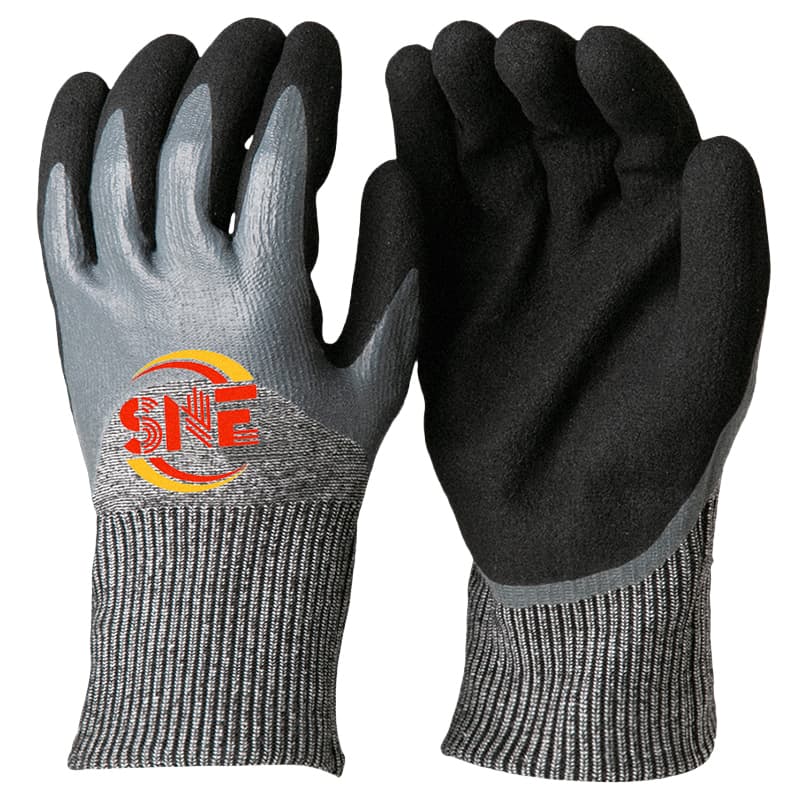
- HPPE/Kevlar 13G liner + sandy nitrile full coating + TPR back-of-hand impact protection — EN 388 cut level E, impact-rated “P”. Designed for underground potash and salt mining, providing crush protection alongside superior oil and abrasion resistance.
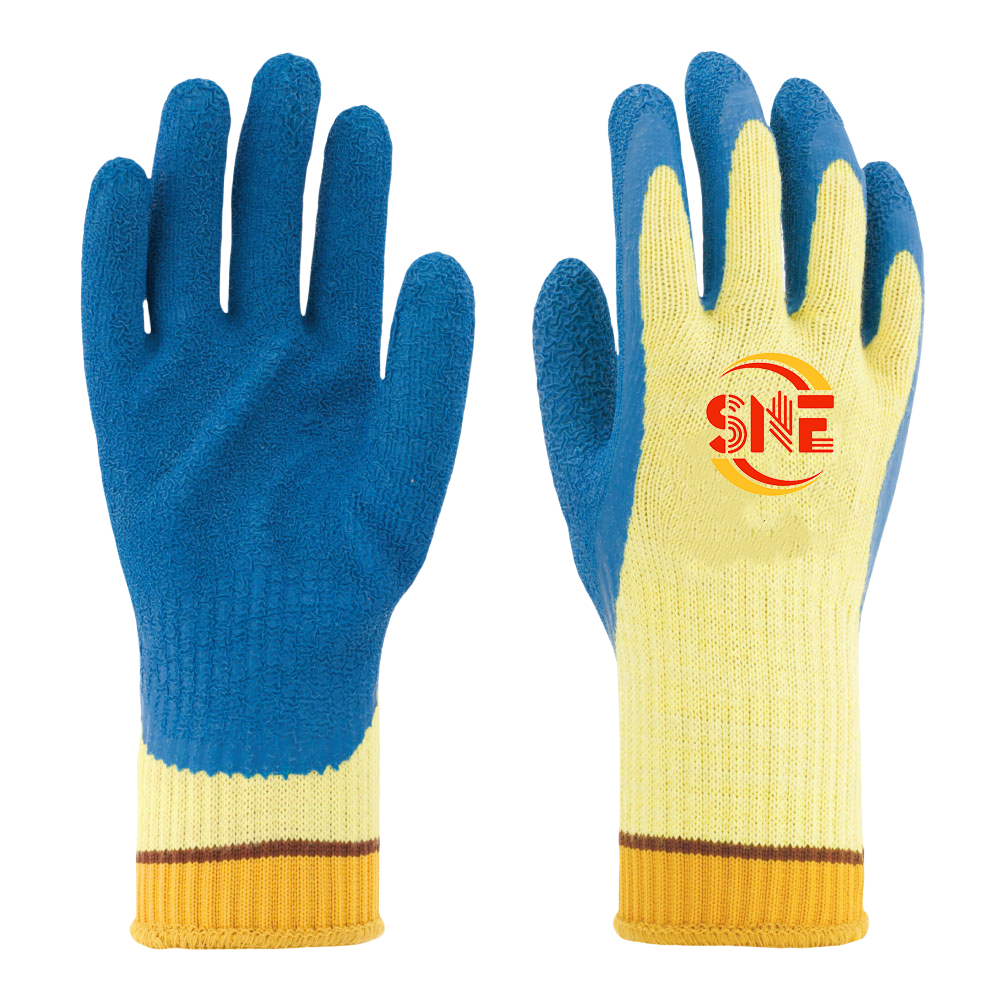
- HPPE/steel wire 10G liner + latex crinkle 3/4 coating + TPR metacarpal guards — EN 388 cut level F, puncture level 3. Engineered for heavy-duty surface quarrying and lignite extraction where maximum cut and impact protection outweigh dexterity requirements.
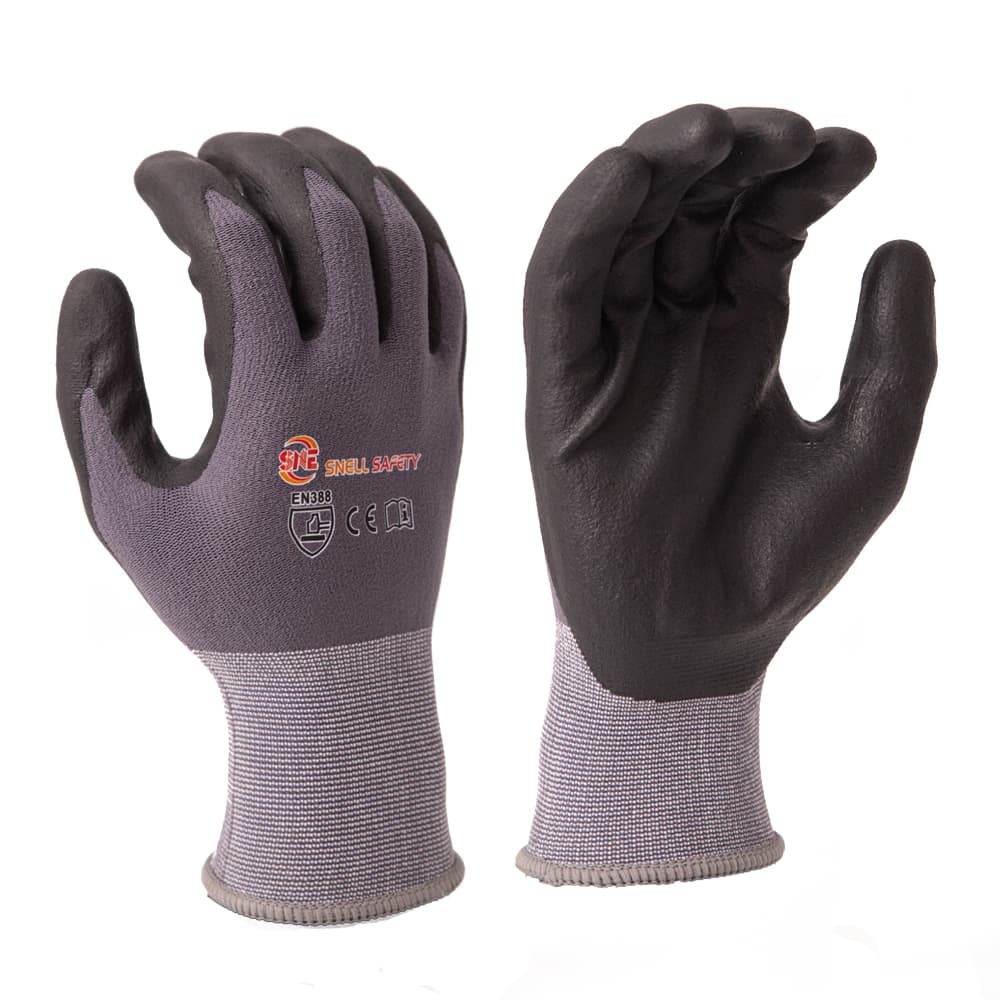
- HPPE/glass fiber 13G liner + nitrile micro-foam palm coating — EN 388 cut level D, abrasion level 4 (8,000+ cycles). Ideal for equipment maintenance, bolt installation, and mechanical tasks requiring tactile sensitivity alongside strong cut protection.
- Nylon/polyester 10G liner + latex crinkle full coating + cold-insulating fleece layer — EN 388 cut level C, EN 511 cold protection rated. Purpose-built for winter mining operations in open-pit lignite fields across the Rhineland and Lusatia.
- Kevlar/spandex 13G liner + nitrile foam palm coating, hi-vis shell — EN 388 cut level D. Suited for material sorting, conveyor maintenance, and above-ground processing plant operations where visibility and dexterity are prioritized.
These specifications reflect what German mining workers consistently prefer: a secure, snug fit that does not compromise grip under dusty or wet conditions, with back-of-hand impact ridges that absorb energy without adding excessive bulk to the glove.
Perché sono consigliati questi tipi di prodotti
These mining safety glove specifications are recommended because they deliver the optimal combination of impact protection, cut resistance, and abrasion durability validated under the EN 388:2016+A1:2018 standard — directly addressing the documented hazard profile in mining operations. MSHA data shows that hand and finger lacerations (~53%) and fractures (~26%) are the most common hand injuries in mining. This injury distribution confirms that mining safety gloves must excel in both cut resistance (to prevent lacerations) and impact absorption (to prevent fractures and crush injuries).
The EN 388 standard evaluates gloves across abrasion resistance (cycles), blade cut resistance (index), tear resistance (Newtons), puncture resistance (Newtons), TDM cut resistance (Newtons, levels A through F), and impact protection (P). For mining applications, we recommend the following performance thresholds:
- Resistenza al taglio: EN 388 level D (15–21.9 N) minimum for general mining tasks; level E (22–29.9 N) or F (30 N+) for rock handling and heavy drilling operations
- Resistenza all'abrasione: Level 4 (8,000+ cycles) for all mining gloves — essential given the highly abrasive nature of rock salt, potash, and mineral ore surfaces
- Protezione dagli impatti: “P” rating mandatory for underground operations and any task involving heavy equipment, pipe fitting, or material transfer
- Resistenza alla perforazione: Level 3 (100 N+) minimum for handling broken rock, wire mesh, and bolting materials
| Specifiche | EN 388 Livello di taglio | Abrasione (Cicli) | Impact Rating | Best Mining Application |
|---|---|---|---|---|
| HPPE/Kevlar 13G + Sandy Nitrile + TPR | E | 4 (8,000+) | P | Underground potash/salt Mining Safety Gloves |
| HPPE/Steel Wire 10G + Latex Crinkle + TPR | F | 4 (8,000+) | P | Surface quarrying and lignite extraction |
| HPPE/Glass Fiber 13G + Nitrile Micro-foam | D | 4 (8,000+) | — | Equipment maintenance and mechanical tasks |
| Nylon/Polyester 10G + Latex Crinkle + Fleece | C | 3 (2,000+) | — | Winter open-pit Mining Safety Gloves |
| Kevlar/Spandex 13G + Nitrile Foam (Hi-vis) | D | 4 (8,000+) | — | Processing plant and conveyor operations |
Use this table to match your specific mining task to the right glove configuration — prioritize impact protection (P rating) for any underground or heavy equipment role, then select cut level based on the sharpness of materials handled.
From a cost-effectiveness standpoint, TPR impact-protected gloves on HPPE liners with sandy nitrile coatings typically last 3–6 weeks under daily mining use, compared to just 1–2 weeks for basic leather gloves in the same environment. The higher unit cost (approximately €3.50–€6.00 per pair vs. €1.50–€2.50 for basic leather) is offset by significantly longer service life, superior injury prevention, and reduced lost workdays — making them the more economical choice over a full procurement cycle.
Key Industries for Mining Safety Gloves in Germany
Germany’s mining and extractive sector generates strong, diversified demand for specialized mining safety gloves across multiple sub-industries. This steady trajectory stems from structural moves away from coal toward critical minerals and geothermal resources, backed by the federal coal-phase-out law and the EU Critical Raw Materials Act. The following industries are the largest consumers:
- Potash and salt mining — Germany is one of the world’s leading potash producers, with K+S operating six mines in three German potash-producing districts: the Hanover district in Lower Saxony, the Calvörde district in Saxony-Anhalt, and the Werra-Fulda district in Hesse and Thuringia. Workers require impact-resistant gloves (EN 388 level E + P) with sandy nitrile coatings for abrasive salt crystal handling and crush protection around heavy continuous miners.
- Lignite (brown coal) surface mining — Germany’s Rhineland and Lusatian lignite basins remain active, employing large workforces in open-pit operations. Gloves must withstand extreme abrasion from overburden handling, provide cold-weather grip during winter months, and feature high-visibility shells for site safety compliance.
- Quarrying and aggregate extraction — Thousands of quarries across Germany produce limestone, gravel, sand, and basalt for the construction industry. Workers face sharp rock edges, heavy stone handling, and vibration from drilling equipment, requiring cut level D–F gloves with anti-vibration padding.
- Lithium and critical minerals exploration — Zinnwald Lithium’s Saxony project, slated to yield 18,000 t of lithium hydroxide annually, requires large-diameter drill rigs, continuous miners, and on-site processing lines. Emerging lithium extraction creates new demand for chemical-resistant nitrile-coated gloves with high dexterity.
- Geothermal drilling operations — Germany’s push for renewable energy includes deep geothermal projects, where drill crews need heat-resistant and oil-resistant gloves rated for sustained high-temperature contact along with cut and puncture protection.
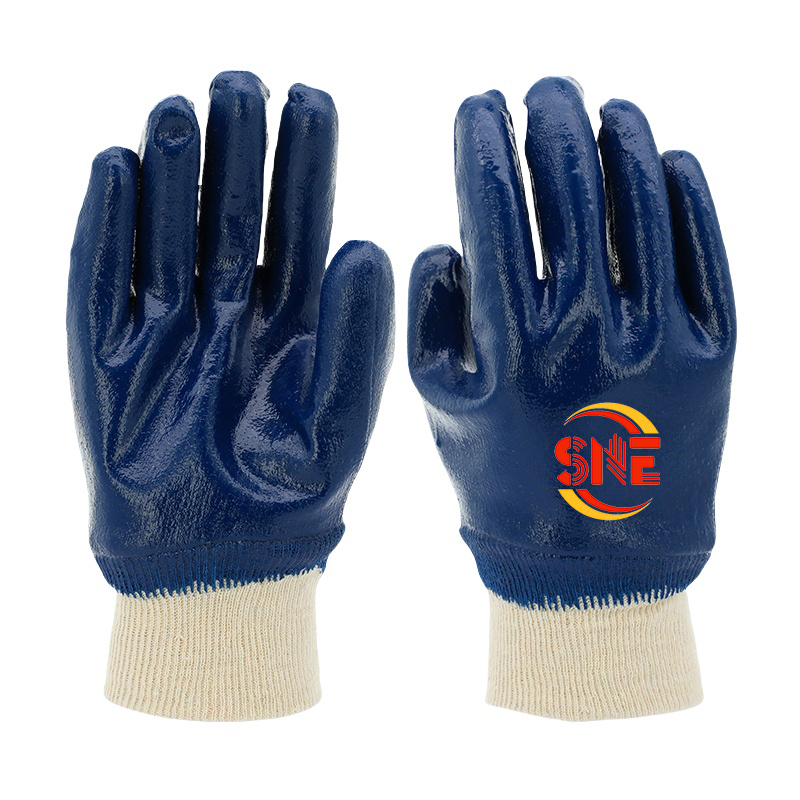
- Underground waste disposal and mine reclamation — Former mine sites across Thuringia, Saxony-Anhalt, and the Ruhr Valley are being repurposed for hazardous waste storage or environmental remediation, requiring chemical-resistant full-coated nitrile gloves with extended cuffs for worker protection.
In Germany, companies meet high environmental and safety standards — something that is by no means a given in international comparison. The DGUV (German Social Accident Insurance) and the regional Berufsgenossenschaften enforce rigorous PPE compliance through mandatory workplace risk assessments, on-site audits, and incident reporting requirements under the Arbeitsschutzgesetz (Occupational Safety Act). Every mining employer must document that the gloves provided to workers match the specific hazard profile of each task — making certified EN 388-rated mining safety gloves a legal procurement requirement, not merely a recommendation.
Specific Application Scenarios for Mining Safety Gloves
Scenario 1: Underground Potash Drilling in Thuringia
Deep underground in a potash mine near the Werra district, drill operators load and position jumbo drill rigs to create blast holes in the salt rock face. The primary hazards are crushing injuries from heavy drill steel, sharp fractured salt edges after blasting, and abrasive dust that erodes glove surfaces rapidly. Workers need HPPE/Kevlar 13G gloves with sandy nitrile full coating and TPR metacarpal impact guards, rated EN 388 cut level E with “P” impact certification. The sandy nitrile finish maintains grip on dusty, slightly damp salt surfaces, while the TPR ridges protect fingers and knuckles from pinch points around drill chucks and steel rods. Gloves are typically rotated every 3–4 weeks in this abrasive environment.
Scenario 2: Open-Pit Lignite Overburden Removal in the Rhineland
Operators of bucket-wheel excavators and heavy dump trucks in the Rhenish lignite district handle conveyor belt maintenance, mechanical repairs, and manual debris clearing around massive earth-moving equipment. Hazards include extreme vibration, sharp metal edges on conveyor frames, and exposure to freezing rain and sub-zero temperatures during winter shifts. The recommended glove is a nylon/polyester 10G liner with latex crinkle full coating, a fleece thermal inner layer, and hi-vis orange shell, rated EN 388 cut level C and EN 511 cold protection. The crinkle latex finish channels water away to maintain grip on wet steel and frozen rock, while the fleece layer keeps hands functional in temperatures down to -10°C.
Scenario 3: Limestone Quarry Loading Operations in Bavaria
At a limestone quarry serving the construction aggregate market, front-end loader operators and ground crew manually sort, position, and signal during rock loading into haul trucks. Workers face impact hazards from falling stone fragments, deep cuts from freshly blasted limestone edges, and prolonged vibration from hand-held pneumatic breakers used to reduce oversized rock. The recommended glove is an HPPE/steel wire 10G liner with latex crinkle 3/4 coating and full TPR back-of-hand and finger impact protection, rated EN 388 cut level F with “P” impact and puncture level 3. For workers operating pneumatic breakers, adding a separate anti-vibration padded palm insert significantly reduces hand-arm vibration syndrome (HAVS) risk over extended shifts.
Casi di studio
A major potash mining company operating underground facilities in Saxony-Anhalt required 120,000 pairs of EN 388 level E impact-rated mining safety gloves annually across three mine sites. We configured an HPPE/Kevlar 13G sandy nitrile glove with full TPR coverage in four sizes (M–XXL), delivered quarterly via sea freight to Hamburg with consistent quality validated through third-party batch testing. The partnership has now continued for multiple order cycles with zero quality complaints.
A German quarrying and aggregate company in North Rhine-Westphalia needed to standardize glove procurement across 14 quarry sites. We developed two OEM product lines — a heavy-duty 10G impact model for blasting and loading crews and a medium-duty 13G nitrile foam model for equipment maintenance — with private-label branding and German-language safety data sheets. The initial trial order of 8,000 pairs scaled to 60,000 pairs per year within 18 months.
Top 6 Recommended Local Mining Safety Gloves Suppliers in Germany
| Nome della società | Punti di forza fondamentali | Regioni di servizio | Supporto pre-vendita | Assistenza post-vendita |
|---|---|---|---|---|
| Bergwerk Schutz GmbH | Mining-specific PPE specialist, deep underground expertise | NRW, Saxony-Anhalt, Thuringia | Valutazioni dei rischi in loco, kit di campioni | 30-day returns, quality audit reports |
| RheinSafe Industrieschutz AG | Heavy industry PPE, impact glove focus | Rhineland, Hessen, nationwide | Technical consultation, product demos | Dedicated account managers, batch testing |
| NordGrip Arbeitsschutz KG | Cold-weather mining PPE, Scandinavian supply partnerships | Lower Saxony, Hamburg, Schleswig-Holstein | Application-matched selection guides | Warranty claims, replacement shipments |
| Lausitz PPE Solutions GmbH | Lignite sector specialist, thermal and hi-vis range | Brandenburg, Saxony, Lusatia | Free trial boxes, multilingual support | Defect replacement, on-site fitting sessions |
| BayernStein Sicherheit AG | Quarrying and aggregate PPE, Mittelstand focus | Baviera, Baden-Württemberg | Low-MOQ programs, online specification tools | 14-day return window, technical hotline |
| SachsenMine SafetyDirect | E-commerce PPE platform, rapid delivery capability | Saxony, nationwide | AI-based glove selector, live chat | Automated reorder triggers, loyalty pricing |
When evaluating local suppliers, always verify that their mining safety gloves carry current EN 388:2016+A1:2018 and EN ISO 21420 test reports from EU-accredited notified bodies, and request physical samples to assess fit, grip, and impact protection quality before committing to volume orders.
Why Choose Snell Safety as Your Global Mining Gloves Partner
Sicurezza Snell combines deep local market expertise with vertically integrated manufacturing to deliver mining safety gloves precisely tailored for Germany’s unique operational requirements. Through extensive collaboration with German mining clients — from potash operators in Saxony-Anhalt to quarrying companies across Bavaria — we have developed an intimate understanding of what works on the ground: the hand feel preferences of German miners, the specific EN 388 cut and impact ratings demanded by BG auditors, and the packaging and documentation standards expected by German importers. We already have established local partners in Germany and are building overseas warehouse capacity to provide in-stock, ready-to-ship supply with significantly reduced lead times.
Our manufacturing backbone ensures we can deliver at the scale and consistency that mining operations demand. With over a decade of production expertise, six dedicated production lines producing 150,000 pairs daily, and full ISO 9001 + CE certification, we offer factory-direct pricing across our complete range of diversified coating technologies — including the sandy nitrile, latex crinkle, and nitrile micro-foam finishes most demanded in mining applications. Our advanced cut-resistant and impact-resistant engineering capabilities, combined with vertically integrated production from R&D through knitting, coating, curing, inspection, and export, ensure every batch meets the exact specifications your mining operations require. Explore our full catalogo prodotti to see the range of configurations available.
We are actively recruiting distribution partners, agents, and e-commerce resellers across Germany. Partners receive comprehensive pre-sale empowerment — product selection guidance, technical training, and market intelligence — alongside robust after-sale support including quality assurance, replacement policies, and ongoing technical assistance. For online brand owners, we offer dropshipping services, free product samples, professional marketing material support, and dedicated e-commerce enablement. Whether you represent an end-user mining enterprise or a distributor building a mining PPE portfolio, contatta il nostro team to start the conversation.
FAQ
What EN 388 cut level do I need for mining operations in Germany?
Most mining tasks in Germany require EN 388 cut level D (15–21.9 N) as a minimum. For underground potash and salt mining, rock handling, and drilling operations, level E (22–29.9 N) or F (30 N+) is recommended. Equipment maintenance and processing plant roles may be adequately served at level C or D.
Which coating is best for mining safety gloves in dusty or wet environments?
Sandy nitrile provides the best grip performance in dusty, oily, and lightly wet mining conditions. For heavy wet exposure — open-pit mining in rain or snow — latex crinkle coating outperforms nitrile variants due to its superior water-channeling texture. PU coatings are not recommended for mining as they lack adequate abrasion resistance.
What EN 388 rating means for mining safety gloves?
EN 388:2016+A1:2018 tests gloves against six mechanical hazards: abrasion, blade cut, tear, puncture, TDM (coupe) cut resistance (levels A–F), and optional impact protection (“P”). For mining safety gloves, look for abrasion level 4, cut level D–F, puncture level 3+, and “P” impact rating for underground work.
Are impact-resistant gloves mandatory in German mines?
While not universally mandated by statute for all mining tasks, BG (Berufsgenossenschaft) risk assessments under the Arbeitsschutzgesetz typically require TPR impact protection for underground operations, heavy equipment maintenance, drilling, blasting support, and any task where crush or pinch hazards are documented.
What is the price range for bulk mining safety gloves orders?
Bulk pricing varies by specification. EN 388 level C–D gloves with nitrile coating on HPPE liners typically range €1.80–€3.00 per pair at MOQs of 10,000+ pairs. Level E–F with full TPR impact protection range €3.50–€6.00 per pair. Factory-direct sourcing from certified manufacturers can reduce costs by 20–35% compared to domestic wholesale.
Quali certificazioni sono necessarie per importare guanti di sicurezza in Germania?
Safety gloves must comply with EU Regulation 2016/425 on PPE and carry CE marking. They require testing to EN 388:2016+A1:2018 by an EU-accredited notified body, plus an EU Declaration of Conformity and full technical documentation. Importers must designate an authorized representative within the EU.
How long do mining safety gloves typically last?
Under daily mining use, quality EN 388 level D–E gloves with nitrile coatings typically last 3–6 weeks in medium-duty roles such as equipment maintenance. In heavy-duty applications like rock drilling, blasting cleanup, or underground ore handling, lifespan may reduce to 2–3 weeks. Factors include abrasion intensity, chemical exposure, and proper sizing.
How to choose the right gauge for mining applications?
For heavy-duty underground mining with impact risk, choose 10G (thicker liner, sturdier construction). For general mining tasks balancing protection and dexterity, 13G is the most versatile choice. Finer gauges (15G, 18G) are rarely used in mining except for specialized inspection or touchscreen operation tasks.
Can mining safety gloves be customized with private label branding?
Yes. Reputable OEM manufacturers offer full private-label customization including custom shell colors, logo printing on the cuff or back-of-hand, branded hang tags, and customized packaging with multilingual safety documentation. Typical MOQs for private-label mining safety gloves start at 5,000–10,000 pairs per design.
What makes German mining different from other markets for glove selection?
Germany’s mining sector is dominated by potash, salt, and lignite operations rather than hard-rock metal mining. This means gloves must prioritize extreme abrasion resistance against mineral crystal surfaces, cold-weather performance for open-pit winter operations, and compliance with DGUV regulations — rather than chemical exposure resistance typical in metal ore processing.
Ready to source high-performance mining safety gloves for the German market? Whether you are an end-user mining enterprise seeking reliable direct supply or a distributor looking to build a profitable mining PPE partnership, submit your requirements or request a quote via Pagina dei contatti di Snell Safety. Visita snellsafety.com to explore our complete range of industrial safety glove solutions.
Contenuto rivisto e aggiornato: Marzo 2026