Best Heat Resistant Gloves Suppliers in Germany | 2026 Guide
2026-03-27
Share This Article
Germany’s powerhouse manufacturing economy — spanning automotive, metal fabrication, chemical processing, and glass production — creates enormous demand for certified heat resistant gloves that protect workers from contact heat, radiant heat, molten metal splashes, and open flame exposure. Whether you procure PPE for a foundry in North Rhine-Westphalia, manage HSE compliance at an automotive plant in Baden-Württemberg, or distribute thermal protection gloves across European markets, this guide delivers expert insights on product types, EN 407 specifications, key industries, and trusted supplier options for the German market.
Looking for expert guidance on selecting the right heat resistant gloves for your German operations? Contact our team at Snell Safety — we have extensive experience serving clients in Germany and can recommend precise product configurations tailored to your industry, thermal hazards, and budget requirements.
Quick Answer
For sourcing heat resistant gloves in Germany, top options include established local PPE distributors with deep EN 407/EN 388 product portfolios and nationwide logistics networks, as well as Chinese manufacturers who specialize in customized thermal protection gloves with competitive factory-direct pricing and full international certifications (ISO 9001, CE marking). Combining local supplier responsiveness with a factory partner’s OEM flexibility typically delivers the best value for German buyers.
Market Overview
The Germany Safety Gloves Market is projected to grow from USD 1,068.97 million in 2023 to an estimated USD 2,100.86 million by 2032, reflecting a compound annual growth rate (CAGR) of 7.78% from 2024 to 2032. Heat resistant gloves represent a critical high-value segment within this market, driven by Germany’s position as Europe’s largest manufacturing economy. The manufacturing sector’s share of gross value added in Germany was 19.7% in 2024, with companies generating a turnover of €2,900 billion — led by the automotive industry at €476 billion. Workers across these sectors face daily thermal hazards requiring EN 407-certified hand protection.
Germany’s robust framework for occupational safety regulations significantly drives the demand for safety gloves, with adherence to stringent EU directives such as Regulation (EU) 2016/425 on personal protective equipment (PPE) mandating the use of high-quality safety gloves across industries. Segment momentum signals a pivot toward cut-, heat- and chemical-resistant variants that combine dexterity with multi-hazard protection. This trend is particularly relevant for heat resistant gloves, where German buyers increasingly demand dual-certified products meeting both EN 407 (thermal protection) and EN 388 (mechanical protection) simultaneously.
What Types of Heat Resistant Gloves Are Needed in Germany
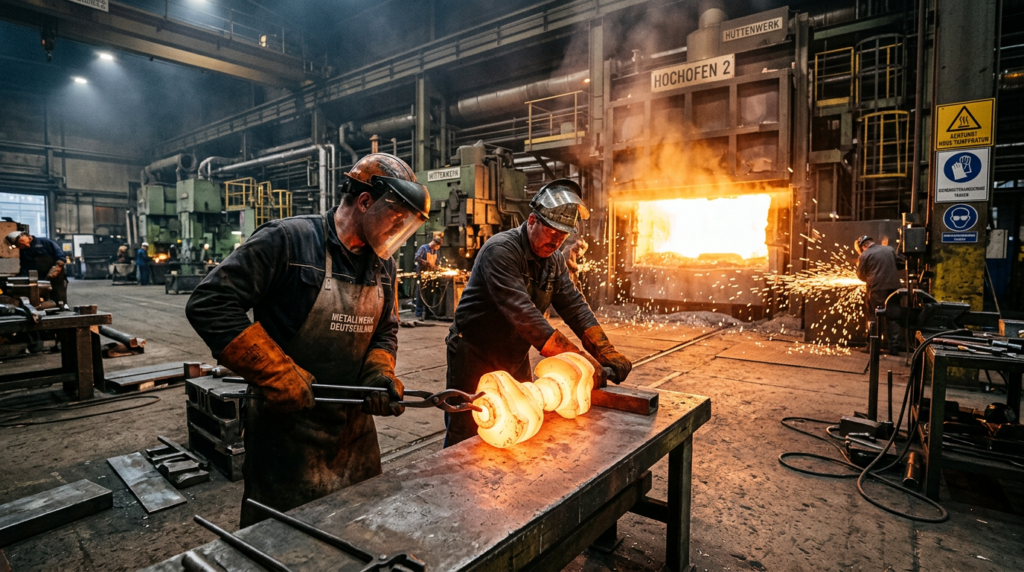
Based on our experience serving German clients across automotive, metal fabrication, chemical processing, and glass manufacturing, heat resistant gloves demand in this market centers on products that combine certified thermal performance (EN 407:2020) with mechanical durability (EN 388) — because workers handling hot metal parts, operating near furnaces, or managing molten material face simultaneous heat and cut/abrasion hazards. German buyers consistently prioritize three attributes: verified contact heat resistance at specific temperature thresholds (100°C–500°C), adequate dexterity for precision tasks, and multi-hazard protection in a single glove to reduce the need for frequent glove changes on the production line.
We have found that the German market strongly favors aramid-fiber (Kevlar) and para-aramid blended liner constructions for their inherent flame resistance and cut protection, paired with nitrile or latex coatings that maintain grip integrity at elevated temperatures. For heavy foundry and welding-adjacent applications, cow split leather gauntlets with Kevlar stitching remain the standard. In lighter thermal environments — such as automotive parts handling, bakery operations, and glass manufacturing — 13G or 15G knitted gloves with nitrile foam or PU palm coatings rated to EN 407 contact heat level 1–2 (up to 250°C) are the fastest-growing segment, as they provide thermal protection without sacrificing the finger dexterity German workers expect.
The following product types represent the highest-demand configurations we supply to the German market:
- 13G Kevlar/Spandex Liner with Nitrile Foam Palm Coating (EN 407: X1XXXX, EN 388 Cut Level D): The most popular dual-purpose heat and cut resistant glove in Germany. Aramid fiber provides inherent heat resistance to 250°C contact and cut protection simultaneously, while nitrile foam maintains grip on oily metal parts. Sizes S–XXL.
- 10G Aramid/Cotton Blend Liner with Latex Crinkle 3/4 Coating (EN 407: X2XXXX, EN 388 Cut Level C): A robust thermal handling glove for moderate-heat industrial tasks such as removing castings, handling hot pipes, and furnace-adjacent work. Contact heat level 2 (up to 250°C) with excellent abrasion resistance for sustained daily use.
- Cow Split Leather Gauntlet with Kevlar Stitching and Cotton Fleece Liner (EN 407: 41XX4X): The standard specification for foundry, welding-adjacent, and heavy metalwork in Germany. Flame resistance level 4, contact heat level 1, and molten metal splash protection. Gauntlet cuff protects wrist and lower forearm.
- 13G HPPE/Glass Fiber/Kevlar Blend with Sandy Nitrile Palm Coating + TPR Back-of-Hand (EN 407: X1XXXX, EN 388 Cut Level E, Impact P): A multi-hazard heat resistant glove for oil and gas, heavy manufacturing, and high-risk environments combining thermal, cut, and impact protection. Sandy nitrile provides exceptional grip on oily hot surfaces.
- 15G Nylon/Spandex Liner with PU Palm Coating (EN 407: X1XXXX, EN 388 Cut Level A): A lightweight heat resistant glove for precision assembly work involving brief contact with warm components up to 100°C. Popular in electronics manufacturing and automotive light-assembly lines where maximum dexterity is essential.
Why These Product Types Are Recommended
Each recommended heat resistant glove specification is engineered to meet EN 407:2020 — the European standard that defines thermal protection performance across six distinct hazard categories. EN 407 is the European standard that specifies the requirements and test methods for protective gloves that protect the wearer against thermal risks such as heat and/or fire. EN 407 is made up of six unique glove tests, each graded on a scale of zero to four. These six tests cover limited flame spread, contact heat resistance (100°C–500°C), convective heat resistance, radiant heat resistance, resistance to small splashes of molten metal, and resistance to large quantities of molten metal. For German industrial applications, contact heat resistance is the most commonly specified parameter, as it directly relates to handling hot parts, tools, and materials in manufacturing environments.
Aramid-fiber (Kevlar) liners outperform standard nylon and polyester in thermal environments because they are inherently flame-resistant and do not melt or drip when exposed to heat — a critical safety factor when EN 407 compliance is mandatory. Kevlar is a popular synthetic fibre used to make work gloves due to its strong heat-resistant properties, as well as additional cut protection properties. Combined with nitrile foam coatings, these gloves deliver excellent grip on oily and dry hot surfaces while maintaining the dexterity German automotive and precision manufacturing workers demand. The cost-effectiveness of knitted aramid-blend gloves versus leather gauntlets is significant — they typically last 2–4 weeks under daily moderate-heat handling, but at 30–50% lower per-pair cost, the total cost of ownership is competitive for applications below 250°C.
| Performance Parameter | 13G Kevlar/Nitrile Foam | 10G Aramid/Latex Crinkle | Leather Gauntlet | 13G Multi-Hazard + TPR |
|---|---|---|---|---|
| Primary Use | Heat Resistant Gloves for Auto/Manufacturing | Moderate-Heat Industrial Handling | Foundry / Welding-Adjacent Work | Oil & Gas / Heavy Manufacturing |
| EN 407 Contact Heat Level | 1 (100°C) | 2 (250°C) | 1 (100°C) | 1 (100°C) |
| EN 407 Flame Spread Level | X (not tested) | X (not tested) | 4 | X (not tested) |
| EN 388 Cut Level | D | C | N/A | E |
| Dexterity Rating (1–5) | 4 | 3 | 1 | 3 |
| Abrasion Resistance (Cycles) | 3,000+ | 4,000+ | 8,000+ | 4,000+ |
| Cost Per Pair (Bulk) | €1.80–€3.00 | €1.50–€2.50 | €4.00–€8.00 | €3.50–€6.50 |
Use this comparison table to match the right heat resistant gloves specification to your workers’ temperature exposure, mechanical hazard profile, and dexterity requirements.
- Kevlar vs. HPPE liners: Kevlar provides inherent heat resistance and flame retardancy; HPPE offers superior cut resistance but can melt at high temperatures unless blended with heat-resistant fibers.
- Nitrile foam vs. latex crinkle coatings: Nitrile foam performs better with oily hot components and offers higher temperature tolerance; latex crinkle excels in wet grip situations at moderate heat.
- Knitted vs. leather construction: Knitted gloves with coatings are ideal for repetitive handling tasks below 250°C where dexterity matters; leather gauntlets remain essential for foundry work, molten metal splash zones, and prolonged radiant heat exposure above 250°C.
Key Industries for Heat Resistant Gloves in Germany
Heat resistant gloves are essential PPE across Germany’s core industrial sectors, with procurement driven by both regulatory compliance under EU PPE Regulation 2016/425 and the practical demands of daily thermal exposure. The following industries generate the highest demand:
- Metal Fabrication & Foundry: Germany’s steel and aluminum foundries, die-casting plants, and forging operations expose workers to molten metal, radiant heat, and contact temperatures exceeding 300°C. Workers require leather gauntlet-style heat resistant gloves rated EN 407 with molten metal splash protection levels 3–4 and flame spread level 4.
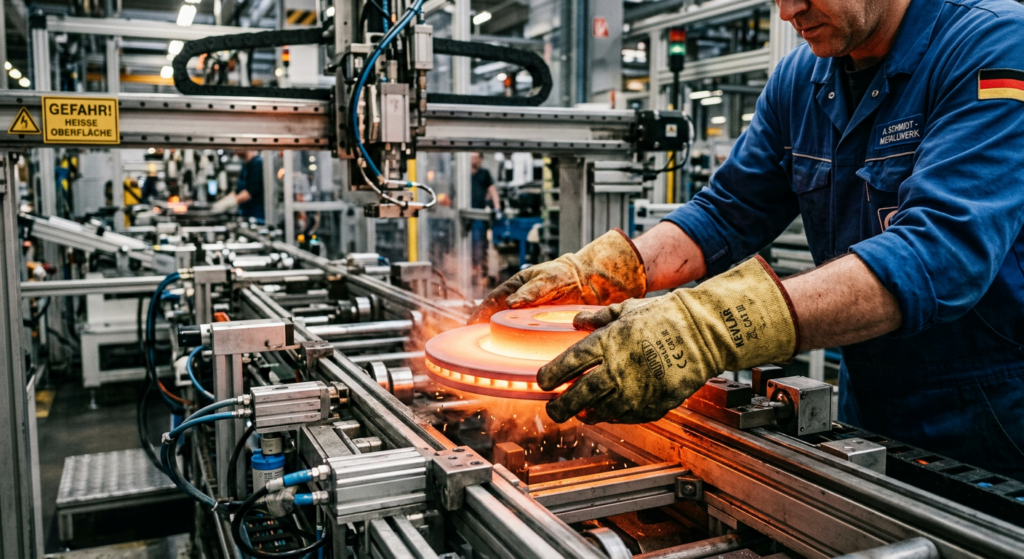
- Automotive Manufacturing: With over 800,000 workers in Germany’s automotive supply chain, thermal hazards arise in engine assembly, brake component handling, paint curing oven operations, and hot stamping lines. EN 407 contact heat level 1–2 gloves with nitrile foam or PU coatings are the standard specification, prioritizing dexterity alongside thermal protection.
- Chemical & Petrochemical Processing: Exothermic reactions, heated pipe systems, and steam exposure create sustained thermal hazards. Workers need heat resistant gloves that also provide chemical splash resistance — often dual-certified to EN 407 and EN 374.
- Glass Manufacturing: Glass forming, cutting, and tempering processes expose workers to contact temperatures from 150°C to over 500°C. Specialized high-temperature Kevlar or carbon fiber gloves with contact heat level 3–4 ratings are essential in this sector.
- Energy & Power Generation: Turbine maintenance, boiler operations, and electrical infrastructure work involve intermittent but intense heat exposure. Multi-hazard gloves combining EN 407 thermal protection with EN 388 cut and abrasion resistance are standard procurement items.
- Food Processing & Commercial Bakeries: Industrial ovens, fryers, and steam equipment create regular contact heat hazards. EN 407-rated gloves with food-safe coatings and silicone grip patterns are increasingly specified, particularly by large commercial bakery chains operating across Germany.
- Welding & Metal Joining: MIG, TIG, and plasma welding operations generate both radiant and convective heat alongside UV exposure and spatter. While EN 12477 (welding gloves) is the primary standard, many fabrication shops also procure EN 407-rated gloves for pre/post-weld handling tasks.
Increasing workplace safety awareness and strict regulatory compliance across industries like construction, healthcare, and manufacturing drive market demand. The enforcement of occupational safety standards and growth in industrial operations amplify the demand for high-performance safety gloves. Germany’s Berufsgenossenschaften (trade association for statutory accident insurance) actively enforces thermal hazard assessments in workplaces, and employers who fail to provide appropriately rated heat resistant gloves face increased insurance premiums and regulatory penalties. Germany’s robust automotive and chemical sectors are fueling demand for specialized gloves that boast a combination of protective features.
Specific Application Scenarios
Scenario 1: Aluminum Die-Casting Plant in Baden-Württemberg
A 60-person production team operates a high-pressure aluminum die-casting facility supplying parts for the automotive sector. Workers extract freshly cast components at temperatures of 200–350°C from die-casting machines, perform deburring on warm parts, and handle hot runners and sprues throughout 8-hour shifts. Primary hazards include contact burns from hot metal surfaces, radiant heat from open mold cavities, and small aluminum splash during mold release. The plant’s HSE team specifies 10G aramid/cotton blend liner with latex crinkle 3/4 coating, rated EN 407: X2XXXX and EN 388: 3X42C. This configuration provides contact heat resistance up to 250°C, excellent grip for extracting parts from molds, and adequate cut protection for deburring operations. The facility consumes approximately 2,400 pairs per month across three shifts.
Scenario 2: Industrial Bakery Operation in Bavaria
A large-scale commercial bakery produces 80,000 loaves and rolls daily using conveyor-fed tunnel ovens operating at 280°C. Some 35 production workers load and unload baking trays, adjust oven conveyors, clean hot surfaces, and handle steam-generating equipment. The primary hazards are contact heat burns from oven doors and trays (120–180°C), steam scalds, and repetitive abrasion from metal tray edges. The bakery specifies 13G Kevlar/spandex liner with nitrile foam palm coating, rated EN 407: X1XXXX, EN 388: 4131B, and certified food-safe. Dexterity is critical — workers must be able to manipulate small dough products and operate touchscreen process controls without removing gloves. The bakery replaces approximately 500 pairs per month across all shifts and lines.
Scenario 3: Steel Fabrication Workshop in North Rhine-Westphalia
A structural steel fabrication shop employs 25 welders and fitters producing bridge components and building frames. Workers perform flame cutting, plasma cutting, MIG welding, and post-weld grinding, facing simultaneous exposure to molten metal spatter, radiant heat from cutting torches (800°C+), and sharp metal edges. The workshop specifies cow split leather gauntlets with Kevlar stitching and cotton fleece liner, rated EN 407: 41XX4X, providing flame resistance level 4 and resistance to small splashes of molten metal level 4. For post-weld handling of warm (but not glowing) components, fitters use 13G HPPE/Kevlar blend gloves with sandy nitrile coating, rated EN 407: X1XXXX and EN 388: 4X44E, giving them the dexterity to perform bolting and fitting operations on components that are still warm to the touch. The workshop consumes 150 pairs of leather gauntlets and 300 pairs of knitted thermal gloves per month.
Case Studies
Case 1: Automotive Tier-1 Supplier in Stuttgart Region
A Tier-1 automotive supplier producing exhaust system components needed 80,000 pairs annually of dual-certified heat and cut resistant gloves for workers handling hot-stamped metal parts at 150–220°C. Their previous supplier delivered inconsistent EN 407 contact heat ratings between production batches, causing HSE audit failures. After partnering with a vertically integrated factory-direct manufacturer offering in-line EN 407 testing and batch traceability, the supplier achieved verified compliance, reduced per-pair cost by 22%, and shortened lead times from 8 weeks to 5 weeks with private-label packaging.
Case 2: Industrial Glass Manufacturer in Thuringia
A specialty glass producer required 12,000 pairs annually of high-temperature Kevlar gloves rated to EN 407 contact heat level 3 (350°C) for furnace operators, plus 6,000 pairs of dexterity-focused EN 407 level 1 gloves with PU coating for quality inspection staff handling warm glass products. A factory partner delivered both specifications within 30 days, including custom branding, EU Declaration of Conformity documentation, and REACH compliance certificates — enabling seamless integration into the customer’s ISO 45001 procurement framework.
Top 6 Recommended Local Suppliers in Germany
| Company Name | Core Strengths | Service Regions | Pre-sale Support | After-sale Support |
|---|---|---|---|---|
| HitzeSchutz Industrie GmbH | Deep Heat Resistant Gloves portfolio, foundry and metalwork specialist | Baden-Württemberg, Bavaria, Hessen | On-site thermal hazard assessments, EN 407 product matching | Dedicated account manager, batch traceability reports |
| RheinFlame PPE Vertrieb | Broad EN 407 catalog, strong automotive industry network | NRW, Rhineland-Palatinate, Saarland | Tender documentation, multi-spec sample kits | Annual quality reviews, rapid warranty processing |
| NordTherm Arbeitsschutz | Heat Resistant Gloves for food processing and bakery sectors | Northern Germany (Hamburg, Lower Saxony, Schleswig-Holstein) | Food-safety compliance guidance, technical consultation | Seasonal restocking programs, field trial coordination |
| OstGlut Schutzhandschuhe | Cost-effective bulk thermal gloves for construction and manufacturing | Eastern Germany (Saxony, Brandenburg, Thuringia) | MOQ flexibility, mixed-spec container options | Defect resolution protocols, replacement shipping |
| FlammGuard PPE Solutions | E-commerce fulfillment specialist for Heat Resistant Gloves, Amazon.de integration | Pan-European via Leipzig hub | Product listing support, FBA logistics coordination, photography | Returns management, customer service integration |
| AlpenHitze Handschutz GmbH | Specialized multi-hazard thermal + impact gloves for oil & gas and energy | Nationwide (focus on industrial corridor) | Hazard-specific engineering, pilot program management | Performance dashboards, KPI-based reorder programs |
When evaluating heat resistant gloves suppliers, always verify that EN 407:2020 test reports are issued by an EU-accredited notified body, and request contact heat resistance test data specific to the palm area, as this is the primary protection zone for handling tasks.
Why Choose Snell Safety as Your Global Partner
Snell Safety combines deep German market expertise with advanced thermal glove manufacturing to deliver heat resistant gloves precisely engineered for local industrial conditions. Through years of collaboration with German distributors, automotive suppliers, metal fabrication shops, and food processing companies, we have developed detailed knowledge of what performs best — from the optimal Kevlar-blend ratios and nitrile foam formulations favored by Stuttgart’s automotive plants to the leather gauntlet constructions that meet the exacting standards of Ruhr Valley foundries. We understand local hand feel preferences, dexterity expectations, and the dual-certification requirements (EN 407 + EN 388) that German HSE departments mandate. We maintain established local partners in Germany and are actively building overseas warehouse capacity for in-stock, ready-to-ship thermal glove supply. Distributors, agents, and e-commerce brand owners are invited to join our growing partner network, with full pre-sale empowerment (product selection guidance, technical training, market intelligence), after-sale support (quality assurance, replacement policies), dropshipping services, free samples, and marketing material support.
Our two manufacturing facilities run 6 dedicated production lines with a daily capacity of 150,000 pairs, powered by a vertically integrated process from R&D and material sourcing through knitting, coating/dipping, drying/curing, quality inspection, and export packaging. With over a decade of expertise in diversified coating technologies — including nitrile foam, nitrile micro-foam, sandy nitrile, latex crinkle, and PU — plus advanced cut-resistant and impact-resistant glove engineering, we deliver the quality consistency, ISO 9001/CE compliance, and competitive factory-direct pricing that German buyers demand. Explore our full product catalog or contact our team to request samples and discuss custom thermal glove specifications for your market.
FAQ
What EN 407 contact heat level do I need for automotive manufacturing in Germany?
For most automotive assembly and parts handling tasks involving components at 80–150°C, EN 407 contact heat level 1 (100°C threshold) is sufficient. For hot stamping, die-casting extraction, or brake rotor handling exceeding 150°C, specify contact heat level 2 (250°C). Always verify the test was performed on the palm area.
Which coating is best for handling hot oily metal parts?
Nitrile foam coating provides the best combination of oil resistance, grip, and heat tolerance for handling warm oily metal parts up to 100–150°C. Sandy nitrile offers enhanced grip on heavily oiled surfaces. Avoid PU coatings for prolonged heat contact, as they degrade faster at elevated temperatures than nitrile formulations.
What does the EN 407 six-digit rating mean for heat resistant gloves?
The EN 407 pictogram displays six performance levels (0–4 each, with X meaning not tested) representing: limited flame spread, contact heat, convective heat, radiant heat, small molten metal splashes, and large molten metal splashes. A higher number indicates greater protection. Not all tests must be passed — only those relevant to the intended application.
How do I choose between knitted and leather heat resistant gloves?
Choose 13G–15G knitted Kevlar-blend gloves with nitrile or PU coating for repetitive handling tasks below 250°C where dexterity is important. Select leather gauntlets for foundry work, welding-adjacent tasks, or any application involving molten metal splash, sustained radiant heat above 250°C, or open flame proximity.
What is the bulk price range for heat resistant gloves in Germany?
Standard 13G Kevlar/nitrile foam heat resistant gloves range from €1.80–€3.00 per pair FOB for orders above 10,000 pairs. Dual-certified (EN 407 + EN 388) multi-hazard gloves cost €3.00–€6.50 per pair. Leather gauntlets with Kevlar stitching range from €4.00–€8.00 per pair. OEM private-label branding adds approximately €0.05–€0.15 per pair.
What certifications are required to import heat resistant gloves into Germany?
Heat resistant gloves sold in Germany must comply with EU Regulation 2016/425. Thermal protection gloves are classified as Category II or Category III PPE (depending on protection level), requiring EU Type Examination by a notified body, EN 407:2020 test reports, and an EU Declaration of Conformity. EN 388:2016+A1:2018 is additionally required if claiming mechanical protection. REACH compliance documentation is also mandatory.
How long do heat resistant gloves typically last in industrial use?
Under daily moderate-heat handling (100–200°C contact) in German manufacturing environments, 13G Kevlar/nitrile foam gloves typically last 2–4 weeks before coating degradation or liner wear-through. Leather gauntlets in foundry applications last 4–8 weeks with proper maintenance. Replace immediately if coating shows cracking, hardening, or delamination, as thermal insulation is compromised.
Can heat resistant gloves also provide cut resistance?
Yes. Dual-certified gloves combining EN 407 thermal protection with EN 388 cut resistance are widely available and increasingly standard in Germany. These use Kevlar, HPPE, or glass fiber blended with aramid in the liner, achieving cut levels C–F while maintaining contact heat level 1–2. They are standard specifications for automotive, metal fabrication, and glass manufacturing applications.
What gauge is best for heat resistant gloves requiring high dexterity?
For precision assembly involving brief heat contact (up to 100°C), choose 15G for maximum dexterity. For moderate-heat handling tasks requiring good tactile sensitivity, 13G offers an excellent balance. For heavy-duty thermal work, 10G provides thicker insulation at the cost of reduced finger sensitivity. The gauge directly affects both dexterity and insulation thickness.
Are touchscreen-compatible heat resistant gloves available?
Yes. Conductive yarn or conductive PU coating on thumb and index fingertips enables operation of HMI panels, tablets, and process control screens without glove removal. These are typically built on 13G–15G aramid-blend platforms with nitrile foam or PU palm coating rated EN 407 contact heat level 1. The additional cost is minimal at €0.05–€0.10 per pair for bulk orders.
Ready to source high-performance heat resistant gloves for the German market? Whether you are an end-user enterprise requiring direct factory supply, a distributor expanding your thermal protection portfolio, or an e-commerce brand owner building a heat-safety product line, Snell Safety is ready to support you with expert guidance, competitive pricing, and full EN 407/EN 388 certification documentation. Submit your requirements or request a quote today — including free samples, custom specifications, and dedicated technical consultation.
Content reviewed and updated: March 2026