Best Cut Resistant Gloves Suppliers in Russia | 2026 Guide
March 18, 2026
Share This Article
For procurement managers and safety officers sourcing cut resistant gloves in Russia, choosing the right supplier is critical to worker safety, regulatory compliance, and cost efficiency. Whether you operate in construction, oil and gas, manufacturing, or metal fabrication, this guide covers the top product configurations, recommended suppliers, key industries, and real-world application scenarios — everything you need to make an informed purchasing decision in the Russian market.
If you need immediate product selection guidance or a custom quotation tailored to Russian workplace conditions, contact our team — Snell Safety has extensive experience serving clients across Russia and can recommend optimal configurations for your specific needs.

Quick Answer
The best cut resistant gloves suppliers in Russia include established domestic PPE distributors such as Technoavia and Alvatex, which offer region-specific products tailored to local regulations. For broader selection and competitive pricing, Chinese manufacturers who specialize in customized products with competitive pricing and full international certifications (ISO/CE) are an excellent option — particularly for OEM/ODM buyers seeking high-volume, factory-direct procurement with flexible MOQs.
Market Overview of Cut Resistant Gloves in Russia
The Russia safety gloves market is projected to grow significantly, increasing from USD 289.31 million in 2023 to an estimated USD 433.69 million by 2032, reflecting a CAGR of 4.58% from 2024 to 2032. This growth is driven by tightening workplace safety enforcement and expansion in heavy industry. The Russia PPE market is forecast to grow at 7.19% CAGR from 2026–31, fueled by industrial expansion and rising workplace safety requirements.
Russia’s regulatory landscape has become significantly more demanding in recent years. All employees whose working conditions are recognized as harmful must now be provided with PPE, following amendments to the Labour Code that came into force on 1 March 2022. The Russian government reports that approximately 190,000 workers are employed in hazardous industries, with around 15,000 fatalities directly linked to occupational injuries — highlighting the urgent need for compliance with regulations like GOST and EN certifications. Globally, gloves retained 28.82% of the personal protective equipment market share in 2025, underscoring that hand protection remains the single largest PPE category.
What Types of Cut Resistant Gloves Are Needed in Russia
Based on our experience serving Russia clients across construction, oil and gas, manufacturing, and logistics, we have identified a clear pattern: Russian buyers demand cut resistant gloves that balance high cut protection with cold-weather durability and chemical resistance. The harsh continental climate — with temperatures plummeting well below −20 °C in Siberia and the Urals during winter — means that standard single-layer cut gloves are often insufficient. Workers need gloves that retain flexibility and grip in freezing conditions while providing EN 388 cut levels C through F (or ANSI A4–A7).
We also observe strong demand for oil-repellent coatings, since Russia’s massive oil and gas sector requires gloves that maintain grip in hydrocarbon-contaminated environments. Sandy nitrile and nitrile foam coatings are the most requested finishes for oilfield and refinery applications, while PU palm coatings dominate in precision assembly and automotive manufacturing. From our collaborations with large distributors in Moscow, Yekaterinburg, and Novosibirsk, the following product types represent the highest-demand configurations:
- HPPE/Glass Fiber Liner + Sandy Nitrile Palm Coat (13G, EN 388 Cut Level D/E): The workhorse glove for oil and gas, mining, and heavy construction. Sandy nitrile provides superior wet and oily grip, while the 13G HPPE liner delivers excellent cut resistance with good dexterity. Sizes M–XXL are most common in Russia.
- HPPE/Spandex Liner + Nitrile Foam 3/4 Coating (15G, EN 388 Cut Level C/D): Preferred for automotive and precision manufacturing. The 15G gauge and foam nitrile finish offer exceptional tactile sensitivity and breathability for extended wear during 10–12 hour shifts.
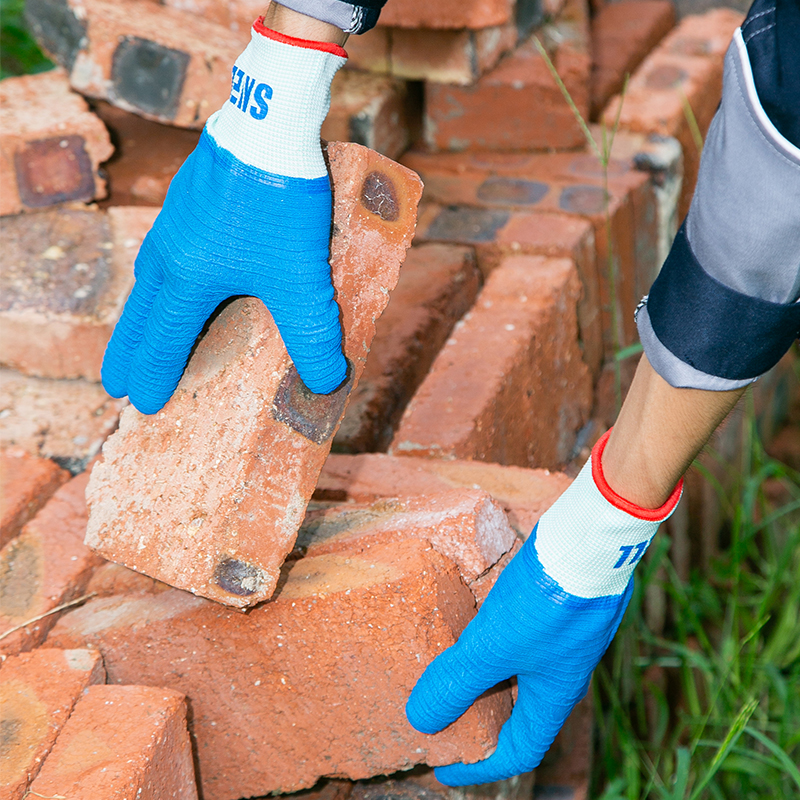
- Kevlar/Steel Wire Liner + Latex Crinkle Palm Coat (10G, EN 388 Cut Level E/F): Heavy-duty option for metal fabrication, glass handling, and demolition. The 10G construction provides maximum cut and puncture resistance, while the crinkle latex coating ensures reliable grip in wet conditions.
- HPPE/Nylon Liner + PU Palm Coat (18G, EN 388 Cut Level B/C): Lightweight precision glove for electronics assembly, quality inspection, and light manufacturing. The 18G ultra-fine gauge is popular with touchscreen-compatible variants for digital shop-floor workflows.
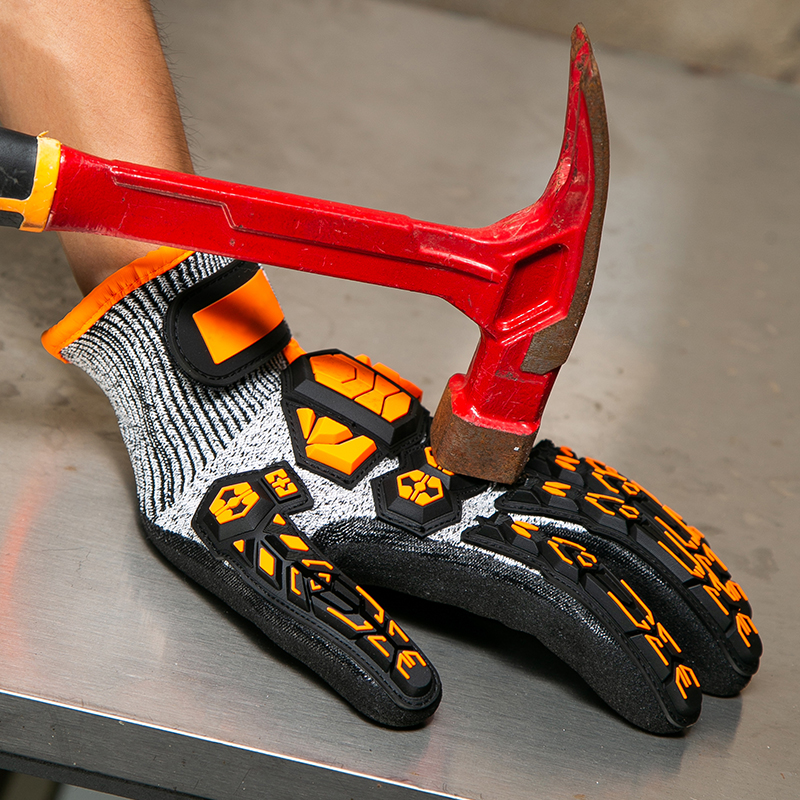
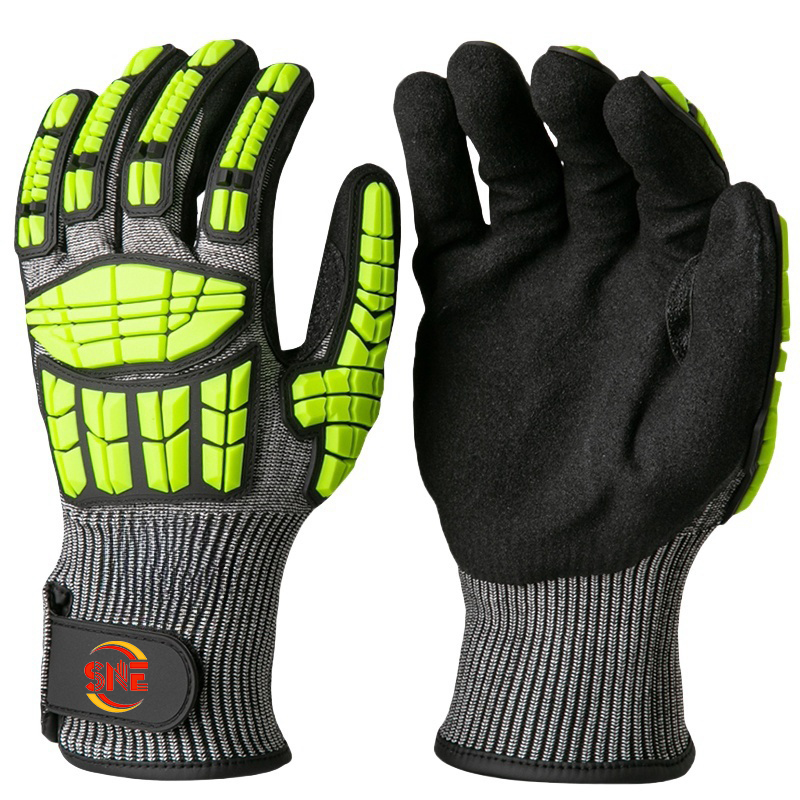
- HPPE Liner + Nitrile Micro-Foam Full Coat + TPR Back-of-Hand (13G, EN 388 Cut Level D, Impact Resistant): Specifically designed for oil rig roughnecks, pipeline workers, and mining crews. TPR (thermoplastic rubber) dorsal protection shields knuckles and fingers from impact hazards. This is the fastest-growing category among our Russian orders.
These configurations reflect the real-world conditions Russian workers face: extreme cold, oily surfaces, sharp metal edges, and high-impact hazards requiring multi-threat protection.
Why These Cut Resistant Glove Types Are Recommended
The recommended specifications above are not arbitrary — they are grounded in performance standards, durability testing, and cost-effectiveness analysis tailored to Russian industrial conditions. Under the EN 388:2016+A1:2018 standard, cut resistance is measured using the TDM (coup) test and reported on a scale from A (lowest) to F (highest). For most heavy industrial applications in Russia — construction, oil and gas, metal fabrication — a minimum cut level of D (equivalent to ANSI A4–A5) is needed to protect against sheet metal edges, wire rope, and sharp tools. For glass handling and demolition, levels E and F are warranted.
The coating type directly influences grip performance, chemical resistance, and wear life. Sandy nitrile coatings typically achieve 3,000+ abrasion resistance cycles under EN 388 testing, making them ideal for rough handling in oily conditions. Nitrile foam and micro-foam coatings offer excellent breathability, which is critical for extended shifts where worker comfort determines compliance — studies indicate that poor glove comfort is a leading reason workers remove protective equipment. Latex crinkle coatings deliver outstanding wet grip but may present latex allergy concerns for some workers, making nitrile alternatives increasingly popular.
| Specification | Sandy Nitrile (13G HPPE) | Nitrile Foam (15G HPPE) | Latex Crinkle (10G Kevlar) | PU Palm (18G HPPE) | Nitrile Micro-Foam + TPR (13G HPPE) |
|---|---|---|---|---|---|
| EN 388 Cut Level | D/E | C/D | E/F | B/C | D |
| Abrasion Resistance | 3,000+ cycles | 2,500+ cycles | 3,500+ cycles | 2,000+ cycles | 3,000+ cycles |
| Oil Grip | Excellent | Good | Moderate | Poor | Excellent |
| Dexterity Rating | Good | Excellent | Moderate | Superior | Good |
| Impact Protection | No | No | No | No | Yes (TPR) |
| Cold Suitability | Good | Moderate | Good | Poor | Good |
| Cut Resistant Gloves Category | Heavy-duty industrial | Precision assembly | Metal fabrication | Light manufacturing | Oil & gas / mining |
Use this table to match your specific application requirements with the optimal coating and liner combination for your cut resistant gloves procurement.
From a cost-effectiveness perspective, 13G sandy nitrile gloves typically last 2–4 weeks in heavy industrial use, offering the best balance of protection and per-pair cost for bulk buyers. The 15G nitrile foam variants may cost 10–15% more per pair but deliver measurably better dexterity, reducing error rates in precision tasks — a trade-off that many Russian automotive and electronics manufacturers find worthwhile.
Key Industries for Cut Resistant Gloves in Russia
Russia’s industrial landscape creates massive, diversified demand for cut resistant gloves. The country’s resource-extraction economy, large-scale construction activity, and growing manufacturing base all require specialized hand protection. Here are the top industries driving demand:
- Oil & Gas and Petrochemical: Russia is one of the world’s largest oil and gas producers, with operations spanning Western Siberia, the Urals, and Arctic shelf projects. Workers handle drill pipe, wire rope, sheet metal flanges, and hydrocarbon-coated equipment daily. Cut resistant gloves with sandy nitrile or nitrile micro-foam coatings and TPR impact protection (EN 388 Level D–E) are essential for roughnecks, pipeline welders, and refinery maintenance crews.
- Construction and Infrastructure: Russia’s ongoing infrastructure modernization — including transportation corridors, residential complexes, and industrial zones — employs millions of workers exposed to rebar, concrete forms, glass panels, and power tools. Cut levels C–E with latex crinkle or nitrile foam coatings are standard. Construction workers account for 24% of workplace fatalities in Russia, followed by manufacturing at 15%.
- Metal Fabrication and Manufacturing: Steel mills, aluminum smelters, and precision machining facilities across the Urals and Central Federal District require gloves that protect against sharp burrs, stamping edges, and lathe chips. HPPE and Kevlar liners at cut levels D–F are standard issue.
- Mining and Mineral Extraction: Russia’s vast mining operations — coal in Kuzbass, nickel in Norilsk, gold in Yakutia — expose workers to jagged ore, heavy machinery, and extreme cold. Impact-resistant cut gloves (TPR + HPPE liner, 13G) are the standard specification for underground and open-pit operations.
- Automotive and Aerospace Manufacturing: Growing domestic automotive production and aerospace assembly demand precision-fit 15G and 18G cut resistant gloves with PU or nitrile foam palm coatings for parts handling, stamping, and final assembly.
- Logistics and Warehousing: The rapid expansion of e-commerce and distribution networks across Russia means warehouse workers increasingly handle boxed goods with sharp edges, banding straps, and cutting tools. General-purpose cut resistant gloves at EN 388 Level B–C provide cost-effective protection for high-volume distribution centers.
Awareness of occupational hazards has surged among employers and workers in Russia, driven by campaigns from government bodies, labor unions, and industry organizations — reflected in the increasing demand for specialized gloves tailored for specific applications. Government procurement initiatives and the enforcement of the amended Labour Code are accelerating PPE adoption, particularly in previously underserved sectors like agriculture and food processing. Russia’s push to modernize domestic manufacturing under import-substitution policies is also creating new demand for high-specification safety gloves in advanced production environments.
Specific Application Scenarios for Cut Resistant Gloves
Scenario 1: Pipeline Maintenance on a Western Siberian Oil Field
A pipeline maintenance crew near Surgut operates in temperatures ranging from −35 °C in winter to +30 °C in summer. Workers use angle grinders, pipe cutters, and manual wrenches to repair and replace corroded pipeline sections. Hazards include sharp metal edges on pipe flanges, flying metal debris, oily surfaces, and crush/impact risks from heavy pipe sections. The recommended specification is a 13G HPPE liner with nitrile micro-foam full coating and TPR back-of-hand protection, rated EN 388 Cut Level D with Level 2 impact resistance. The full-dip coating provides all-around oil resistance, while the micro-foam finish maintains grip even when gloves are contaminated with crude oil residue. For winter operations, a fleece-lined thermal variant at 10G gauge is specified.
Scenario 2: Steel Sheet Stamping at an Automotive Plant Near Togliatti
On the stamping line, operators load flat steel blanks into 500-ton presses, remove formed parts, and perform visual quality checks. The primary hazard is laceration from razor-sharp stamped edges — a single unprotected hand contact with a blank can cause a deep cut requiring stitches and weeks of lost work time. Workers need high dexterity to position blanks precisely and operate touchscreen control panels. The recommended specification is a 15G HPPE/spandex liner with nitrile foam palm coating, rated EN 388 Cut Level C, with touchscreen-compatible fingertips. The ultra-thin 15G gauge gives operators near-bare-hand tactile sensitivity while the HPPE fibers provide reliable cut protection against sheet metal edges.
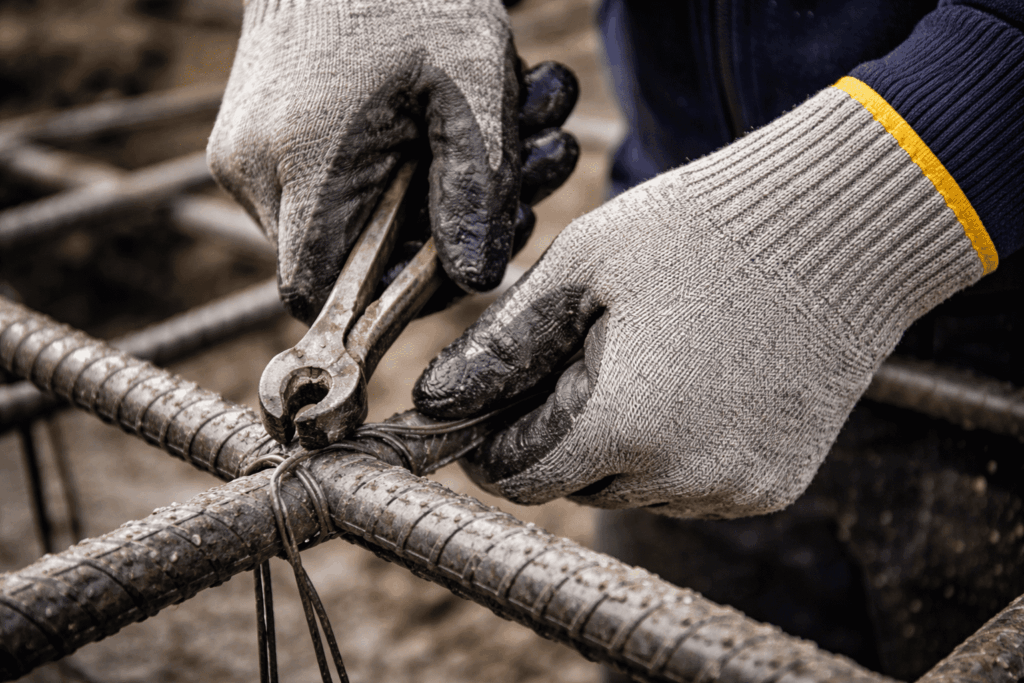
Scenario 3: Rebar Tying on a Moscow High-Rise Construction Site
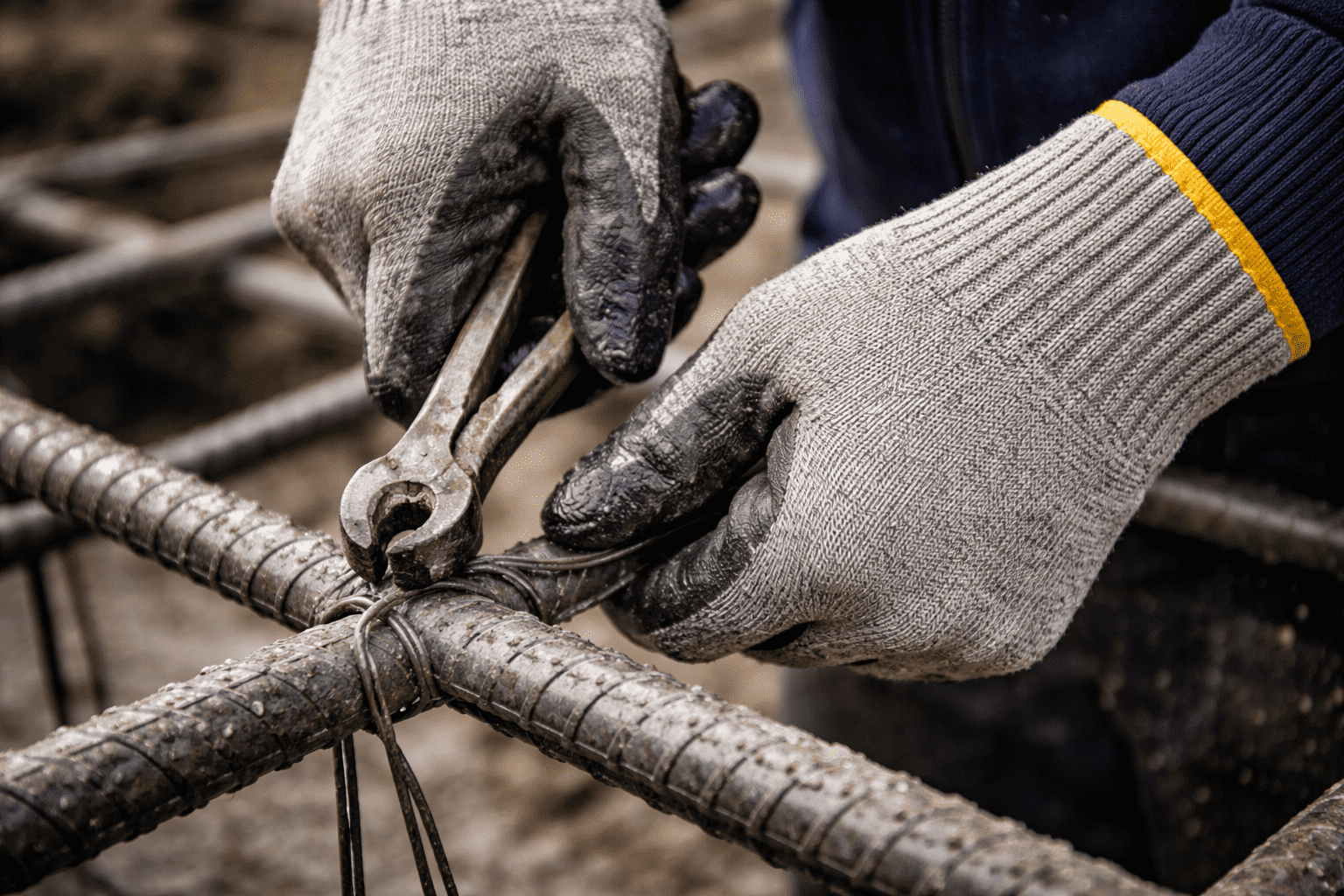
Ironworkers on a high-rise project handle, cut, and tie thousands of rebar pieces daily. The steel rebar ends are sharp and often coated with rust or concrete dust, creating both laceration and abrasion hazards. Workers also operate hand-held rebar cutters and tying tools in rain and cold. The recommended specification is a 13G HPPE/glass fiber liner with sandy nitrile palm coating, rated EN 388 Cut Level E. Sandy nitrile excels in dusty, damp conditions by channeling moisture away from the grip surface. The 13G gauge provides a solid balance of cut protection and dexterity for repetitive hand tasks like wire tying.
Case Studies
Siberian Oil Services Company — Bulk Cut Resistant Gloves Deployment
A major oilfield services company operating across three Western Siberian production sites needed 50,000 pairs of impact-resistant cut gloves per quarter. We supplied 13G HPPE/nitrile micro-foam gloves with TPR dorsal protection, customized with their corporate branding under our OEM program. The client reported a 40% reduction in recordable hand injuries within six months and extended the contract to include cold-weather thermal variants.
Moscow-Region Construction Distributor — Private Label Program
A PPE distributor serving over 200 construction contractors in the Moscow region launched a private label line of cut resistant gloves. We manufactured three SKUs — 13G sandy nitrile (Level D), 10G latex crinkle (Level E), and 15G nitrile foam (Level C) — with custom packaging in Russian. The distributor achieved 30% better margins compared to previous sourcing, with consistent quality across all deliveries.
Top 6 Recommended Local Suppliers in Russia
| Company Name | Core Strengths | Service Regions | Pre-sale Support | After-sale Support |
|---|---|---|---|---|
| UralZashchita PPE | Wide range of industrial Cut Resistant Gloves; strong logistics network | Urals, Western Siberia | Product catalogs, on-site consultations | Defect replacement, restocking programs |
| MosPromSnab | Large inventory, fast delivery from Moscow warehouse | Central Federal District, Moscow | Technical spec sheets, sample provision | 30-day return policy, quality complaint hotline |
| SibirSafety Group | Specializes in extreme-cold PPE including thermal cut gloves | Siberia, Far East | Cold-weather product selection guidance | Seasonal exchange programs, warranty support |
| NevaProtect | Focus on oil & gas PPE, EAC-certified product lines | Northwest Russia, St. Petersburg | Hazard assessment consultation, EN 388 compliance guidance | On-site quality audits, dedicated account managers |
| VolgaTrade Industrial | Competitive bulk pricing, strong relationships with Chinese manufacturers | Volga Region, Central Russia | Bulk quotation support, Cut Resistant Gloves spec comparison | Inventory management, reorder automation |
| KavkazProm Safety | Growing presence in southern Russia, agricultural and construction focus | Southern Federal District, North Caucasus | Bilingual support (Russian/English), product training | Regional warehousing, expedited replacement shipping |
When evaluating local suppliers, always verify EAC/GOST-R certification documentation, request third-party test reports for EN 388 cut resistance ratings, and order production samples before committing to large volumes.
Why Choose Snell Safety as Your Global Partner
Snell Safety stands apart through deep local market expertise in Russia. Through years of collaboration with Russian distributors, construction companies, and oil and gas procurement teams, we have developed a precise understanding of what works in Russian conditions — from the coating durability needed for Siberian cold to the hand-feel preferences of workers on Moscow construction sites. We already have established local partners in key Russian regions and are actively planning overseas warehousing to enable stock-ready, rapid-delivery supply. We are recruiting new distributors and agents across Russia, offering comprehensive pre-sale support (product selection guidance, technical training, market intelligence) and after-sale empowerment (quality assurance, replacement policies, ongoing assistance). For e-commerce brand owners, we provide dropshipping services, free product samples, and marketing material support including professional photography and listing content.
On the manufacturing side, Snell Safety brings over a decade of hands-on cut resistant glove production expertise, with 6 dedicated production lines and a daily capacity of 150,000 pairs. Our factory-direct B2B model eliminates middlemen, delivering ISO 9001 and CE-certified gloves at genuinely competitive pricing. We offer full OEM/ODM customization — liners, coatings, gauges, branding, packaging — with vertically integrated production from knitting through dipping, curing, quality inspection, and export packaging.
Whether you are an end-user enterprise seeking direct factory supply for your Russian operations, a distributor looking to expand your cut resistant gloves portfolio, or an e-commerce seller building a PPE brand, contact our team to discuss partnership opportunities. Explore our full product catalog for detailed specifications.
FAQ: Cut Resistant Gloves for the Russian Market
What cut level do I need for construction work in Russia?
For general construction tasks like rebar handling and formwork, EN 388 Cut Level D (ANSI A4–A5) is recommended. For demolition and glass handling, Level E or F provides additional protection. Always conduct a site-specific hazard assessment to determine the minimum required cut level.
Which coating is best for oily environments in Russian oil fields?
Sandy nitrile and nitrile micro-foam coatings are the top choices for oil-contaminated environments. Sandy nitrile provides the best grip on oily metal surfaces, while micro-foam offers a softer feel with good oil resistance. PU and latex coatings are not recommended for hydrocarbon exposure.
What does the EN 388 rating mean for cut resistant gloves?
EN 388:2016 rates gloves on six performance criteria: abrasion resistance (cycles), cut resistance (coup test), tear resistance (Newtons), puncture resistance (Newtons), TDM cut resistance (levels A–F), and impact protection (P = pass). The TDM cut level A–F is the primary indicator for cut resistant gloves selection.
How do I choose the right gauge for my industry?
Heavier gauges (7G, 10G) offer maximum protection for heavy-duty tasks like metal fabrication and mining. Medium gauges (13G) balance protection and dexterity for construction and oil and gas. Fine gauges (15G, 18G) suit precision assembly, electronics, and automotive manufacturing where tactile sensitivity is critical.
What certifications are required to import safety gloves into Russia?
Safety gloves classified as PPE must comply with EAEU Technical Regulation TR CU 019/2011 “On the Safety of Personal Protective Equipment.” An EAC Certificate or Declaration of Conformity is required for customs clearance. Products must also meet applicable GOST standards. CE and ISO 9001 certifications strengthen compliance documentation.
What is the typical price range for bulk cut resistant gloves orders?
Bulk pricing for cut resistant gloves varies by specification: basic 13G HPPE/PU palm gloves range from USD 0.80–1.50 per pair for orders of 10,000+ pairs. Premium impact-resistant TPR models with nitrile micro-foam coating range from USD 2.00–4.00 per pair. Factory-direct sourcing from manufacturers typically saves 20–35% versus distributor pricing.
How long do cut resistant gloves typically last in heavy industrial use?
In heavy-duty applications like construction and metal fabrication, quality 13G HPPE cut resistant gloves with nitrile coating typically last 2–4 weeks of daily use. In lighter applications like logistics and assembly, the same gloves can last 4–8 weeks. Replace gloves immediately if the coating is worn through or if the liner shows visible fiber damage.
Can cut resistant gloves be used in cold Russian winter conditions?
Standard single-layer cut resistant gloves provide limited cold protection. For winter operations, specify thermal-lined variants with fleece or acrylic inner linings, typically at 10G or 7G gauge. Some manufacturers offer dual-layer systems with a cut-resistant shell over a thermal liner. Nitrile and latex coatings retain flexibility better than PU in sub-zero temperatures.
What is the minimum order quantity for custom-branded cut resistant gloves?
MOQs for OEM/ODM cut resistant gloves from Chinese manufacturers typically start at 3,000–5,000 pairs per SKU for custom specifications and branding. For standard catalog products without customization, some factories accept orders as low as 1,000 pairs. Private label packaging minimum quantities may differ from glove production MOQs.
How do I verify the cut resistance rating of gloves before purchasing?
Request the original EN 388 test report from an accredited laboratory (notified body). The report should reference the specific glove model and show TDM coup test results with corresponding cut level classification. Reputable manufacturers provide these documents proactively. For additional confidence, send samples to an independent testing laboratory for verification.
Content reviewed and updated: March 2026