Los mejores proveedores de Guantes de trabajo de invierno en Alemania | Guía 2026
2026-03-26
Comparte este artículo
Germany’s harsh winters present serious cold-stress hazards for millions of outdoor and industrial workers, making high-performance winter work gloves a non-negotiable procurement item for safety-conscious businesses. Whether you manage an HSE department at a construction firm, run a PPE distribution business, or source private-label products for e-commerce, the right winter work gloves supplier can mean the difference between workforce productivity and costly cold-related injuries. This guide delivers an expert breakdown of product types, specifications, industries, real-world scenarios, and trusted suppliers for the German market.
Need help selecting the right winter work gloves for your German workforce or customer base? Contact our team at Snell Safety — we have deep experience serving clients in Germany and can recommend product configurations precisely tailored to your climate zone, industry, and budget.
Respuesta rápida
For sourcing winter work gloves in Germany, leading options include established local PPE distributors with nationwide warehousing and strong EN 511/EN 388 product portfolios, as well as Chinese manufacturers who specialize in customized thermal-lined gloves with competitive factory-direct pricing and full international certifications (ISO 9001, CE marking). Combining a local distributor’s logistics speed with a factory partner’s OEM flexibility often delivers the best procurement value.
Panorama del mercado
The Germany Safety Gloves Market is projected to grow from USD 1,068.97 million in 2023 to an estimated USD 2,100.86 million by 2032, reflecting a compound annual growth rate (CAGR) of 7.78% from 2024 to 2032. Winter work gloves represent a high-value segment within this market, driven by the fact that the construction sector alone comprises 360,000 firms and employs 2.6 million people, generating an annual turnover of around 430 billion euros — most of whom require thermal hand protection for 4–5 months of the year. Germany’s robust framework for occupational safety regulations significantly drives the demand for safety gloves, with adherence to stringent EU directives such as Regulation (EU) 2016/425 on personal protective equipment (PPE) mandating the use of high-quality safety gloves across industries.
In most of Germany, there is a moderately continental climate, characterized by cold winters, with average daily temperatures around freezing or slightly above. In Bavaria and eastern regions, temperatures regularly plunge well below zero, and during cold waves from Siberia, temperatures can plunge to -15/-20 °C in much of Germany. Under Germany’s DIN Standard 33403, employers must provide warming breaks every 90 minutes when outdoor temperatures drop below 5°C — but proper winter work gloves remain the primary line of defense for hand protection during active work periods.

What Types of Winter Work Gloves Are Needed in Germany
Based on our experience serving German clients, winter work gloves demand in this market centers on products that combine reliable thermal insulation (EN 511 certified) with mechanical protection (EN 388) — because workers handling cold metal, wet concrete, or frozen materials face both cold stress and cut/abrasion hazards simultaneously. German buyers consistently prioritize three things: certified thermal performance with convective and contact cold ratings, coating grip retention in wet and icy conditions, and enough dexterity to operate tools and equipment without removing gloves. The standard German winter work season runs from late October through March, but cold-storage, refrigeration, and food-processing workers need thermal protection year-round.
We have found that the German market strongly favors dual-certified gloves (EN 511 + EN 388) with latex crinkle or nitrile foam coatings, as these maintain superior grip in wet and cold conditions compared to PU or smooth nitrile alternatives. Acrylic or terry-loop thermal liners are the most popular insulation choice for outdoor construction and logistics, while Thinsulate-style synthetic insulation is preferred for higher-dexterity applications. Impact-resistant winter work gloves with TPR back-of-hand protection are gaining traction in oil and gas, mining, and heavy infrastructure sectors where workers face combined cold, impact, and cut hazards during winter maintenance campaigns.
The following product types represent the highest demand configurations we supply to German buyers:
- 7G Acrylic Terry-Loop Liner with Latex Crinkle 3/4 Coating (EN 511: 2×1, EN 388 Cut Level A): The most widely procured winter work glove in Germany. Thick acrylic loop provides excellent thermal insulation while crinkle latex ensures wet grip on concrete, rebar, and masonry. Sizes M–XXL.
- 10G HPPE + Acrylic Blend Liner with Nitrile Foam Palm Coating (EN 511: 1×1, EN 388 Cut Level C): A dual-purpose winter cut-resistant glove ideal for metal fabrication, automotive maintenance, and warehousing during cold months. The HPPE component delivers cut protection while acrylic provides warmth.
- 13G Nylon/Spandex + Fleece Liner with Sandy Nitrile Full Coating (EN 511: 2×0, EN 388 Cut Level B): Designed for heavy-duty winter tasks in wet environments. Full sandy nitrile coating provides superior oil and water resistance, making it ideal for outdoor machinery maintenance and oily cold-weather operations.
- Cow Split Leather with Thinsulate Insulation Liner + Rubberized Safety Cuff (EN 511: 3×1): A premium insulated leather glove for extreme-cold outdoor work in construction, forestry, and municipal services. Excellent contact cold resistance for handling frozen steel and ice-covered tools.
- 13G HPPE + Acrylic Liner with Nitrile Micro-Foam Palm Coating + TPR Back-of-Hand (EN 511: 1×1, EN 388 Cut Level D, Impact P): The top-tier specification for winter oil and gas, mining, and heavy infrastructure. Combines thermal insulation, cut resistance, impact protection, and oily grip in a single glove.
Why These Product Types Are Recommended
Each recommended winter work glove specification is engineered to meet both EN 511:2006 (cold protection) and EN 388:2016+A1:2018 (mechanical protection), which is the standard expectation in the German market. The EN 511 standard is a European norm that specifies requirements and test methods for gloves to protect against convective cold, contact cold, and water. The standard outlines three specific performance levels relating to convective cold resistance, contact cold resistance, and water permeability. Performance levels range from 0 to 4 for both convective and contact cold (4 being the highest protection), and water permeability is rated pass (1) or fail (0). For general outdoor construction in Germany’s typical 0°C to -10°C winter range, convective cold level 2 and contact cold level 1–2 are sufficient; for extreme cold or cold-storage environments, level 3–4 is recommended.
Latex crinkle coatings outperform other technologies in cold-wet German conditions because the textured crinkle surface channels water away from the grip zone while maintaining flexibility at sub-zero temperatures. Nitrile foam coatings offer an excellent alternative where oil resistance is required alongside cold protection. The cost-effectiveness advantage of 7G acrylic terry-loop liner gloves is substantial — they typically cost 40–60% less per pair than Thinsulate-insulated leather alternatives while delivering comparable warmth for moderate-cold applications, with a service life of 3–6 weeks under daily outdoor use.
| Especificación | 7G Acrylic Latex Crinkle | 10G HPPE/Acrylic Nitrile Foam | Leather + Thinsulate | 13G HPPE/Acrylic + TPR |
|---|---|---|---|---|
| Primary Use | Winter Work Gloves for Construction | Winter Cut-Resistant Handling | Extreme Cold Outdoor Work | Winter Oil & Gas / Impact |
| EN 511 Rating | 2×1 | 1×1 | 3×1 | 1×1 |
| EN 388 Nivel de corte | A | C | N/A | D |
| Wet Grip | Excelente | Muy buena | Moderado | Excelente |
| Dexterity (1–5) | 2 | 3 | 2 | 3 |
| Thermal Comfort Range | 0°C to -15°C | +5°C to -10°C | -5°C to -30°C | +5°C to -10°C |
| Cost Per Pair (Bulk) | €1.20–€2.00 | €1.80–€3.00 | €4.00–€8.00 | €3.50–€6.00 |
Use this table to match the right winter work gloves specification to your workers’ temperature exposure, hazard profile, and budget.
- Latex crinkle vs. nitrile foam: Latex crinkle excels in cold-wet outdoor environments; nitrile foam is preferred where oil or hydrocarbon contact is expected.
- 7G vs. 10G vs. 13G: Lower gauge numbers mean thicker, warmer liners with less dexterity. Choose 7G for maximum warmth in heavy construction; 13G for tasks requiring finger precision in moderate cold.
- Insulation trade-off: Acrylic terry-loop provides bulk warmth at low cost; Thinsulate delivers equivalent warmth in thinner profiles for higher dexterity.
- Water permeability: For sustained wet conditions, specify EN 511 water rating of 1 (pass) to prevent moisture ingress that dramatically reduces thermal insulation.
Key Industries for Winter Work Gloves in Germany
Winter work gloves are essential PPE across Germany’s major industrial sectors, with procurement peaks occurring from August through October as HSE departments prepare for the cold season. The following industries represent the primary demand drivers:
- Construction & Civil Engineering: Germany’s 2.6-million-strong construction workforce faces extended outdoor exposure from November through March. Workers handling frozen rebar, wet concrete, cold steel, and icy scaffolding need EN 511-rated gloves with latex crinkle or nitrile coatings. Infrastructure projects such as bridge construction, road paving, and tunnel work continue through winter, creating sustained demand for thermal protection.
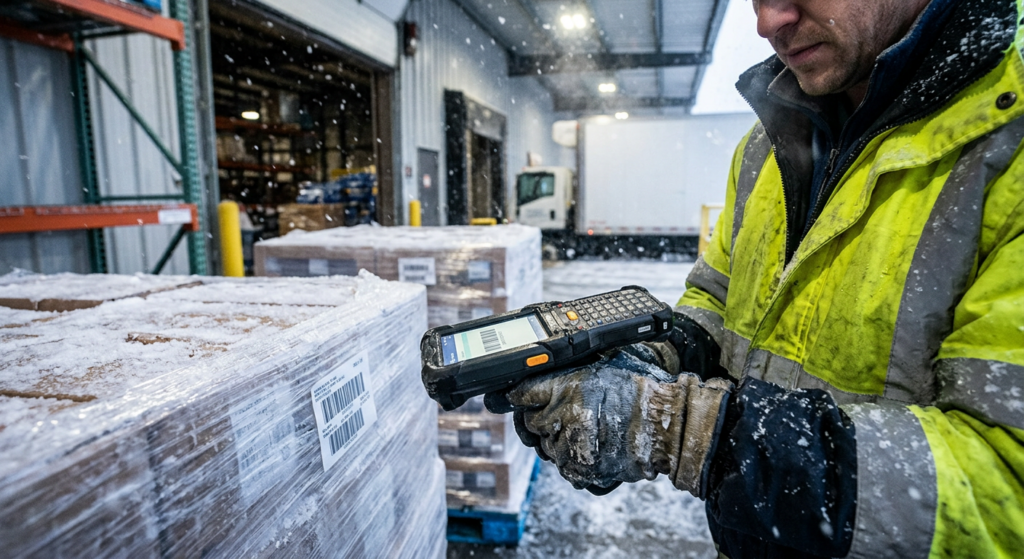
- Logística y almacenamiento: E-commerce growth has driven year-round expansion of logistics facilities, many with loading docks exposed to outdoor temperatures. Forklift operators, package handlers, and dock workers need insulated gloves with touchscreen-compatible fingertips and adequate grip for wet cardboard and plastic-wrapped pallets.
- Petróleo, gas y minería: North Sea offshore platforms and onshore refineries require multi-hazard winter gloves combining cold protection with cut resistance, impact protection (TPR), and hydrocarbon-resistant coatings. Winter maintenance shutdowns are critical procurement periods for these sectors.
- Automotive Manufacturing & Maintenance: Workers in unheated or partially heated facilities, outdoor fleet yards, and vehicle testing centers need moderate-insulation winter gloves with nitrile foam coatings for oily metal handling in cold conditions.
- Agriculture & Forestry: Seasonal winter activities including timber harvesting, livestock management, and orchard maintenance require durable insulated gloves with abrasion resistance and waterproofing. Leather-Thinsulate combinations are particularly popular in forestry operations.
- Municipal Services & Utilities: Snow removal crews, road maintenance teams, and utility workers represent a significant winter work gloves market segment. These workers handle cold metal tools, de-icing chemicals, and operate equipment in sustained sub-zero exposure.
- Cold Storage & Food Processing: Refrigeration warehouse operators, frozen food processors, and cold chain logistics providers require EN 511-certified gloves year-round, with convective cold ratings of 3–4 for environments reaching -25°C to -40°C.
Increasing workplace safety awareness and strict regulatory compliance across industries like construction, healthcare, and manufacturing drive the market. The enforcement of occupational safety standards and growth in industrial operations amplify the demand for high-performance safety gloves. Germany’s Berufsgenossenschaften (BG) system — the employer liability insurance associations — actively audits PPE compliance on job sites, and failure to provide EN 511-certified cold protection gloves during winter months can result in significant penalties and increased insurance premiums. The German government’s planned infrastructure investment of hundreds of billions of euros over the coming years will further expand winter work gloves demand as construction activity intensifies across all seasons.
Escenarios de aplicación específicos
Scenario 1: Highway Bridge Repair in North Rhine-Westphalia, January
A 45-person crew is performing emergency bridge deck repair on the A3 motorway near Cologne in mid-January, with ambient temperatures hovering around -4°C and sustained wind chill bringing effective temperatures to -12°C. Workers handle cold steel reinforcement bars, pour quick-setting concrete mix, and operate pneumatic jackhammers for 8-hour shifts with mandatory warming breaks every 90 minutes. The primary hazards include frostbite, contact cold from frozen steel, wet grip failure leading to dropped loads, and abrasion from rough concrete surfaces. The HSE department specifies 7G acrylic terry-loop liner with latex crinkle 3/4 coating, rated EN 511: 2×1 and EN 388: 2131A. This configuration delivers reliable thermal insulation for the -4°C to -12°C range, excellent wet grip on cold rebar and wet concrete, and adequate abrasion resistance at a bulk cost under €1.50 per pair. The crew consumes approximately 300 pairs per week.
Scenario 2: Offshore Wind Turbine Maintenance, German North Sea, December
A maintenance team of 24 technicians performs scheduled winter service on an offshore wind farm 80 km north of Borkum. Workers conduct nacelle inspections, cable pulling, bolted connection torquing, and blade de-icing at heights of 90+ meters, facing wind speeds of 40+ km/h and temperatures of -5°C to -10°C with salt spray. Critical hazards include extreme wind chill, contact cold from metal tower structures, cut risks from sharp cable ends, and impact risks from heavy tooling. The required specification is 13G HPPE + acrylic blend liner with nitrile foam palm coating and TPR back-of-hand impact protection, rated EN 511: 1×1, EN 388: 4X44D with impact rating P. Gloves must be high-visibility yellow and waterproof. Each technician receives 6 pairs per rotation, totaling approximately 600 pairs per campaign.
Scenario 3: Frozen Food Distribution Center in Saxony, Year-Round
A cold chain logistics operator manages a 35,000 m² frozen food warehouse near Leipzig operating at -25°C. Some 120 warehouse workers pick, sort, and load frozen pallets using forklifts and manual hand-stacking for 6-hour shifts with mandatory warm-up breaks. The primary hazards are sustained convective and contact cold exposure, reduced manual dexterity leading to drop accidents, and abrasion from cardboard and wooden pallets. The facility specifies cow split leather with Thinsulate insulation liner, rated EN 511: 3×1, with a rubberized safety cuff for added forearm protection. For workers operating touchscreen-based warehouse management terminals, an alternative 10G acrylic-blend glove with sandy nitrile palm coating and conductive fingertips is provided. Annual consumption across the facility exceeds 12,000 pairs.
Casos prácticos
Case 1: Regional Construction PPE Distributor in Hamburg
A PPE distributor supplying 200+ construction and municipal service companies across northern Germany needed a reliable winter work gloves source for 120,000 pairs annually in three specifications. Previous suppliers delivered inconsistent thermal insulation between batches, causing field complaints. After switching to a vertically integrated factory-direct partner with in-line EN 511 testing, the distributor achieved verified batch-to-batch consistency, reduced per-pair cost by 25%, and cut lead times from 10 weeks to 6 weeks — including private-label packaging with German-language EN documentation.
Case 2: Cold Storage Operator in Bavaria
A frozen food logistics provider operating three warehouses at -25°C required 15,000 pairs annually of EN 511-rated insulated gloves with Thinsulate liner, plus 5,000 pairs of touchscreen-compatible cold-weather gloves for supervisors using tablet-based WMS systems. A factory partner delivered both specifications within 25 days, including customized branding, EN 511 test certificates from an EU-accredited notified body, and REACH compliance documentation — enabling seamless procurement approval under the customer’s ISO 45001 system.
Los 6 proveedores locales más recomendados en Alemania
| Nombre de la empresa | Puntos fuertes | Regiones de servicio | Asistencia preventa | Asistencia posventa |
|---|---|---|---|---|
| NordKalt Arbeitsschutz GmbH | Deep Winter Work Gloves portfolio, cold storage specialist | Northern Germany (Hamburg, Bremen, Lower Saxony) | On-site cold hazard assessments, EN 511 product matching | Dedicated account manager, rapid replacement shipping |
| RheinTherm Schutzhandschuhe | Broad thermal PPE catalog, strong municipal contract network | Western Germany (NRW, Hessen, Rhineland-Palatinate) | Tender documentation support, sample kits | Warranty claims processing, annual quality reviews |
| BayernWarm PPE Vertrieb | Premium insulated gloves for extreme cold, forestry expertise | Baviera, Baden-Wurtemberg | Technical consultation, EN 511/EN 388 certification dossiers | Seasonal restocking programs, field performance reports |
| OstGrip Winterschutz | Cost-effective bulk Winter Work Gloves for construction & logistics | Eastern Germany (Saxony, Brandenburg, Thuringia) | MOQ flexibility, mixed-container options | Batch traceability, defect resolution protocols |
| HansaFrost PPE Solutions | E-commerce fulfillment specialist, Amazon.de integration | Pan-European via Hamburg hub | Listing content support, product photography, FBA coordination | Customer service integration, returns management |
| AlpinSafe Handschutz GmbH | Specialized impact + thermal gloves for oil & gas and mining | Nationwide (focus on North Sea operations) | Hazard-specific product engineering, field trials | Performance monitoring dashboards, KPI tracking |
When evaluating winter work gloves suppliers, always verify that EN 511 and EN 388 test reports are issued by EU-accredited notified bodies, and request batch-to-batch thermal insulation consistency data before committing to annual procurement contracts.
Por qué elegir Snell Safety como socio global
Seguridad Snell brings together deep German market expertise and advanced thermal glove engineering to deliver winter work gloves that perform precisely in local conditions. Through years of serving German distributors, construction companies, and logistics operators, we have developed a detailed understanding of what works — from the optimal acrylic terry-loop weight and latex crinkle formulation for Hamburg’s wet-cold coastal winters to the HPPE/acrylic blend ratios that balance cut protection and warmth for Bavarian metal fabrication workshops. We maintain established local partners in Germany and are actively building overseas warehouse capacity for in-stock, ready-to-ship winter glove supply. Distributors, agents, and e-commerce brand owners are welcome to join our growing partner network, with full pre-sale empowerment (product selection guidance, technical training, market intelligence), after-sale support (quality assurance, replacement policies), dropshipping services, free samples, and marketing material support including product photography and listing content.
Our two manufacturing facilities operate 6 dedicated production lines with a daily capacity of 150,000 pairs, supported by a vertically integrated process spanning knitting, coating/dipping, drying/curing, quality inspection, and export packaging. With over a decade of hands-on expertise in diversified coating technologies — including latex crinkle, nitrile foam, nitrile micro-foam, sandy nitrile, and PU — plus advanced cut-resistant and impact-resistant glove engineering, we deliver the quality consistency, ISO 9001/CE compliance, and competitive factory-direct pricing that German buyers expect. Explore our full catálogo de productos o contacte con nuestro equipo to request samples and discuss custom winter glove specifications.
FAQ
What EN 511 ratings do I need for outdoor construction in Germany?
For typical German winter construction (0°C to -10°C), specify EN 511 convective cold level 2, contact cold level 1–2, and water permeability pass (1). For extreme cold waves or alpine construction sites reaching -15°C or below, upgrade to convective cold level 3 and contact cold level 2–3. All gloves must carry valid CE marking.
Which coating works best for wet and cold conditions?
Latex crinkle coating provides the best grip in wet-cold outdoor environments, channeling water away from the grip surface while maintaining flexibility at sub-zero temperatures. Sandy nitrile is the preferred alternative when oil or hydrocarbon contact is expected alongside cold exposure. Avoid PU coatings for wet-cold applications.
How does EN 511 differ from EN 388 for winter work gloves?
EN 511 specifically tests thermal protection: convective cold resistance (0–4), contact cold resistance (0–4), and water permeability (pass/fail). EN 388 tests mechanical risks: abrasion, blade cut, tear, puncture, and ISO 13997 cut resistance (A–F). Most German winter work gloves require dual certification to protect against both cold and mechanical hazards.
What gauge should I choose for winter gloves?
For maximum warmth in heavy outdoor work, choose 7G (thickest liner, lowest dexterity). For moderate cold with better dexterity needs, choose 10G. For light cold-weather tasks requiring fine motor control, choose 13G. Gauge directly affects thermal insulation — lower numbers mean thicker, warmer liners but reduced finger sensitivity.
What is the typical price range for bulk winter work gloves?
Standard 7G acrylic latex crinkle winter work gloves range from €1.20–€2.00 per pair FOB for bulk orders above 10,000 pairs. Dual-certified (EN 511 + EN 388) cut-resistant thermal gloves cost €1.80–€3.50 per pair. Insulated leather with Thinsulate ranges from €4.00–€8.00 per pair. OEM branding adds approximately €0.05–€0.15 per pair.
What certifications are required to import winter work gloves into Germany?
Winter work gloves sold in Germany must comply with EU Regulation 2016/425. Cold-protection gloves are classified as Category II PPE, requiring EU Type Examination by a notified body, EN 511:2006 test reports, and an EU Declaration of Conformity. If also claiming mechanical protection, EN 388:2016+A1:2018 testing is needed. REACH compliance documentation is also required.
How long do winter work gloves typically last?
Under daily outdoor construction use in German winter conditions, 7G acrylic latex crinkle gloves typically last 3–6 weeks before coating wear-through or insulation compression. Insulated leather gloves last 2–4 months with proper care. Service life depends on abrasion intensity, moisture exposure, and temperature extremes. Replace immediately when thermal insulation feels diminished.
Can winter work gloves also provide cut resistance?
Yes. Dual-certified gloves combining EN 511 cold protection with EN 388 cut resistance are widely available. These use HPPE or Kevlar blended with acrylic thermal yarn in the liner, achieving cut levels B–D while maintaining convective cold ratings of 1–2. They are standard specifications for winter metal fabrication, automotive maintenance, and offshore operations.
What is the minimum order quantity for OEM winter work gloves?
Most factory-direct manufacturers require MOQs of 5,000–10,000 pairs per style for OEM/private-label winter work gloves. Standard catalog styles may accept 2,000–3,000 pairs. Custom liner blends, special Thinsulate configurations, or unique TPR mold designs typically require 10,000+ pairs per specification.
Are touchscreen-compatible winter work gloves available?
Yes. Conductive yarn or conductive coating is applied to thumb and index fingertips, enabling operation of RF scanners, tablets, and smartphones without glove removal. These are typically built on 10G–13G liner platforms with nitrile foam or PU palm coating and light thermal insulation. The additional cost is minimal at €0.03–€0.10 per pair for bulk orders.
Ready to source high-performance winter work gloves for the German market? Whether you are an end-user enterprise needing direct supply, a distributor expanding your cold-weather portfolio, or an e-commerce brand owner launching a winter PPE line, Seguridad Snell is ready to support you. Submit your requirements or request a quote today — including free samples, custom specifications, and full EN 511/EN 388 certification documentation.
Contenido revisado y actualizado: marzo 2026