Los mejores proveedores de Guantes resistentes al aceite en Alemania | Guía 2026
2026-04-07
Comparte este artículo
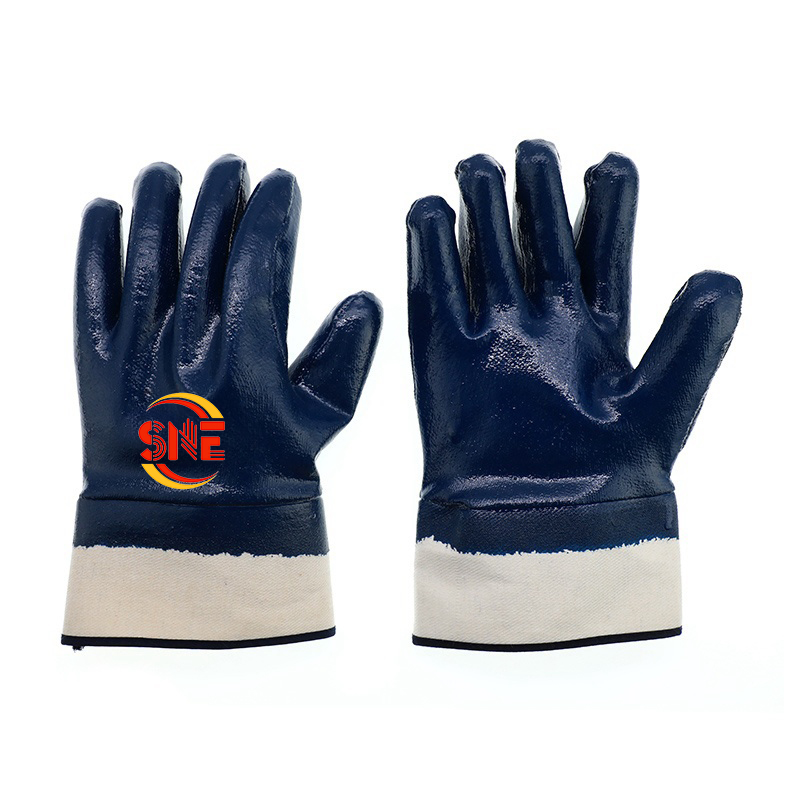
Oil resistant gloves are essential hand protection in Germany’s industrial landscape, where automotive assembly lines, chemical processing plants, and heavy machinery operations expose workers to lubricants, hydraulic fluids, greases, and solvents on a daily basis. Choosing the right oil resistant gloves — with the correct coating technology, liner material, and EN 388 certification — directly impacts worker safety, productivity, and total procurement costs.
If you are sourcing oil resistant gloves for the German market and need help selecting the right configurations for your specific workplace scenarios, contacte con nuestro equipo at Snell Safety. We have extensive experience serving German clients across automotive, chemical, manufacturing, and oil & gas industries, and can recommend precisely tailored products with competitive factory-direct pricing.
Respuesta rápida
For sourcing oil resistant gloves in Germany, consider established local PPE distributors with deep EN 388-certified catalogs and regional warehouse networks across NRW, Bavaria, and Baden-Württemberg. Additionally, Chinese manufacturers who specialize in customized products with competitive pricing and full international certifications (ISO 9001/CE) are ideal for OEM/ODM, private-label, and high-volume bulk programs. Combining local partners for rapid replenishment with a certified factory-direct manufacturer for custom orders delivers optimal value.
Panorama del mercado
Se prevé que el mercado alemán de guantes de seguridad pase de 1.068,97 millones de dólares en 2023 a una cifra estimada de 2.100,86 millones de dólares en 2032, lo que refleja una tasa de crecimiento anual compuesto (TCAC) del 7,78%. Within this expanding market, oil resistant gloves represent a high-growth segment driven by Germany’s dominant automotive, chemical, and mechanical engineering sectors. Nitrile gloves — the primary material for oil-resistant hand protection — are expected to grow at the fastest CAGR of 8.3% over the forecast period in Germany, reflecting surging adoption across industrial applications where oil and chemical contact is routine.
Germany’s robust framework for occupational safety regulations significantly drives demand for safety gloves, with the country’s adherence to stringent EU directives, such as Regulation (EU) 2016/425 on personal protective equipment, mandating the use of high-quality safety gloves across industries. Under the Arbeitsschutzgesetz (ArbSchG) and DGUV regulations, employers must provide CE-certified hand protection at no cost to workers. Every year, around 1 million accidents occur in Germany involving employees who are either working or on their way to or from work, with hand injuries accounting for up to one-third of all workplace injuries — making oil resistant gloves a critical procurement priority.
What Types of Oil Resistant Gloves Are Most in Demand in Germany
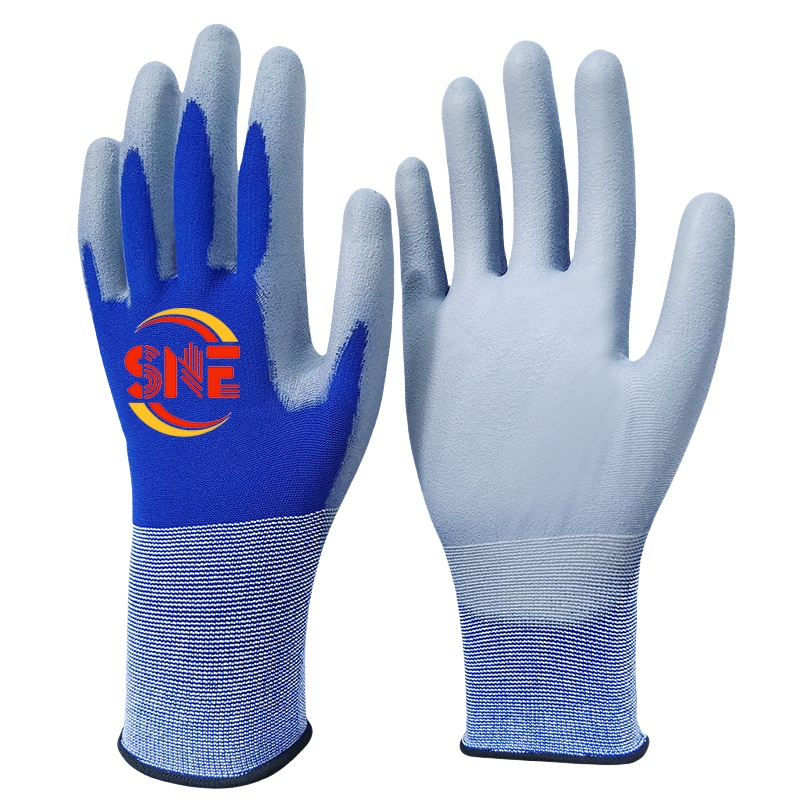
The most in-demand oil resistant gloves in Germany feature nitrile-based coatings (foam nitrile, micro-foam nitrile, sandy nitrile) on seamless-knit liners, engineered for superior grip and barrier protection against oils, greases, and petroleum-based fluids. Based on our experience serving German clients across automotive, chemical, and manufacturing sectors, we at Seguridad Snell consistently see demand gravitating toward coating technologies that balance oil repellency with tactile sensitivity — a priority shaped by the precision-oriented nature of German manufacturing.
Through years of supplying PPE distributors and end-user enterprises in Germany, we have mapped clear preferences shaped by the country’s industrial profile and worker expectations. Germany’s automotive Tier 1 and Tier 2 suppliers in Stuttgart and Munich require nitrile foam or micro-foam coated gloves that channel oil away from the grip surface while maintaining the dexterity needed for parts inspection and connector assembly. Chemical plants in the Rhineland and Ludwigshafen demand gloves that resist a range of industrial solvents, cutting oils, and hydraulic fluids without degrading. Maintenance and MRO teams across Germany’s Mittelstand companies prefer sandy nitrile coatings for their exceptional wet-and-oily grip characteristics. German workers also strongly prefer snug-fitting, comfortable gloves that can be worn for full 8-hour shifts without causing hand fatigue — which is why liner gauge selection (13G, 15G, 18G) and spandex-blended compositions are critical to acceptance on the factory floor.
Here are the top product types we supply most frequently to the German market:
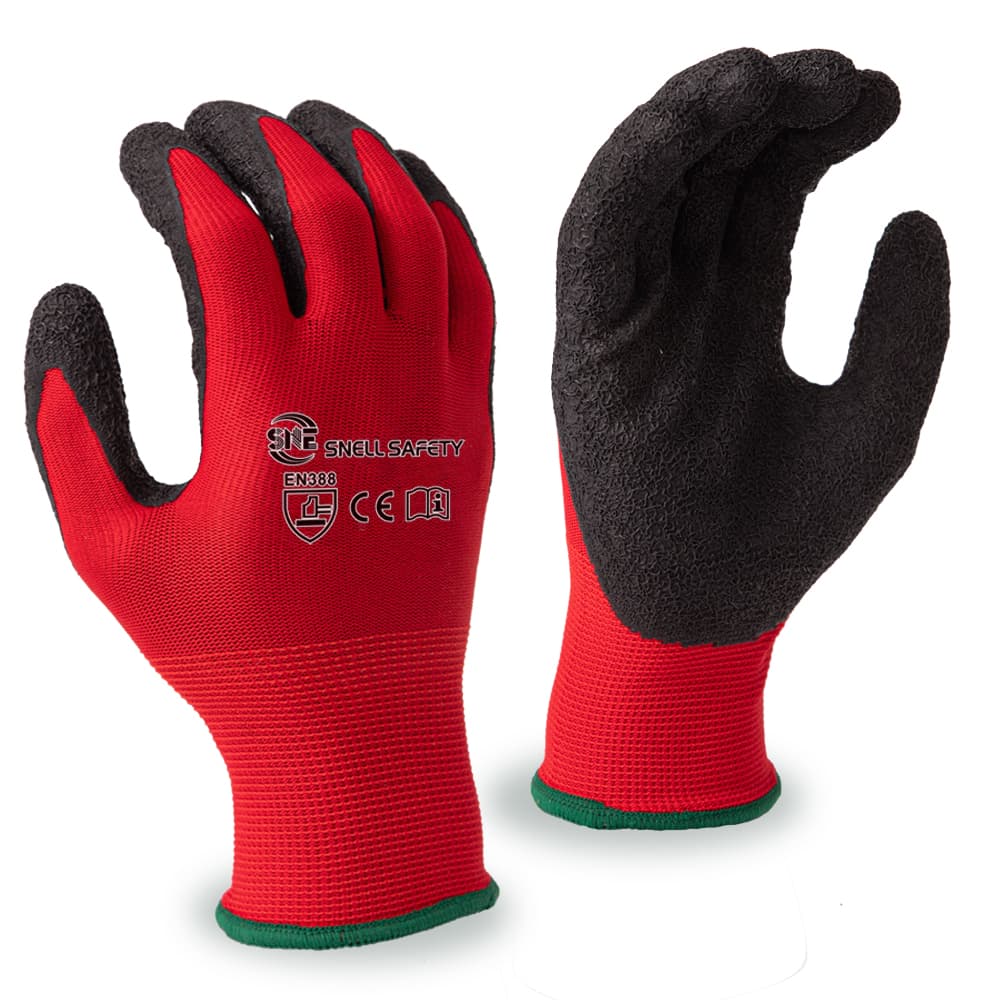
- 13G Nylon-Spandex Liner + Nitrile Foam Palm Coating, EN 388: 4121 — Versatile oil resistant glove for automotive assembly, general maintenance, and light oily handling. The foam nitrile coating absorbs and disperses oil from the contact surface, providing reliable grip on oily metal parts. Sizes S–XXL.
- 15G HPPE Liner + Sandy Nitrile Palm Coating, EN 388: 4X43C — Cut-resistant oil resistant glove for metal stamping, machined parts handling, and sheet metal operations where sharp edges and cutting oils coexist. Sandy nitrile texture provides micro-channel grip in heavy oil conditions.
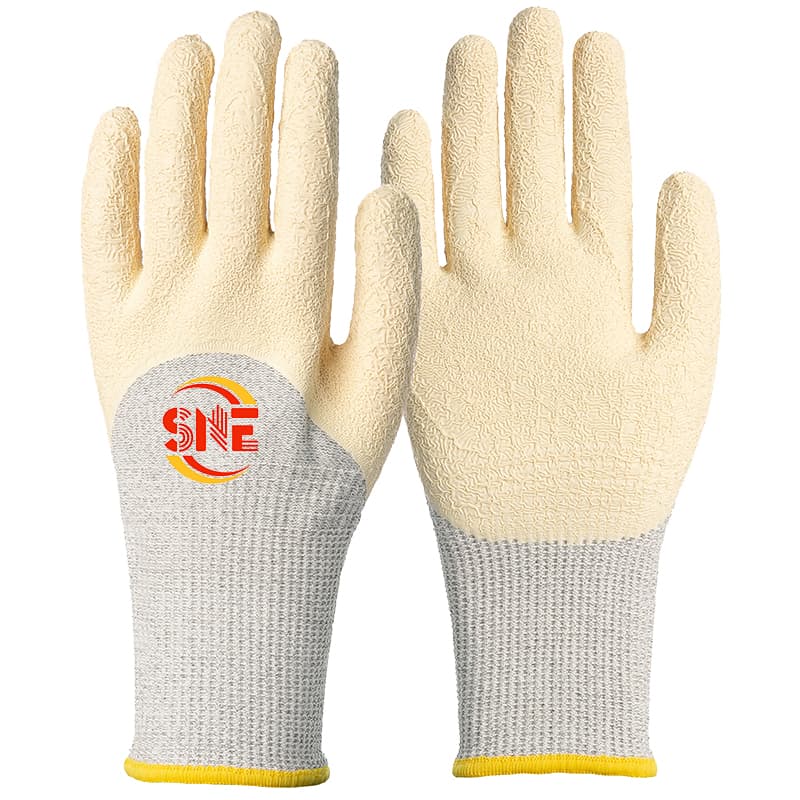
- 13G Polyester Liner + Nitrile Micro-Foam 3/4 Coating, EN 388: 4121 — Extended-coverage oil resistant glove for chemical handling, petrochemical maintenance, and lubrication tasks. The 3/4 dip protects the back of the hand from splash exposure while the micro-foam technology maintains breathability.
- 13G HPPE-Glass Fiber Liner + Sandy Nitrile Full Coating + TPR Back, EN 388: 4X44DP — Heavy-duty impact-resistant oil resistant glove for oil and gas operations, pipeline maintenance, and heavy machinery work. TPR dorsal protection guards against crush and impact hazards.
- 15G Nylon Liner + Nitrile Micro-Foam Palm Coating, Touchscreen-Compatible, EN 388: 4131 — Modern oil resistant glove for logistics, warehouse operations, and light manufacturing where workers use tablets and scanning devices in oily environments.
Why These Oil Resistant Glove Types Are Recommended
Nitrile-based coatings are the gold standard for oil resistant gloves because of their inherent chemical resistance to petroleum products, greases, and many industrial solvents. Nitrile gloves have exceptional resistance to oils, greases, solvents and cuts, which makes them a top choice among industries like automotive, chemicals, and pharmaceuticals that require protection from hazardous chemicals on a daily basis. Unlike PU coatings — which excel in dry conditions but degrade rapidly in oily environments — nitrile maintains its structural integrity and grip performance even after prolonged oil exposure. The foam, micro-foam, and sandy surface textures engineered into nitrile coatings create micro-channels that displace oil from the grip zone, allowing the glove to maintain reliable contact friction where it matters most.
The EN 388:2016+A1:2018 standard is the governing benchmark for mechanical hazard assessment in Germany and across the EU. EN 388 is a European safety standard for protective work gloves, providing comprehensive assessment for their resistance to mechanical risks — evaluating gloves based on performance against abrasion, cut, tear, puncture, and impact. For oil resistant gloves, abrasion resistance is particularly critical because nitrile coatings in oily conditions face accelerated surface wear. Level 4 abrasion resistance (8,000+ cycles under EN 388) is the minimum we recommend for German industrial applications. Where cut hazards are present — such as metal fabrication and automotive stamping — pairing nitrile coatings with HPPE or HPPE-glass fiber liners delivers EN 388 ISO 13997 cut levels B through D without compromising grip performance.
Key performance metrics to evaluate when selecting oil resistant gloves:
- Oil grip performance: Sandy nitrile provides the strongest grip in heavy oil conditions; nitrile foam and micro-foam excel in light-to-medium oil exposure with better tactile sensitivity.
- Resistencia a la abrasión: EN 388 level 4 (8,000+ cycles) is standard for nitrile-coated oil resistant gloves, delivering 2–3x the service life of PU coatings in oily environments.
- Resistencia al corte: HPPE and HPPE-glass fiber liners achieve EN 388 cut levels B–D (ISO 13997: 2.5–15.0 N), essential for metal handling applications.
- Coating coverage: Palm coating for general tasks; 3/4 coating for splash protection; full coating for immersion-level oil contact.
- Breathability vs. protection trade-off: Foam and micro-foam coatings allow moisture vapor transmission for all-day comfort; full-dip coatings maximize oil barrier but reduce breathability.
| Característica | Espuma de nitrilo | Nitrile Micro-Foam | Nitrilo arenoso | Full Nitrile Dip |
|---|---|---|---|---|
| Oil Grip Level | Bien | Muy buena | Excelente | Bien |
| Destreza | Alta | Alta | Medio | Bajo |
| Transpirabilidad | Bien | Muy buena | Moderado | Bajo |
| Oil Barrier | Moderado | Moderado | Moderado | Excelente |
| Lo mejor para | Light oily assembly | Mixed conditions | Heavy oil/grease | Oil immersion |
| Oil Resistant Gloves Category | General purpose | Versatile industrial | Heavy-duty grip | Maximum barrier |
Use this table to match the primary oil exposure level and grip requirement at your workplace to the optimal nitrile coating technology for your oil resistant gloves specification.
Key Industries for Oil Resistant Gloves in Germany
Oil resistant gloves serve mission-critical roles across Germany’s largest and most productive industrial sectors. Germany’s robust automotive and chemical sectors are fueling demand for specialized gloves that boast a combination of protective features. With €2,900 billion in manufacturing sector turnover in 2024, led by the automotive industry at €476 billion, the scale of oil resistant glove consumption in Germany is substantial.
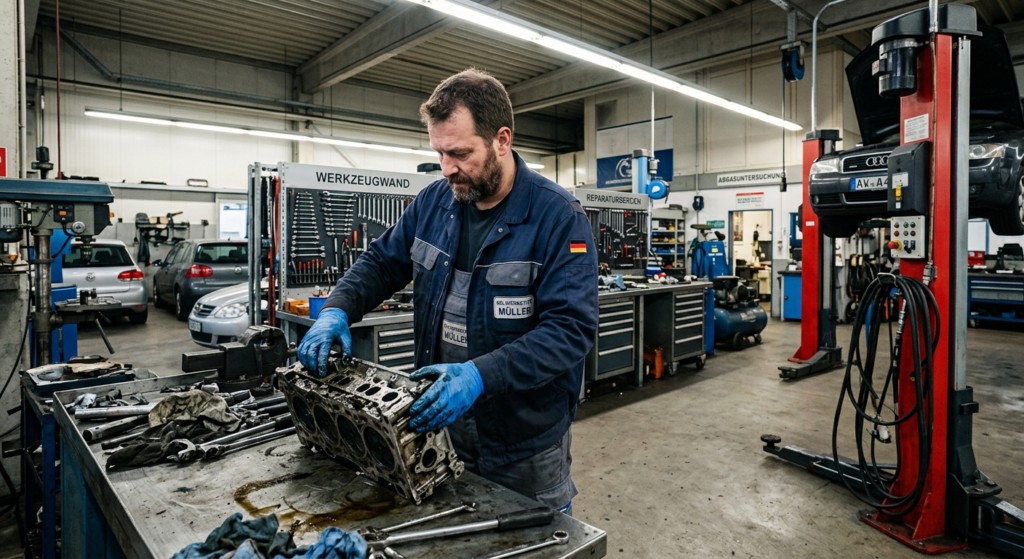
- Automotive Manufacturing and Supply Chain: Germany’s automotive industry — centered in Stuttgart, Munich, Wolfsburg, and Ingolstadt — is the single largest consumer of oil resistant gloves in the country. Workers handling stamped metal parts with cutting oil residue, assembling lubricated drivetrain components, and performing engine maintenance require nitrile foam or sandy nitrile coated gloves with EN 388 cut levels B–C and reliable oil grip.
- Chemical and Petrochemical Processing: Chemical plants across the Rhineland, Ludwigshafen, and Leverkusen handle solvents, petroleum derivatives, and industrial lubricants that demand full-dip or 3/4 nitrile coated gloves with chemical splash resistance. Workers need gloves rated to both EN 388 for mechanical risks and EN ISO 374-1 for limited chemical permeation.
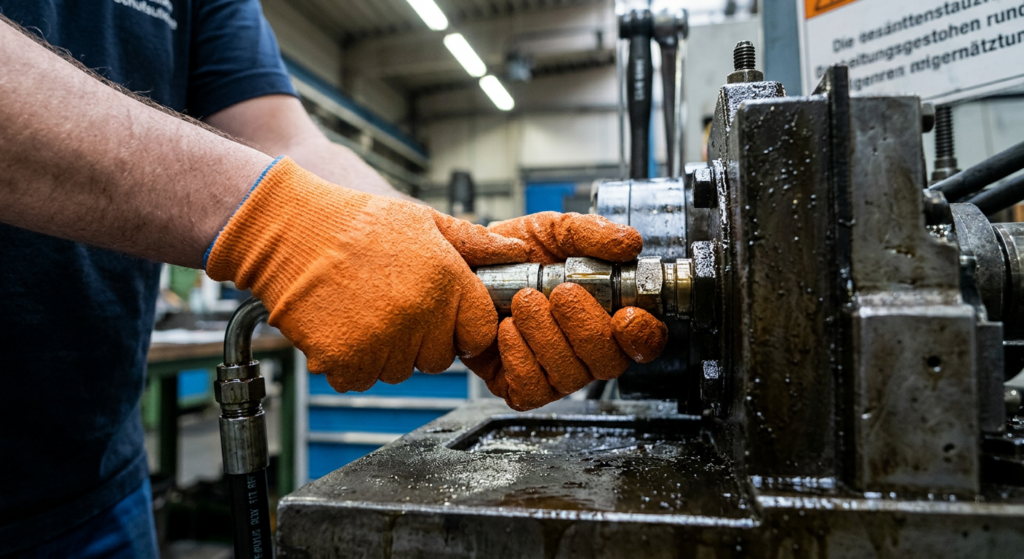
- Mechanical Engineering and Machinery Maintenance: With 1.3 million employees, mechanical engineering is the largest industry in Germany. MRO technicians servicing CNC machines, hydraulic presses, and industrial robots require oil resistant gloves that combine hydraulic fluid resistance with dexterity for tool handling and fine adjustments.
- Fabricación y estampación de metales: Sheet metal operations across NRW and Bavaria involve cutting oils, stamping lubricants, and coolants. Workers need cut-resistant HPPE liners (EN 388 cut level C–D) paired with sandy nitrile palm coatings for maximum oil grip and edge protection.
- Oil, Gas, and Energy: Germany’s refineries and energy infrastructure operations require heavy-duty oil resistant gloves with TPR impact protection, full nitrile dip coating, and EN 388 ratings of 4X44DP for pipeline maintenance, valve operations, and drilling equipment handling.
- Logistics and Warehouse Operations: Germany’s position as Europe’s logistics hub generates increasing demand for touchscreen-compatible oil resistant gloves that handle greasy packages, oily machinery, and barcode scanners simultaneously.
Se prevé que el mercado de guantes de seguridad industrial en Alemania experimente un crecimiento sustancial y prometedor de 2025 a 2034, impulsado por el aumento de las actividades industriales, regulaciones de seguridad más estrictas y un creciente énfasis en las normas de seguridad en el lugar de trabajo. Germany’s Berufsgenossenschaften (statutory accident insurance institutions) continue to tighten enforcement of PPE compliance, creating sustained year-round procurement demand for certified oil resistant gloves — with particular volume spikes during Q1 and Q3 annual PPE refresh cycles.
Specific Application Scenarios for Oil Resistant Gloves
Scenario 1: Automotive Transmission Assembly in Stuttgart
At a major transmission component supplier near Stuttgart, 180 assembly workers handle gear shafts, bearing housings, and synchronizer rings that arrive from CNC machining stations coated in a thin film of cutting oil. The primary hazards are slippery oil-coated surfaces that can cause dropped parts and hand injuries, plus sharp machined edges on newly cut components. Workers wear 15G HPPE liner gloves with sandy nitrile palm coating (EN 388: 4X43C) — the sandy texture displaces the oil film to maintain a firm grip on precision components, while the HPPE liner provides cut level C protection against sharp chamfered edges. Each worker uses approximately 2 pairs per week, and the gloves must leave no fiber residue on precision-machined surfaces.
Scenario 2: Chemical Maintenance Shutdown in the Rhineland
During a scheduled maintenance turnaround at a petrochemical facility in Ludwigshafen, 90 maintenance contractors perform valve replacement, pipe flange dismantling, and pump overhaul tasks. Workers face exposure to residual process fluids (light hydrocarbons, glycol solutions), hydraulic oil from actuator lines, and impact hazards from heavy tools and flanges. The recommended specification is 13G HPPE-glass fiber liner with full nitrile dip coating and TPR back-of-hand impact protection (EN 388: 4X44DP). The full nitrile dip creates a complete barrier against oil and light chemical splash, while the TPR panels protect knuckles and fingers from pinch-and-crush hazards during flange bolt-up operations. Workers consume 3–4 pairs during a typical 14-day shutdown cycle.
Scenario 3: CNC Machine Shop in Bavaria
At a precision machining facility near Augsburg producing hydraulic cylinder components, 45 machine operators load and unload CNC lathes, inspect freshly turned parts coated in emulsion coolant, and perform deburring operations. The hazards include slippery coolant-coated surfaces, sharp burrs on machined edges, and the need for fine motor control to position parts in chuck jaws accurately. The recommended specification is 13G nylon-spandex liner with nitrile micro-foam palm coating (EN 388: 4121) — the micro-foam texture provides excellent grip on emulsion-wet surfaces while maintaining the tactile sensitivity needed for precise part positioning. The nylon-spandex blend ensures a comfortable, fatigue-free fit through rotating 8-hour shifts.
Casos prácticos
Case 1: Automotive OEM Glove Standardization, Bavaria
A leading German automotive OEM operating 6 production facilities needed to consolidate oil resistant glove procurement from 12 inconsistent suppliers to a single optimized specification. Working with a factory-direct manufacturing partner, they developed a custom 15G HPPE-sandy nitrile glove with anti-static properties, department-specific color coding, and embossed branding. The consolidated program reduced annual glove spend by 19% while improving worker grip confidence scores by 34% in oily assembly zones.
Case 2: Private-Label Oil Resistant Gloves for German Distributor
A mid-sized German PPE distributor identified a gap in their catalog for premium cut-resistant oil resistant gloves targeting the Mittelstand manufacturing segment. They partnered with an OEM manufacturer to develop 3 SKUs — 13G nitrile foam, 15G sandy nitrile, and 13G HPPE-sandy nitrile with cut level C — all branded with bilingual DE/EN packaging and complete CE/EN 388 documentation. The initial order of 30,000 pairs shipped within 25 days, with ongoing quarterly replenishment.
Top 6 Recommended Local Oil Resistant Gloves Suppliers in Germany
| Nombre de la empresa | Puntos fuertes | Regiones de servicio | Asistencia preventa | Asistencia posventa |
|---|---|---|---|---|
| RheinGrip Arbeitsschutz GmbH | Extensive nitrile-coated Oil Resistant Gloves portfolio for automotive and chemical sectors | Renania del Norte-Westfalia, Hesse, Renania-Palatinado | On-site hazard assessments, EN 388 & EN ISO 374-1 compliance consulting | Dedicated account management, quarterly usage analysis |
| BayernSafe Industrieschutz | Premium cut-resistant oil resistant gloves for metal fabrication and precision engineering | Baviera, Baden-Wurtemberg | Ergonomic fit testing, cut hazard evaluation | Field quality audits, warranty processing |
| NordPro PPE Handel | Multi-category catalog with Oil Resistant Gloves for logistics and maritime operations | Hamburgo, Baja Sajonia, Schleswig-Holstein | Technical datasheets, import compliance guidance | Express replacement shipping, returns management |
| SachsenGuard Handschutz | Cost-effective bulk supply of nitrile-coated gloves for Mittelstand manufacturing | Sajonia, Brandeburgo, Turingia | Government tender support, MOQ-flexible quoting | On-site inventory management, batch traceability |
| Distribución HansaPPE | E-commerce-optimized packaging with Amazon.de and B2B platform integration | En todo el país a través del centro de Hamburgo | Contenido de listados de productos, paquetes de documentos de certificación | Consumer review management, warranty fulfillment |
| AlpenTech Schutzausrüstung | Specialized heavy-duty impact-resistant oil resistant gloves for oil & gas and mining | Bavaria, Alpine industrial zones | Application-specific TPR glove recommendations | Seasonal stock planning, performance monitoring |
When evaluating suppliers, always request EN 388 test reports from EU-accredited notified bodies and verify that each supplier can provide a German-language EU Declaration of Conformity, REACH compliance documentation, and SVHC substance declarations alongside every oil resistant gloves product.
Why Choose Snell Safety as Your Global Oil Resistant Gloves Partner
Seguridad Snell brings deep German market expertise built through years of serving PPE distributors, automotive manufacturers, and chemical companies across Germany. We know exactly which nitrile coating technologies, liner compositions, and gauge configurations perform best in German workplaces — from the sandy nitrile gloves demanded by Stuttgart automotive assemblers handling oily transmission parts to the full-dip TPR impact gloves used on Rhineland petrochemical shutdowns. With established local partners and planned overseas warehouse capacity for stock-ready delivery in Germany, we support both end-user enterprises and distribution channels with products precisely tailored to local working conditions and the hand-feel preferences German workers expect. We are actively recruiting distributors, agents, and e-commerce brand owners — offering comprehensive pre-sale empowerment (product selection guidance, technical training, market intelligence), after-sale support (quality assurance, replacement policies), dropshipping services, free samples, and marketing material support for online sellers.
Our manufacturing strength underpins this local market knowledge. With over a decade of production expertise, 6 dedicated production lines, and a daily capacity of 150,000 pairs, our vertically integrated process (R&D → material sourcing → knitting → nitrile dipping/curing → quality inspection → packaging → export) ensures consistent quality at factory-direct pricing. We offer the full spectrum of oil resistant coating technologies — nitrile foam, nitrile micro-foam, sandy nitrile, and smooth nitrile in palm, 3/4, and full-dip configurations — on liners from 10G to 18G in nylon, polyester, HPPE, HPPE-glass fiber, Kevlar, and nylon-spandex blends, all carrying ISO 9001 and CE certifications. Browse our catálogo de productos o contacte con nuestro equipo to request free samples and a custom quotation for your oil resistant gloves program.
| Capacidad | Detalles |
|---|---|
| Capacidad de producción diaria | 150.000 pares en 6 líneas de producción |
| Oil Resistant Coating Technologies | Nitrile foam, micro-foam, sandy nitrile, smooth nitrile, full dip |
| Opciones de medidor de revestimiento | 10G, 13G, 15G, 18G |
| Materiales de revestimiento | Nylon, polyester, HPPE, HPPE-glass fiber, Kevlar, nylon-spandex |
| Cut Resistance Range | EN 388 cut level A1 through F; ANSI A1 through A9 |
| Protección contra impactos | TPR back-of-hand, finger, and knuckle guards |
| Certificaciones | ISO 9001, marcado CE (EN 388, EU 2016/425) |
Use this table to verify whether Snell Safety’s manufacturing capabilities align with your oil resistant gloves sourcing requirements for the German market.
FAQ
Which nitrile coating type is best for oily environments in Germany?
Sandy nitrile provides the strongest grip in heavy oil and grease conditions, making it the top choice for automotive maintenance and metal fabrication. Nitrile micro-foam offers excellent grip in light-to-medium oil with better tactile sensitivity. For full oil immersion tasks, smooth nitrile full-dip coatings provide the most complete barrier protection against petroleum-based fluids.
What EN 388 rating should I look for in oil resistant gloves?
For general oily handling in manufacturing, EN 388: 4121 (level 4 abrasion, level 1 cut, level 2 tear, level 1 puncture) is the baseline. For metal handling with cutting oils, look for ratings like 4X43C or 4X44D — the letter indicates ISO 13997 cut level (C = 5.0–10.0 N, D = 10.0–15.0 N), critical for sharp-edge protection.
What certifications are required to import oil resistant gloves into Germany?
Oil resistant gloves must comply with EU Regulation 2016/425 and carry CE marking. They require EN 388:2016+A1:2018 testing by an EU-accredited notified body, a German-language EU Declaration of Conformity, and REACH compliance documentation. Category II PPE (mechanical risk) requires EU Type Examination certification from a notified body.
How do I choose the right gauge for oil resistant gloves?
For precision assembly with light oil exposure, 15G or 18G liners offer maximum dexterity. For general maintenance and medium-duty oily tasks, 13G is the standard offering good durability and comfort. For heavy-duty oil and gas operations with impact protection, 10G or 13G liners with TPR dorsal guards are recommended. Higher gauge numbers mean thinner, more dexterous gloves.
What is the price range for bulk oil resistant gloves orders?
For factory-direct OEM orders (typical MOQ 5,000–10,000 pairs), 13G nylon-nitrile foam oil resistant gloves range from €0.30–€0.55 per pair. Sandy nitrile cut-resistant models (HPPE liner, cut level C) cost €0.90–€1.60 per pair. Full-dip nitrile with TPR impact protection ranges from €1.80–€3.50 per pair. Custom branding and individual packaging add €0.05–€0.15 per pair.
How long do oil resistant gloves typically last in industrial use?
Service life depends on oil type and task intensity. In light oily assembly, nitrile-coated gloves last 2–4 weeks per pair. In automotive maintenance with regular cutting oil contact, expect 1–2 weeks. In heavy oil and petrochemical environments, 3–7 days is typical. Replace oil resistant gloves when the coating shows visible softening, peeling, or loss of grip texture.
Can oil resistant gloves also protect against cuts in metal handling?
Yes. Oil resistant gloves with HPPE, HPPE-glass fiber, or Kevlar liners provide dual-hazard protection — combining nitrile oil grip with EN 388 cut levels B through F. For example, a 13G HPPE liner with sandy nitrile palm coating (EN 388: 4X43C) simultaneously resists cutting oils and sharp machined edges — the most common combination in German automotive and metal fabrication plants.
What is the difference between nitrile foam and sandy nitrile coatings?
Nitrile foam features a sponge-like cellular structure that absorbs and channels oil away from the grip surface, offering good oil grip with high dexterity and breathability. Sandy nitrile has a rough textured surface created by a salt-wash process, providing superior mechanical grip in heavy oil and grease but with slightly reduced tactile sensitivity. Choose foam for precision tasks and sandy for heavy-grip applications.
Are touchscreen-compatible oil resistant gloves available?
Yes. Touchscreen-compatible oil resistant gloves incorporate conductive fibers (typically silver-coated nylon or carbon fiber) in the fingertip zones, enabling capacitive screen operation without glove removal. These are increasingly specified in German logistics, warehouse, and modern manufacturing environments where workers use tablets, scanners, and smartphones throughout oily shifts.
What DGUV rules apply to oil resistant gloves procurement in Germany?
Under DGUV Regel 112-195 (formerly BGR 195), employers must conduct a hazard assessment to determine the required glove protection level, provide CE-certified gloves at no cost to employees, ensure proper fit and training, and document glove selection rationale. For oil hazard environments, the assessment must identify the specific oils, greases, or chemicals encountered and match the glove specification accordingly.
Whether you are an end-user enterprise seeking reliable factory-direct supply of oil resistant gloves, a distribuidor de EPI distributor expanding your German product range, or an e-commerce brand building a private-label hand protection line, Seguridad Snell está preparada para satisfacer sus necesidades con productos adaptados con precisión, precios competitivos y una amplia capacitación de los socios. Envíe sus especificaciones o solicite una cotización hoy , incluida muestras gratuitas, soluciones personalizadas OEM/ODM y consulta técnica dedicada para el mercado alemán.
Contenido revisado y actualizado: marzo 2026