Best Nitrile Foam Gloves Suppliers in Germany | 2026 Guide
2026-04-10
Comparte este artículo
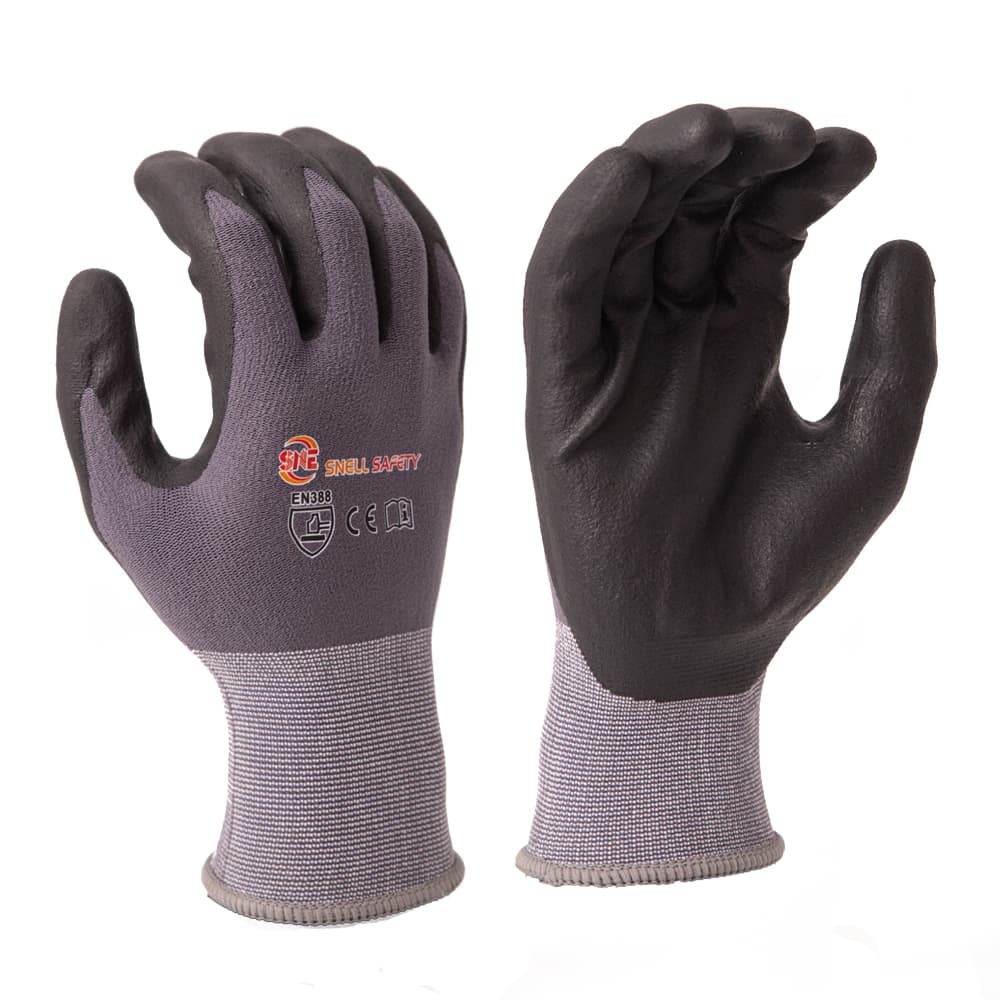
Finding the right nitrile foam gloves for Germany’s demanding industrial landscape requires a careful balance of EN 388 mechanical protection, grip performance across mixed conditions, and the all-day comfort that German workers consistently expect. Whether you are an HSE procurement manager at a Bavarian automotive plant, a PPE distributor serving the Mittelstand, or a logistics company equipping hundreds of warehouse operatives, this guide walks you through everything you need to know about sourcing nitrile foam gloves for the German market.
If you need expert product selection guidance for nitrile foam gloves tailored to Germany’s industrial requirements, contacte con nuestro equipo at Snell Safety. With deep experience serving German clients across automotive, manufacturing, logistics, and construction sectors, we can recommend precise configurations — from liner gauge and coating formulation to hand-feel preferences — optimized for your local application scenarios.
Respuesta rápida
For nitrile foam gloves in Germany, consider established local PPE distributors with wide EN 388-certified catalogs and warehouse networks across NRW, Bavaria, and Baden-Württemberg. Additionally, evaluate Chinese manufacturers who specialize in customized products with competitive pricing and full international certifications (ISO 9001/CE) — a strong option for OEM/ODM, private label, and high-volume procurement. Combining both sources offers the best balance of rapid local delivery and cost-effective custom supply.
Panorama del mercado
Se prevé que el mercado alemán de guantes de seguridad pase de 1.068,97 millones de dólares en 2023 a una cifra estimada de 2.100,86 millones de dólares en 2032, lo que refleja una tasa de crecimiento anual compuesto (TCAC) del 7,78%. Within this expanding landscape, nitrile-coated gloves — including the foam variant — represent the fastest-growing material segment. Nitrile gloves are expected to grow at the fastest CAGR of 8.3% over the forecast period, driven by their versatility in mixed dry, damp, and oily workplace conditions. In 2023, a total of 783,426 reportable accidents at work occurred in Germany, and hand injuries constitute up to 30% of the total cases treated in emergency departments, reinforcing the critical need for reliable hand protection across all industrial sectors.
Germany’s robust framework for occupational safety regulations significantly drives the demand for safety gloves. The country’s adherence to stringent EU directives, such as Regulation (EU) 2016/425 on personal protective equipment (PPE), mandates the use of high-quality safety gloves across industries. The growing emphasis on touchscreen-compatible and ergonomic PPE designs further accelerates adoption of nitrile foam gloves, particularly in logistics, automotive, and smart manufacturing environments where digital devices are integral to daily workflows.
What Types of Nitrile Foam Gloves Are Needed in Germany
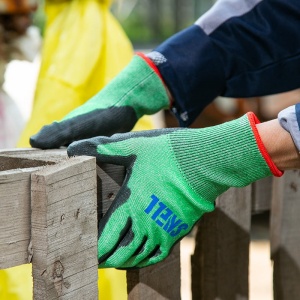
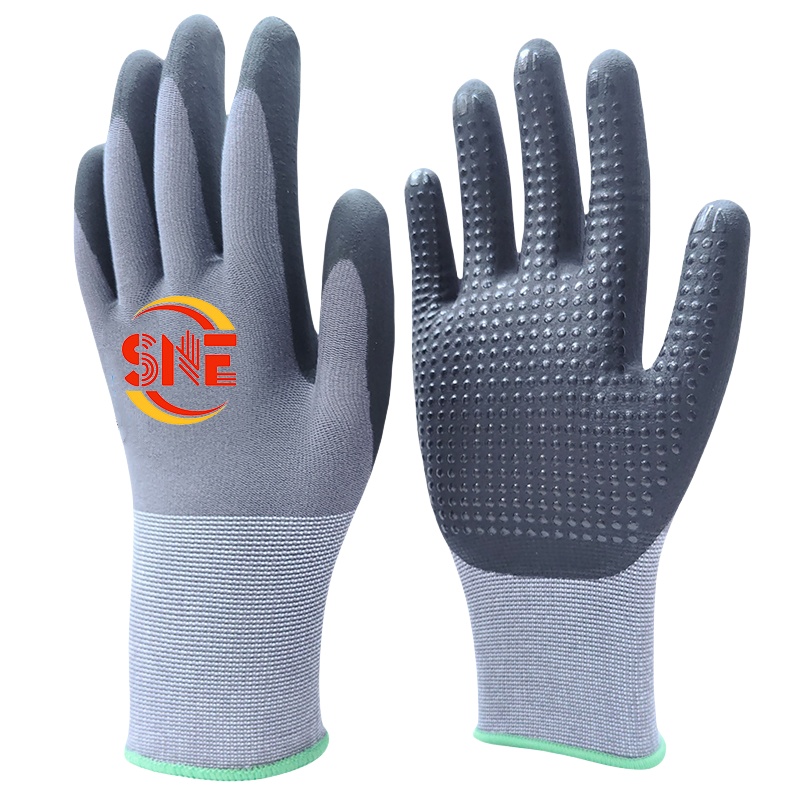
The most in-demand nitrile foam gloves in Germany feature 13G or 15G seamless-knit liners with foam nitrile palm or 3/4 dip coatings, delivering EN 388-certified mechanical protection combined with superior grip in mixed wet, dry, and lightly oily environments. These gloves have become the go-to multi-purpose hand protection across Germany’s diverse industrial base.
Based on our experience serving German clients at Seguridad Snell, we consistently observe a strong preference for gloves that combine mechanical protection with tactile sensitivity and breathability. German workers are particularly discerning about hand feel — they reject gloves that feel stiff, bulky, or generate excessive hand perspiration during 8-hour shifts. The nitrile foam coating’s open-cell structure directly addresses this: it allows air circulation through microscopic pores while providing reliable grip on surfaces ranging from dry cardboard to damp metal parts. Germany’s climate, with cold, wet winters and warm summers, makes breathability and moisture management essential year-round. Our German clients also consistently prioritize EN 388 compliance documentation with full German-language Declarations of Conformity, a non-negotiable requirement for workplace inspections.
Here are the top nitrile foam gloves configurations we supply most frequently to Germany:
- 13G Nylon Liner + Nitrile Foam Palm Coating (EN 388: 4121X) — The highest-volume specification for general industrial handling, logistics, and MRO maintenance. Provides Level 4 abrasion resistance with excellent breathability and moderate oil resistance. Sizes S–XXL.
- 15G Nylon-Spandex Liner + Nitrile Foam Palm Coating (EN 388: 4131X) — Premium precision-handling glove for automotive assembly, electronics, and quality inspection tasks. The 15G ultra-fine gauge provides near-barehand tactile sensitivity while spandex ensures a compression fit.
- 13G HPPE Liner + Nitrile Foam Palm Coating (EN 388: 4X43C) — Cut-resistant variant for light metal handling, glass processing, and automotive stamping. EN 388 Cut Level C protection with the same excellent foam nitrile grip characteristics.
- 13G Polyester-Spandex Liner + Nitrile Foam 3/4 Coating (EN 388: 4121X) — Extended coverage variant for tasks involving splash exposure. The 3/4 dip protects knuckles and the back of fingers while maintaining breathability through the open knit back.
- 10G Cotton-Polyester Liner + Nitrile Foam Full Coating (EN 388: 3121X) — Cold-weather variant for outdoor construction and utility work. The thicker 10G gauge provides insulation and cushioning for winter conditions in northern Germany.
Why Nitrile Foam Gloves Are Recommended for the German Market
Nitrile foam gloves are recommended because their open-cell foam coating structure provides a unique combination of breathability, multi-surface grip, and liquid resistance that no single alternative coating can match. This makes them the optimal choice for Germany’s mixed-condition industrial environments where workers transition between dry, damp, and lightly oily tasks throughout a single shift.
The foam nitrile coating is created through a specialized dip process where the nitrile compound is aerated to produce microscopic open cells on the coating surface. These cells act as tiny suction cups on smooth surfaces, improving grip by 30–40% compared to smooth nitrile coatings, while simultaneously allowing air and moisture vapor to escape, reducing hand perspiration. Under EN 388:2016+A1:2018 testing, foam nitrile gloves on a 13G nylon liner typically achieve ratings of 4121X — Level 4 abrasion resistance (8,000+ Martindale cycles), Level 1 blade cut, Level 2 tear, and Level 1 puncture. When paired with cut-resistant HPPE or Kevlar liners, the same foam nitrile coating can deliver EN 388 Cut Levels C through E (ISO 13997 method), addressing more demanding metal-handling applications without sacrificing grip performance. From a cost-effectiveness standpoint, nitrile foam gloves offer 20–35% longer service life than standard PU-coated gloves in mixed-condition environments because the nitrile polymer is inherently more resistant to oils, solvents, and abrasion.
Key performance comparisons for nitrile foam gloves versus alternative coatings:
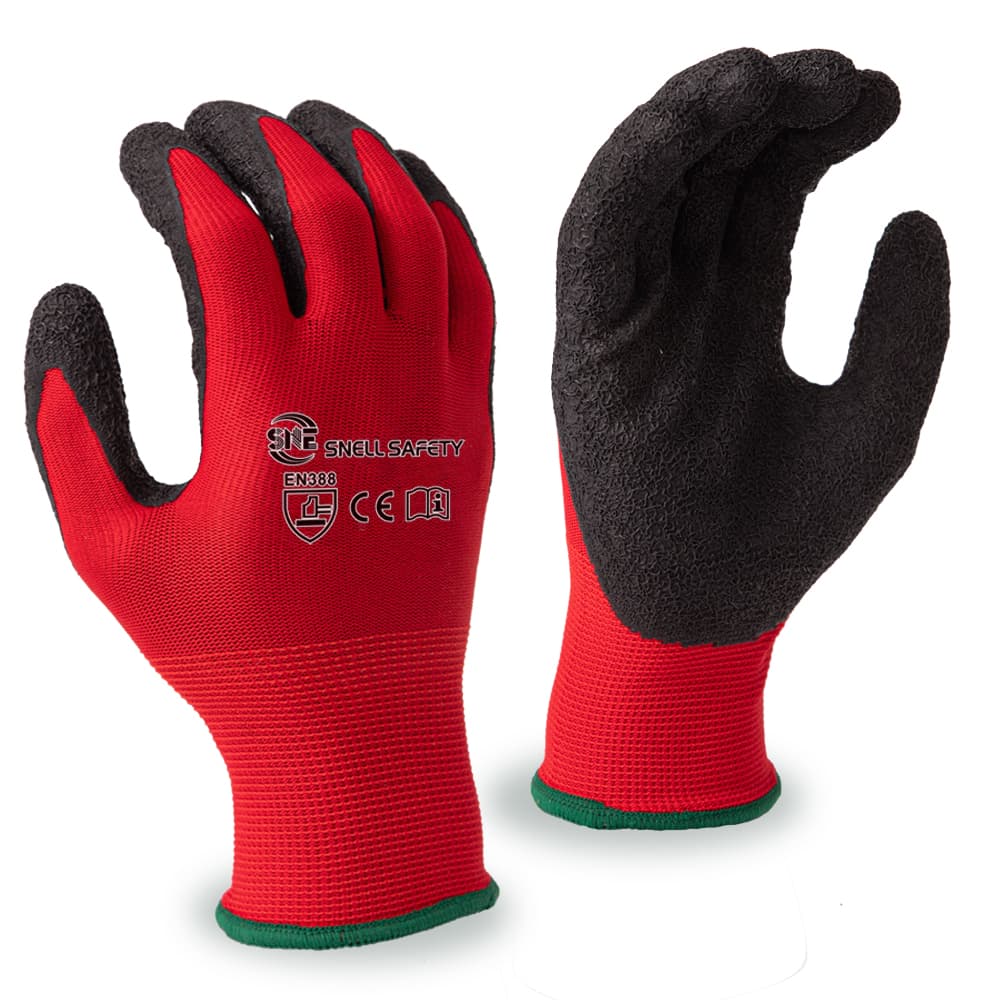
- Grip in damp conditions: Nitrile foam significantly outperforms PU coatings; comparable to latex crinkle without the latex allergy risk
- Transpirabilidad: Superior to smooth nitrile and sandy nitrile; comparable to PU palm-coated designs due to open-cell structure
- Resistencia al aceite: Moderate oil resistance (suitable for light machining fluids); for heavy oil exposure, upgrade to sandy nitrile or nitrile micro-foam
- Destreza: High on 13G liner (EN 420 Level 5 dexterity); excellent on 15G liner; slightly lower than PU fingertip coatings
- Durabilidad: 3–6 week typical service life in moderate general handling; 2–4 weeks in logistics with heavy box handling
| Característica | Nitrile Foam Gloves | PU Palm Coating | Latex Crinkle | Nitrilo arenoso |
|---|---|---|---|---|
| Dry Grip | Excelente | Excelente | Bien | Excelente |
| Wet/Damp Grip | Muy buena | Pobre | Excelente | Bien |
| Light Oil Grip | Bien | Pobre | Feria | Muy buena |
| Transpirabilidad | Muy buena | Excelente | Feria | Bien |
| Abrasión EN 388 | Level 3–4 | Level 4 | Level 2–3 | Level 4 |
| Latex Allergy Risk | Ninguno | Ninguno | Sí | Ninguno |
| Typical Bulk Price | €0.22–€0.45 | €0.18–€0.35 | €0.25–€0.45 | €0.28–€0.50 |
Use this table to compare nitrile foam gloves against alternative coating technologies when selecting the best option for your specific workplace conditions and budget.
Key Industries for Nitrile Foam Gloves in Germany
Nitrile foam gloves are consumed across virtually every major industrial sector in Germany, but demand is concentrated most heavily in automotive manufacturing, logistics, general manufacturing, and construction. These sectors account for the majority of bulk procurement volume.
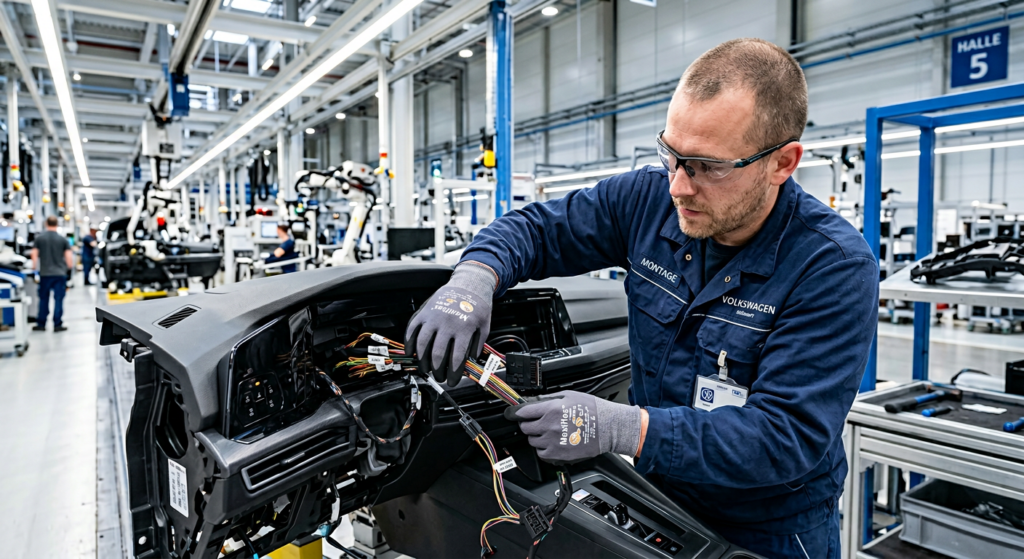
- Fabricación de automóviles: Germany’s automotive sector — concentrated in Stuttgart, Munich, Wolfsburg, and Ingolstadt — is the single largest consumer of nitrile foam gloves. Assembly line workers handling painted components, wiring harnesses, and plastic trim need the foam nitrile’s combination of anti-slip grip, fingerprint-free handling, and tactile sensitivity. The 15G nylon-spandex variant with nitrile foam palm is the preferred specification.
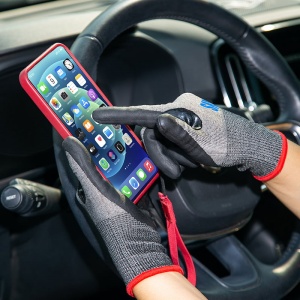
- Logística y almacenamiento: Major distribution hubs in Hamburg, Frankfurt, Leipzig, and the Rhine-Ruhr corridor consume enormous volumes. Workers handling cardboard cartons, shrink-wrapped pallets, and damp packaging in cold-dock environments rely on nitrile foam’s moisture-channeling grip. Touchscreen-compatible nitrile foam gloves are increasingly standard.
- General Manufacturing and MRO: Germany’s robust automotive and chemical sectors are fueling demand for specialized gloves that boast a combination of protective features. The Mittelstand’s diverse manufacturing base requires versatile nitrile foam gloves for mixed maintenance, repair, and operations tasks.
- Construction and Building Trades: In the decade from 2011 to 2021, an average of 118,000 workplace accidents occurred on construction sites each year. Nitrile foam gloves with 10G or 13G liners and 3/4 or full coatings are widely used for material handling, scaffolding work, and masonry tasks.
- Electrical and Renewable Energy: The growing electrical industry in Germany underscores a parallel increase in demand for hand protection equipment. The surge in electricity generation activities and the expansive installation of solar power plants necessitate stringent safety measures. Nitrile foam gloves provide essential dexterity for cable routing and panel installation.
- Food Processing and Packaging: Nitrile foam gloves without lint-shedding fibers are increasingly specified for secondary food packaging operations where EU Regulation 1935/2004 compliance is required.
The market shows significant penetration across major industrial hubs such as North Rhine-Westphalia, Baden-Württemberg, and Bavaria, supported by their robust manufacturing and automotive industries. Germany’s DGUV regulations (particularly DGUV Regel 112-195) require employers to conduct formal hazard assessments and provide certified gloves at no cost to employees, creating a steady procurement cycle for nitrile foam gloves across all these industries.
Specific Application Scenarios for Nitrile Foam Gloves
Scenario 1: Automotive Parts Assembly in Bavaria
At a Tier 1 automotive supplier near Munich, 200 assembly workers install interior trim panels, clip wiring looms, and attach sensor components along a conveyor line. Hazards include abrasion from plastic edges, pinch points between parts, and contamination of painted surfaces from fingerprints or coarse glove textures. The recommended nitrile foam gloves specification is 15G nylon-spandex liner with nitrile foam palm coating (EN 388: 4131X) — the ultra-fine gauge delivers near-barehand dexterity for small clip insertion, the foam nitrile prevents fingerprinting while providing secure grip on smooth plastic, and the spandex ensures a second-skin fit that minimizes hand fatigue over full shifts. Each worker uses approximately 1 pair per week, and lint-free performance is a non-negotiable requirement.
Scenario 2: E-Commerce Fulfillment Hub in Lower Saxony
In a high-volume distribution center near Hanover, 350 warehouse operatives perform picking, packing, barcode scanning, and pallet wrapping across three rotating shifts. Workers encounter dry cardboard in the main pick zone, condensation-dampened packages in the cold-dock receiving area, and adhesive residue from packing tape throughout the facility. The ideal specification is 13G polyester-spandex liner with nitrile foam palm coating and conductive fingertips (EN 388: 4121X). The foam nitrile’s micro-cell surface maintains reliable grip as surface conditions change from zone to zone, conductive thumb and index fingertips allow seamless scanner and tablet use, and the open-back breathable design prevents overheating during intensive physical work.
Scenario 3: Bridge Maintenance Crew in North Rhine-Westphalia
A municipal infrastructure team in Düsseldorf maintains 45 bridge structures, performing concrete inspection, rebar handling, bolt torquing, and paint preparation in all weather conditions. Workers face wet steel surfaces after rain, rough concrete edges, and chemical exposure from rust inhibitors and surface primers. The recommended specification is 13G HPPE liner with nitrile foam 3/4 coating (EN 388: 4X43C) — the HPPE liner provides Cut Level C protection against rebar edges and sharp concrete, the 3/4 nitrile foam dip shields knuckles and finger backs from splash exposure, and the foam texture channels rainwater away from the grip surface for reliable wet handling of tools and materials.
Casos prácticos
Case 1: Nitrile Foam Glove Standardization for German Logistics Group
A national logistics operator managing 12 distribution centers across Germany needed to standardize hand protection for 4,000+ warehouse workers. Through a factory-direct OEM partnership, they developed a custom 13G nitrile foam gloves specification with touchscreen-compatible fingertips, hi-vis yellow liner for safety visibility, and branded wristband labeling. The unified program reduced SKU complexity from 8 glove types to 2, lowered annual procurement costs by 22%, and improved worker compliance rates.
Case 2: Private-Label Nitrile Foam Range for German PPE Distributor
A Hamburg-based PPE distributor identified growing demand from Mittelstand clients seeking EN 388-certified nitrile foam gloves at competitive price points. They commissioned an ODM manufacturer to develop a 3-SKU product line: 13G general purpose, 13G cut-resistant (HPPE, Level C), and 15G precision-handling variants. All featured bilingual German/English retail packaging with full CE documentation. Initial order of 80,000 pairs delivered within 25 days, with quarterly replenishment contracts established.
Top 6 Recommended Local Nitrile Foam Gloves Suppliers in Germany
| Nombre de la empresa | Puntos fuertes | Regiones de servicio | Asistencia preventa | Asistencia posventa |
|---|---|---|---|---|
| RheinGuard Arbeitsschutz GmbH | Broad Nitrile Foam Gloves catalog for automotive and chemical sectors | Renania del Norte-Westfalia, Hesse, Renania-Palatinado | Evaluaciones de riesgos in situ, consultoría para el cumplimiento de la norma EN 388 | Quarterly usage reviews, dedicated account management |
| BayernPro Industrieschutz | Premium 15G nitrile foam gloves for precision manufacturing | Baviera, Baden-Wurtemberg | Ergonomic fit testing, product trial programs | Field quality audits, warranty replacement |
| NordSafe PPE Handel | Multi-category nitrile foam catalog for logistics and food packaging | Hamburgo, Baja Sajonia, Schleswig-Holstein | Technical datasheets, import compliance guidance | Express replacement shipping, returns processing |
| SachsenWerk Handschutz | Cost-effective bulk Nitrile Foam Gloves for Mittelstand manufacturing | Sajonia, Brandeburgo, Turingia | Government tender support, flexible MOQ quoting | On-site inventory management, batch traceability |
| Distribución HansaPPE | E-commerce-optimized packaging for Amazon.de and B2B platforms | En todo el país a través del centro de Hamburgo | Contenido de listados de productos, documentación de certificación | Consumer review management, fulfillment support |
| AlpenTech Schutzprodukte | Specialized winter and outdoor nitrile foam variants for construction | Bavaria, Alpine regions | Application-specific product recommendations | Seasonal stock planning, performance monitoring |
When evaluating any nitrile foam gloves supplier, always verify EN 388 test reports from EU-accredited notified bodies and request the full German-language EU Declaration of Conformity, REACH compliance certificates, and SVHC substance declarations before placing orders.
Why Choose Snell Safety as Your Global Nitrile Foam Gloves Partner
Seguridad Snell brings deep German market expertise developed through years of direct collaboration with PPE distributors, automotive OEMs, and HSE procurement teams across Germany. We understand precisely which nitrile foam formulations, liner compositions, gauge weights, and hand-feel profiles German workers prefer — from the 15G spandex-blend foam nitrile gloves demanded by Bavarian automotive inspectors to the heavy-duty 10G foam nitrile variants used by NRW construction crews. Our products are engineered for the specific workplace conditions and comfort expectations of the German industrial workforce. With established local partners in Germany and planned overseas warehouse capacity for stock-ready delivery, we serve both end-user enterprises and distribution channels with localized support. We are actively recruiting distributors, agents, and e-commerce brand owners — offering pre-sale empowerment (product selection guidance, technical training, market intelligence), after-sale support (quality assurance, replacement policies), dropshipping services, free samples, and marketing material support.
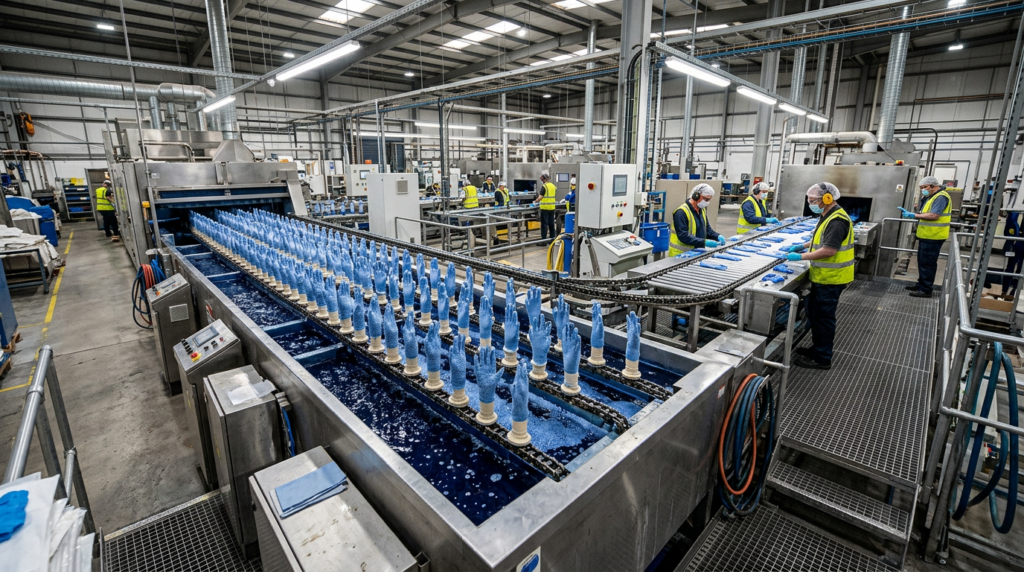
Our vertically integrated manufacturing — spanning R&D, material sourcing, knitting, nitrile foam dipping, drying/curing, quality inspection, packaging, and export logistics — ensures consistent quality at factory-direct pricing. With over a decade of hands-on production expertise, 6 dedicated production lines producing 150,000 pairs per day, and full ISO 9001 and CE certification, we deliver OEM/ODM nitrile foam gloves from concept to delivery with fast turnaround times. Browse our complete catálogo de productos o contacte con nuestro equipo to request free samples and a competitive quotation for the German market.
FAQ
What EN 388 rating should I look for in nitrile foam gloves?
For standard general-purpose nitrile foam gloves in Germany, look for EN 388:2016 rating of 4121X — Level 4 abrasion resistance (8,000+ Martindale cycles), Level 1 blade cut, Level 2 tear, and Level 1 puncture. For cut-resistant variants on HPPE liners, the rating should read 4X43C or higher, with the ISO 13997 cut level (A–F) as the final character.
Which nitrile foam gloves coating style is best for oily environments?
For light oil and machining fluid exposure, standard nitrile foam palm coating provides adequate grip. For heavier oil contamination, upgrade to sandy nitrile or nitrile micro-foam coatings, which offer superior oil channeling. The foam coating’s open-cell structure provides moderate oil resistance but is not designed for full immersion in petroleum-based fluids.
How to choose the right gauge for nitrile foam gloves?
Select 13G for the best all-around balance of protection and dexterity in warehousing, manufacturing, and MRO tasks. Choose 15G or 18G for precision assembly, electronics, and quality inspection where tactile sensitivity is paramount. Opt for 10G when warmth, cushioning, and robust handling are priorities, such as outdoor construction or cold-storage work.
What certifications are required to import nitrile foam gloves into Germany?
All safety gloves sold in Germany must comply with EU Regulation 2016/425 and carry CE marking. Category II distribuidor de EPI requires EU Type Examination by an accredited notified body, EN 388:2016+A1:2018 test certification, a German-language EU Declaration of Conformity, REACH compliance documentation, and SVHC substance declarations. Importers must maintain a technical file accessible to market surveillance authorities.
What is the price range for bulk nitrile foam gloves orders?
For factory-direct orders (typical MOQ 5,000–10,000 pairs), 13G nylon-liner nitrile foam gloves range from €0.22–€0.45 per pair. Cut-resistant HPPE-liner variants cost €0.45–€0.80 per pair. The 15G precision variants range from €0.28–€0.50 per pair. Custom branding, color coding, and retail packaging add approximately €0.05–€0.15 per pair.
How long do nitrile foam gloves typically last?
Service life depends on application intensity. In light assembly and inspection, nitrile foam gloves typically last 4–6 weeks. In warehousing and logistics with heavy box handling, expect 2–4 weeks. In construction and outdoor maintenance, 1–3 weeks is realistic. Replace gloves immediately when the foam coating shows peeling, through-holes, or noticeable grip degradation.
Are nitrile foam gloves safe for workers with latex allergies?
Yes. Nitrile foam gloves contain zero natural rubber latex proteins. They are the preferred alternative for workplaces where latex allergy is a concern. This is a significant advantage in Germany, where awareness of occupational skin conditions (including Type I and Type IV latex allergies) is high and DGUV regulations require employers to provide non-sensitizing PPE alternatives.
¿Cuál es la diferencia entre los recubrimientos de espuma de nitrilo y microespuma de nitrilo?
Nitrile foam has larger, more uniform open cells that prioritize breathability and dry-to-damp grip versatility. Nitrile micro-foam features a finer, denser cell structure that delivers enhanced liquid absorption and superior grip on wet and oily surfaces. Micro-foam is the upgrade choice when moisture exposure is frequent; foam is the better option when breathability and comfort are the top priorities.
Can nitrile foam gloves be used for touchscreen operation?
Standard nitrile foam gloves are not inherently touchscreen-compatible because the foam coating is non-conductive. However, manufacturers can integrate conductive fibers (silver-coated nylon or carbon fiber) into the thumb and index fingertip zones during the knitting process, enabling capacitive touchscreen operation. Specify touchscreen compatibility when ordering for logistics and smart factory applications.
What DGUV requirements apply to nitrile foam gloves procurement in Germany?
Under DGUV Regel 112-195, employers must conduct a formal workplace hazard assessment, select CE-certified gloves that match the identified risks, provide gloves at no cost to employees, ensure proper fit through sizing trials, deliver user training on correct donning and doffing, and maintain documentation of the entire selection rationale. Compliance is subject to Berufsgenossenschaft inspection.
Whether you are an end-user enterprise seeking factory-direct nitrile foam gloves supply, a PPE distributor expanding your German product portfolio, or an e-commerce brand developing a private-label line, Seguridad Snell is ready to support you with precisely tailored products and comprehensive local-market empowerment. Envíe sus requisitos o solicite un presupuesto hoy mismo — including free samples, custom OEM/ODM development, and dedicated technical consultation for the German market.
Contenido revisado y actualizado: marzo 2026