Best Cut Resistant Sleeves Suppliers in Germany | 2026 Guide
2026-04-04
Share This Article
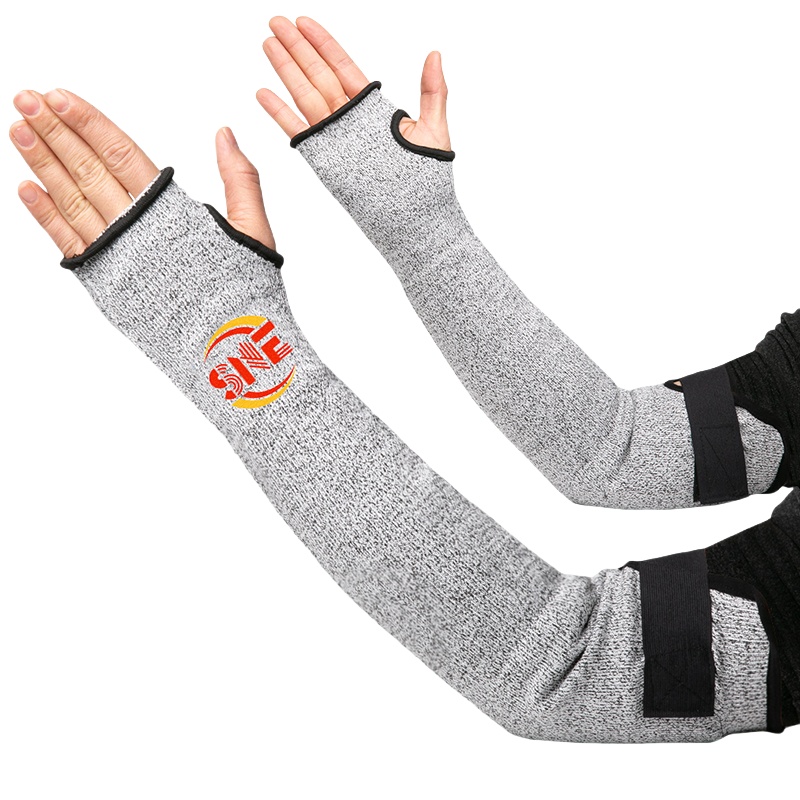
Cut resistant sleeves are an essential but often overlooked component of forearm and wrist protection across Germany’s manufacturing, automotive, construction, and metal fabrication industries. Arm injuries account for nearly 23% of reported incidents in construction, manufacturing, and oil & gas sectors where PPE mandates are intensifying. With Germany’s position as Europe’s leading industrial hub, procurement teams and safety managers must source cut resistant sleeves that meet EN 388:2016 standards while offering the right balance of protection, comfort, and breathability for specific workplace conditions.
If you need expert guidance selecting the right cut resistant sleeves for the German market, or want to explore OEM/ODM custom manufacturing with CE-certified products, contact our team at Snell Safety. We have served numerous German clients and understand local protection requirements inside and out.
Quick Answer
For sourcing high-quality cut resistant sleeves in Germany, consider established local PPE distributors with strong regional coverage and EN 388-certified product portfolios. Additionally, Chinese manufacturers who specialize in customized products with competitive pricing and full international certifications (ISO 9001/CE) offer excellent OEM/ODM flexibility for private-label and bulk programs. A blended sourcing strategy — combining local distributors for quick replenishment with a factory-direct partner for customized bulk orders — delivers optimal cost and supply chain performance.
Market Overview
The Germany Safety Gloves Market is projected to grow from USD 1,068.97 million in 2023 to an estimated USD 2,100.86 million by 2032, reflecting a compound annual growth rate (CAGR) of 7.78% from 2024 to 2032. Cut resistant sleeves, which function as complementary arm protection paired with safety gloves, are riding this same growth wave. The global cut resistant sleeves market size was valued at approximately USD 1.5 billion in 2023 and is projected to reach around USD 2.8 billion by 2032, growing at a robust CAGR of 6.7% during the forecast period.
This significant growth is driven by increasing awareness of workplace safety and stringent regulations across industries such as construction, healthcare, and manufacturing, along with the enforcement of occupational safety standards and the rise in industrial activities. Germany’s robust manufacturing sector and UK construction activity drive steady demand across the European arm protection market. Under Germany’s Arbeitsschutzgesetz (ArbSchG) and DGUV regulations, employers are legally obligated to conduct risk assessments and provide appropriate PPE — including arm protection — at no cost to workers, creating a compliance-driven procurement cycle.
What Types of Cut Resistant Sleeves Are Most in Demand in Germany
The most popular cut resistant sleeves in Germany feature HPPE, Kevlar, or blended fiber construction with EN 388 cut ratings from level C to level F, depending on the application severity. Based on our experience serving German clients across automotive, metal fabrication, glass handling, and general manufacturing, we consistently see demand concentrated around lightweight, breathable sleeves that provide all-day wearing comfort without sacrificing cut performance.
Through years of collaboration with distributors, HSE managers, and end-user enterprises in Germany, we have identified clear preferences shaped by the country’s industrial profile. Automotive suppliers in Baden-Württemberg and Bavaria prefer thin-gauge 18G HPPE sleeves that allow maximum dexterity for parts handling, while metalworking shops in North Rhine-Westphalia demand heavier Kevlar-blend sleeves with heat resistance for near-weld and grinding tasks. A common thread across all German industries is the emphasis on skin comfort — many German workers wear sleeves for 8–10 hour shifts, making breathability, moisture-wicking, and hypoallergenic fiber construction critical buying factors. Here are the top product types we supply most frequently to the German market:
- 18G HPPE + Spandex Knit Sleeve, EN 388 Cut Level C (35 cm length) — Lightweight everyday arm protection for automotive assembly, parts handling, and light manufacturing. The high-gauge knit delivers a second-skin fit with excellent breathability. Thumb slot keeps the sleeve in position during repetitive arm movements.
- 13G HPPE + Glass Fiber + Nylon Knit Sleeve, EN 388 Cut Level D (40 cm length) — Mid-range protection for metal stamping, sheet metal handling, and construction material processing. The glass fiber reinforcement boosts cut performance without adding significant weight.
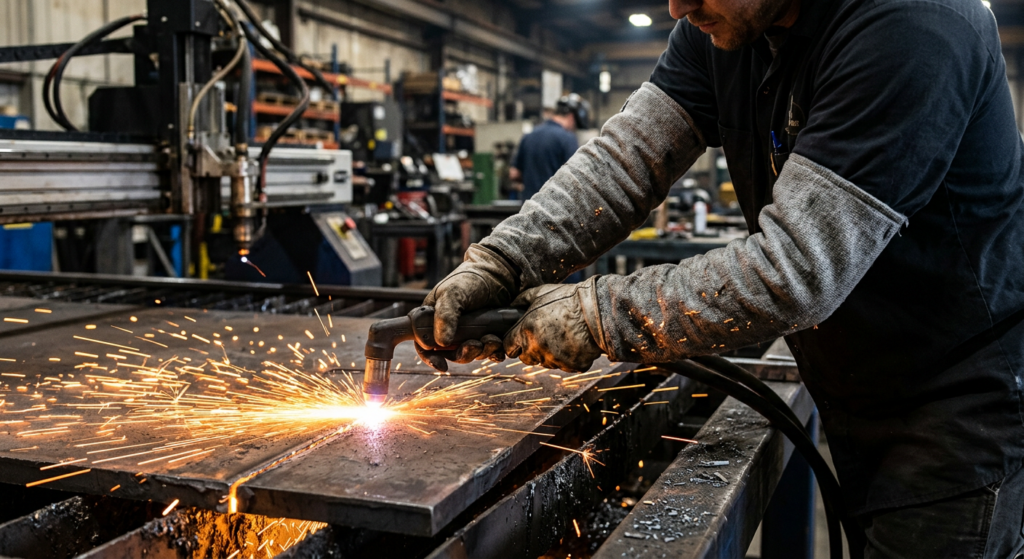
- 10G Kevlar + Cotton Jersey Knit Sleeve, EN 388 Cut Level E (45 cm length, with thumb loop) — Heavy-duty arm protection for welding-adjacent tasks, metal fabrication, and glass handling. Kevlar provides inherent heat resistance up to 250 °C, critical for tasks near hot-work zones. The cotton jersey interior adds comfort for extended wear.
- 15G HPPE + Steel Wire + Spandex Knit Sleeve, EN 388 Cut Level F (40 cm length) — Maximum cut protection for glass processing, razor-sharp metal edge handling, and recycling operations. Steel wire reinforcement achieves the highest EN 388 cut rating while the spandex blend maintains flexibility.
- 13G Kevlar Knit Sleeve with PU Forearm Coating, EN 388 Cut Level D (35 cm length) — Specialized variant combining cut resistance with liquid splash protection on the forearm, ideal for oily metalworking environments and CNC machining operations.
Why These Cut Resistant Sleeve Types Are Recommended
Gloves with an EN 388 rating are third party tested for abrasion, cut, tear, puncture and impact resistance. The same EN 388:2016+A1:2018 framework applies to cut resistant sleeves, evaluating cut performance using both the traditional Coup Test and the ISO 13997 (TDM-100) method. The most distinct component to the EN 388 2016 standard is the formal inclusion of the ISO 13997 cut test method, also known as the “TDM-100 Test”, which is similar to the ASTM F2992-15 test method used in the ANSI 105 standard. For German buyers, the ISO 13997 letter rating (A through F) provides the most reliable indication of real-world cut protection because it measures the force in Newtons required to cut through the material — eliminating the blade-dulling variability of the older Coup Test.
The recommended specifications are aligned to the actual hazard profiles in German workplaces. Cut Level C (10–15 N) suffices for general automotive assembly and light manufacturing where incidental contact with edges is the primary risk. Cut Level D (15–22 N) addresses the more demanding requirements of metal stamping, sheet metal fabrication, and construction environments. Cut Levels E (22–30 N) and F (≥30 N) are reserved for the most extreme applications — glass handling, sharp metal recycling, and demolition — where forearm lacerations could cause life-threatening injuries.
| Specification | Fiber Composition | EN 388 Cut Level | Weight (g/sleeve) | Best Application | Cut Resistant Sleeves Type |
|---|---|---|---|---|---|
| 18G HPPE + Spandex | HPPE 85%, Spandex 15% | C (10–15 N) | 35–45 | Automotive, light assembly | Lightweight daily wear |
| 13G HPPE + Glass Fiber | HPPE 70%, Glass 20%, Nylon 10% | D (15–22 N) | 55–70 | Metal stamping, construction | Mid-range multi-hazard |
| 10G Kevlar + Cotton | Kevlar 60%, Cotton 40% | E (22–30 N) | 80–100 | Welding-adjacent, glass | Heavy-duty with heat resistance |
| 15G HPPE + Steel Wire | HPPE 75%, Steel 15%, Spandex 10% | F (≥30 N) | 65–80 | Glass processing, recycling | Maximum cut protection |
| 13G Kevlar + PU Coating | Kevlar 80%, Nylon 20% + PU forearm | D (15–22 N) | 70–85 | CNC machining, oily metal | Cut Resistant Sleeves with splash guard |
Use this table to match your workers’ primary forearm hazard profile to the optimal sleeve specification, balancing protection level with comfort and budget.
Key technical advantages of these recommendations include:
- Gauge-to-protection optimization: 18G delivers maximum flexibility for fine assembly; 13G balances protection and comfort; 10G provides the thickest padding for heavy-duty use.
- Fiber synergy: HPPE + glass fiber achieves higher cut ratings than HPPE alone at comparable weight, while Kevlar adds thermal protection for multi-hazard environments.
- Breathability engineering: Higher-gauge knits (15G, 18G) with spandex blends allow superior air circulation, reducing sweat accumulation during long shifts — a decisive factor in German worker acceptance and compliance.
Key Industries for Cut Resistant Sleeves in Germany
Cut resistant sleeves serve critical arm protection roles across Germany’s most productive industrial sectors, from automotive manufacturing to food processing. The expanding automotive, manufacturing, and construction sectors significantly contribute to market growth as these industries rely on manual labor and advanced machinery, increasing exposure to potential risks.
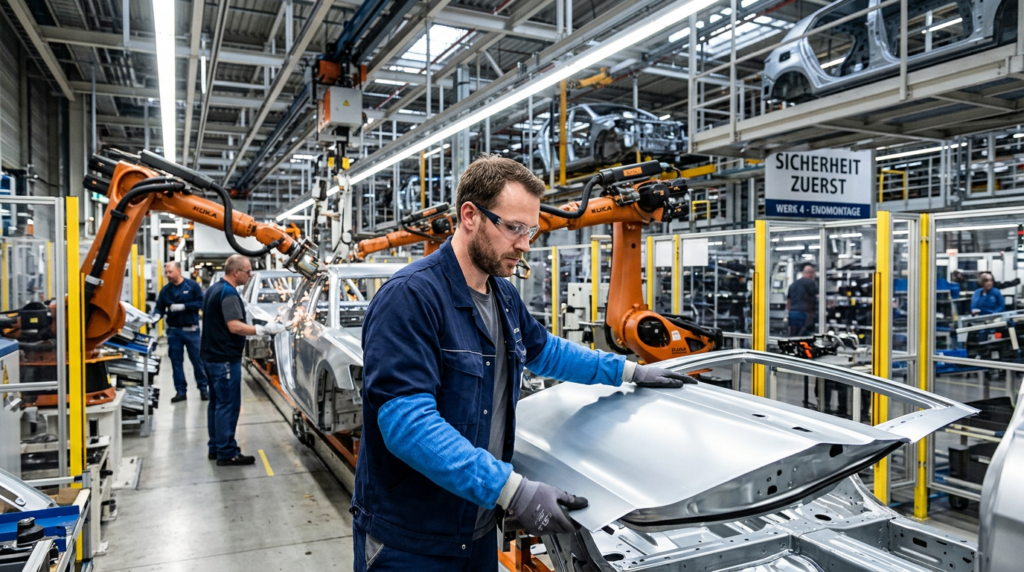
- Automotive Manufacturing: Germany’s automotive sector (BMW, Mercedes-Benz, Volkswagen supply chains) generates enormous demand for lightweight cut resistant sleeves. Assembly line workers handling stamped metal panels, wiring harnesses, and glass components face constant forearm laceration risk. EN 388 cut level C–D sleeves in 18G or 15G gauge are standard requirements for Tier 1 and Tier 2 suppliers.
- Metal Fabrication and Machining: CNC operators, stamping press workers, and metal finishers require cut resistant sleeves that withstand sharp burrs, swarf, and metal edge contact. EN 388 cut level D–E with oil-resistant forearm coatings are commonly specified, especially in the Ruhr Valley and Swabia industrial corridors.
- Glass Handling and Processing: Flat glass manufacturing, window fabrication, and automotive glass installation workers face extreme laceration hazards. EN 388 cut level F sleeves with 15G HPPE + steel wire construction provide the maximum forearm protection required for these high-risk tasks.
- Construction and Demolition: Rebar tying, steel erection, and demolition work expose forearms to sharp edges and abrasive surfaces. Workers typically pair cut resistant sleeves (level C–D) with compatible cut-resistant gloves for full hand-to-upper-arm coverage.
- Food Processing and Commercial Kitchens: Germany’s large-scale meat processing, fish filleting, and industrial kitchen operations require hygienic, washable cut resistant sleeves rated to EN 388 cut level C or higher, often in white or blue for visual contamination detection.
- Recycling and Waste Processing: Workers sorting construction debris, scrap metal, and electronic waste encounter unpredictable sharp objects. High-cut-level sleeves (EN 388 E–F) with puncture resistance are critical in this rapidly growing German sector.
Germany’s industrial safety gloves market is anticipated to experience substantial growth from 2025 to 2034, driven by increasing industrial activities, stricter safety regulations, and a growing emphasis on workplace safety standards. Germany’s focus on technological innovation and high-quality manufacturing processes encourages the adoption of advanced safety gloves with enhanced cut, chemical, and impact protection. In Germany, occupational safety and health are regulated by a dual occupational safety system, meaning that in addition to the state, the German Social Accident Insurance Institutions are also responsible for occupational safety and health. This dual framework — state ArbSchG regulations plus DGUV/BG oversight — ensures consistent enforcement of PPE requirements, sustaining year-round demand for certified cut resistant sleeves across all federal states.
Specific Application Scenarios for Cut Resistant Sleeves
Scenario 1: Automotive Stamping Plant in Stuttgart
In a large Tier 1 automotive supplier near Stuttgart, 120 press operators handle freshly stamped body panels and structural reinforcements from progressive die presses. Each panel edge is razor-sharp after blanking, and operators must lift, inspect, and rack these components repeatedly throughout their shift. Forearm lacerations from sharp panel edges are the single most common recordable injury category. The recommended specification is 18G HPPE + spandex cut resistant sleeves rated EN 388 cut level C, 35 cm length with integrated thumb slot. The ultra-thin 18G knit allows workers to maintain tactile sensitivity for quality inspections while the HPPE fiber prevents laceration from incidental edge contact. Workers pair these with 18G PU-coated cut resistant gloves for complete hand-to-elbow coverage.
Scenario 2: Flat Glass Processing Facility in North Rhine-Westphalia
A flat glass manufacturer near Düsseldorf employs 60 workers who cut, edge, laminate, and transport large glass sheets (up to 3.2 m × 6.0 m). Glass edge contact during manual handling creates extreme laceration risk — a single unprotected forearm contact can result in deep tendon-severing injuries requiring months of rehabilitation. Workers are required to wear 15G HPPE + steel wire cut resistant sleeves rated EN 388 cut level F, 40 cm length with adjustable bicep strap, providing maximum forearm protection. The steel wire reinforcement achieves cut resistance exceeding 30 N while maintaining enough flexibility for workers to bend elbows freely during glass manipulation tasks.
Scenario 3: Industrial Meat Processing Plant in Lower Saxony
In a high-throughput meat processing facility near Oldenburg, 200 butchers and meat cutters work with sharp knives, band saws, and deboning tools for 8-hour shifts. Forearm cuts from blade deflection and bone splinters are persistent hazards that require both cut and puncture protection. The recommended specification is 13G HPPE + glass fiber + nylon cut resistant sleeves rated EN 388 cut level D, 40 cm length with thumb loop, paired with stainless steel mesh forearm guards for the highest-risk deboning stations. The sleeves must be machine-washable at 60 °C for hygiene compliance and available in food-safe blue color for visual foreign body detection.
Case Studies
Case 1: Automotive Parts Supplier, Baden-Württemberg
A mid-sized German automotive supplier with 8 production facilities needed to standardize their cut resistant sleeves specification across all plants — replacing a patchwork of 6 different products from 3 suppliers. They partnered with a vertically integrated OEM manufacturer to develop a single optimized 18G HPPE sleeve in two cut levels (C and D) with company-branded packaging and unified size labeling. The consolidated specification reduced procurement costs by 22% while improving compliance rates from 74% to 96% within six months.
Case 2: PPE Distributor Expanding Arm Protection Line
A German PPE distributor based in Hamburg identified cut resistant sleeves as a high-growth category with limited private-label competition. They commissioned an OEM partner to produce 4 SKUs spanning cut levels C through F, each with bilingual (German/English) EN 388 labeling, individual poly-bag packaging, and branded header cards. The first order of 25,000 pairs shipped within 25 days, complete with product photography, data sheets, and CE technical documentation for Amazon.de and B2B webshop listings.
Top 6 Recommended Local Cut Resistant Sleeves Suppliers in Germany
| Company Name | Core Strengths | Service Regions | Pre-sale Support | After-sale Support |
|---|---|---|---|---|
| RheinSchutz Armprotection | Specialized Cut Resistant Sleeves for automotive and metal fabrication sectors | NRW, Hessen, Rhineland-Palatinate | EN 388 compliance consulting, sample programs | Dedicated account managers, quarterly stock reviews |
| BayerArm Sicherheit GmbH | Premium dexterity-focused arm sleeves for precision manufacturing | Bavaria, Baden-Württemberg | On-site hazard assessments, ergonomic fit trials | Warranty handling, field performance feedback |
| NordArm PPE Handel | Broad multi-industry catalog including food-grade and industrial sleeves | Hamburg, Lower Saxony, Schleswig-Holstein | Technical data sheets, regulatory guidance | Express replacement shipping, returns processing |
| SachsenGuard Arbeitsschutz | Cost-effective bulk Cut Resistant Sleeves for construction and recycling | Saxony, Brandenburg, Thuringia | Government tender support, specification matching | On-site quality inspections, batch traceability |
| HansaTextil Safety | E-commerce-ready packaging and Amazon.de fulfillment integration | Nationwide via Hamburg hub | Product listing content, certification documents | Consumer support, rating management |
| AlpenCut Schutzprodukte | High-cut-level specialist (EN 388 E–F) for glass and heavy metal industries | Nationwide (industrial zone focus) | Custom specification development, risk assessments | Wear-life tracking, field replacement programs |
When evaluating cut resistant sleeves suppliers, always verify EN 388:2016+A1:2018 test reports from EU-accredited notified bodies and request wash-durability data to confirm that cut performance is maintained after repeated laundering cycles.
Why Choose Snell Safety as Your Global Cut Resistant Sleeves Partner
Snell Safety has built deep German market expertise through years of serving PPE distributors, automotive OEMs, and industrial safety buyers across Germany. We understand precisely which fiber blends, gauge constructions, cut levels, and sleeve lengths perform best in German workplaces — from the ultra-thin 18G HPPE models favored by Stuttgart automotive suppliers to the heavy-duty Kevlar-blend sleeves demanded by NRW metalworking shops. With established local partners and planned overseas warehouse capacity for stock-ready delivery in Germany, we serve both end-user enterprises and distribution channels with products tailored to local working conditions, hand-feel preferences, and regulatory requirements. We are actively recruiting new distributors, agents, and e-commerce brand owners — offering pre-sale empowerment (product selection guidance, technical training, market intelligence), after-sale support (quality assurance, replacement policies), dropshipping services, free samples, and marketing material support.
Our manufacturing strength ensures this market knowledge translates into real product excellence. With over a decade of hands-on production expertise, 6 dedicated production lines, and a daily capacity of 150,000 pairs, our vertically integrated process (R&D → material sourcing → knitting → quality inspection → packaging → export) delivers consistent quality at factory-direct pricing. We engineer cut resistant sleeves using the full range of advanced fibers — HPPE, Kevlar, glass fiber, steel wire, nylon, and spandex — and maintain ISO 9001 and CE certifications for seamless EU market compliance. Browse our product catalog or contact our team to request samples and a custom quotation.
| Capability | Details |
|---|---|
| Daily Production Capacity | 150,000 pairs across 6 lines |
| Cut Resistant Sleeves Materials | HPPE, Kevlar, glass fiber, steel wire, nylon, spandex |
| Gauge Options | 7G, 10G, 13G, 15G, 18G |
| EN 388 Cut Levels Available | A through F |
| Customization | OEM/ODM private label, custom branding, custom lengths (30–55 cm), custom colors |
| Certifications | ISO 9001, CE marking |
Use this table to evaluate whether Snell Safety’s manufacturing capabilities align with your sourcing requirements.
FAQ
What EN 388 cut level do I need for cut resistant sleeves in German manufacturing?
For general automotive assembly and light manufacturing, EN 388 cut level C (10–15 N) provides sufficient protection against incidental sharp-edge contact. Metal fabrication and stamping operations typically require cut level D (15–22 N). Glass handling and heavy metal recycling demand cut levels E (22–30 N) or F (≥30 N) for maximum forearm safety.
What is the difference between EN 388 cut levels and ANSI/ISEA 105 levels?
EN 388:2016 uses an A–F letter scale based on ISO 13997 (TDM-100) testing measured in Newtons, while ANSI/ISEA 105 uses an A1–A9 scale measured in grams. Both use similar blade-on-material test methods but have different breakpoint thresholds. In Germany, EN 388 is the required standard for CE-marked PPE, while ANSI is supplementary.
How should I wash and maintain cut resistant sleeves?
Most HPPE and Kevlar cut resistant sleeves can be machine washed at 40–60 °C using mild detergent without bleach. Tumble dry on low heat or air dry. Cut resistance generally holds up through 30–50 wash cycles depending on fiber composition and construction quality. Always check the manufacturer’s care label and re-test cut performance periodically.
What certifications are required to import cut resistant sleeves into Germany?
Cut resistant sleeves are classified as Category II PPE under EU Regulation 2016/425 and must carry CE marking. They require EU Type Examination by an accredited notified body, EN 388:2016+A1:2018 testing, and a German-language EU Declaration of Conformity. REACH compliance documentation is also mandatory for EU market entry.
How long do cut resistant sleeves typically last in industrial use?
Service life depends on the application intensity and fiber quality. In heavy metal fabrication and glass handling, expect 2–4 weeks per pair. For general automotive assembly and light manufacturing, 4–8 weeks is typical. Laundering frequency, chemical exposure, and abrasion intensity all affect lifespan. Replace immediately when fibers are visibly damaged or cut protection feels degraded.
What is the price range for bulk cut resistant sleeves orders?
For factory-direct OEM orders (MOQ 3,000–5,000 pairs), prices typically range from €1.00–€2.00 per pair for standard 18G HPPE sleeves (cut level C) to €3.50–€6.00 per pair for premium 10G Kevlar or 15G HPPE + steel wire sleeves (cut levels E–F). Custom branding, specialized features, and individual poly-bag packaging add €0.10–€0.30 per pair.
Can cut resistant sleeves also provide heat protection?
Yes. Kevlar-based cut resistant sleeves offer inherent heat resistance up to approximately 250 °C for brief contact, making them suitable for welding-adjacent tasks and hot material handling. For applications requiring certified heat protection, look for sleeves tested to EN 407 in addition to EN 388. HPPE sleeves do not provide heat resistance and may shrink above 130 °C.
How do I choose the right sleeve length for my workers?
Standard lengths range from 30 cm (wrist-to-mid-forearm) to 55 cm (wrist-to-upper-bicep). For most manufacturing and construction tasks, 35–40 cm sleeves provide adequate forearm coverage. Glass handling and demolition work benefit from 45–55 cm sleeves that protect the full arm from wrist to bicep. Always measure workers’ arm lengths and consider overlap with glove cuffs to eliminate any gap in coverage.
Should cut resistant sleeves be paired with cut resistant gloves?
Yes, absolutely. Cut resistant sleeves protect the forearm and wrist, but they leave hands exposed. For comprehensive hand-to-upper-arm protection, pair sleeves with EN 388-rated cut resistant gloves in a matching or higher cut level. Ensure the glove cuff overlaps the sleeve edge by at least 3–5 cm to eliminate any unprotected gap where laceration injuries could occur.
Whether you are an end-user enterprise seeking reliable factory-direct supply of cut resistant sleeves, a PPE distributor expanding your German product catalog, or an e-commerce brand developing a private-label arm protection line, Snell Safety is ready to support your requirements. Submit your specifications or request a quote today — including free samples, custom OEM/ODM solutions, and dedicated technical consultation for the German market.
Content reviewed and updated: March 2026