Best Cold Protection Gloves Suppliers in Germany | 2026 Guide
2026-04-02
Share This Article
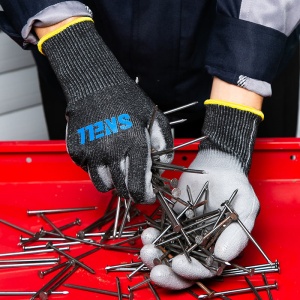
Cold protection gloves are an essential component of workplace safety across Germany’s construction sites, logistics hubs, cold storage facilities, and outdoor manufacturing operations. Winter temperatures in Germany range from -1 °C to 3 °C during December through February, and eastern Germany, including Berlin and Dresden, can experience harsh continental weather patterns with temperatures occasionally dropping to -15 °C during particularly cold winters. For millions of German workers who perform manual tasks in these conditions, properly certified cold protection gloves are not optional — they are a regulatory requirement under the Arbeitsschutzgesetz (ArbSchG) and DGUV frameworks.
Whether you are a PPE distributor sourcing winter gloves for your catalog, an EHS manager at a manufacturing plant, or an e-commerce brand owner building a cold-weather product line, this guide delivers the technical insight and supplier intelligence you need. If you need tailored product recommendations or custom OEM/ODM cold protection gloves for the German market, contact our team — Snell Safety has extensive experience serving German clients and can help you identify the ideal configurations for your specific applications.
Quick Answer
For sourcing high-quality cold protection gloves in Germany, consider established local PPE distributors with deep inventory across EN 511 and EN 388-rated thermal gloves, as well as Chinese manufacturers who specialize in customized products with competitive pricing and full international certifications (ISO 9001/CE). A dual-sourcing strategy — pairing a local distributor for quick restocking with a factory-direct OEM partner for customized bulk production — typically yields the best balance of flexibility, cost, and product quality.
Market Overview
The Germany Safety Gloves Market is projected to grow from USD 1,068.97 million in 2023 to an estimated USD 2,100.86 million by 2032, reflecting a compound annual growth rate (CAGR) of 7.78% from 2024 to 2032. Within this expansion, cold protection gloves represent one of the fastest-growing subcategories, driven by stringent winter workplace safety enforcement and Germany’s massive outdoor workforce in construction, logistics, and energy infrastructure. The need for high-performance safety gloves — such as cut-resistant, chemical-resistant, and thermal-resistant gloves — has risen as Germany’s industrial sectors modernize and automate.
In Germany, occupational safety and health are regulated by a dual occupational safety system, meaning that in addition to the state, the German Social Accident Insurance Institutions are also responsible for occupational safety and health. Under DGUV Regulation 1, Section 23, employers working their staff outdoors must implement suitable measures to counter weather-related hazards — including providing EN 511-certified cold protection gloves. Hand injuries constitute up to 30% of the total cases treated in emergency departments, making hand protection a top priority for German safety procurement teams during the extended cold season from November through March.
What Types of Cold Protection Gloves Are Needed in Germany
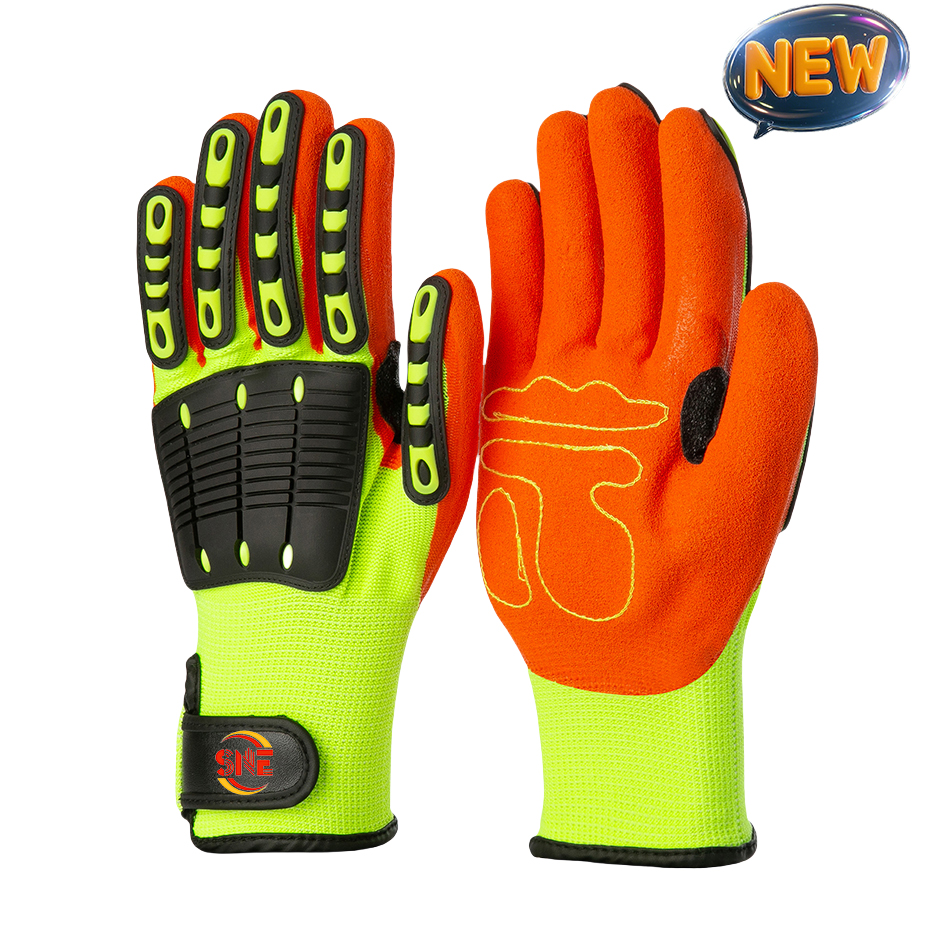
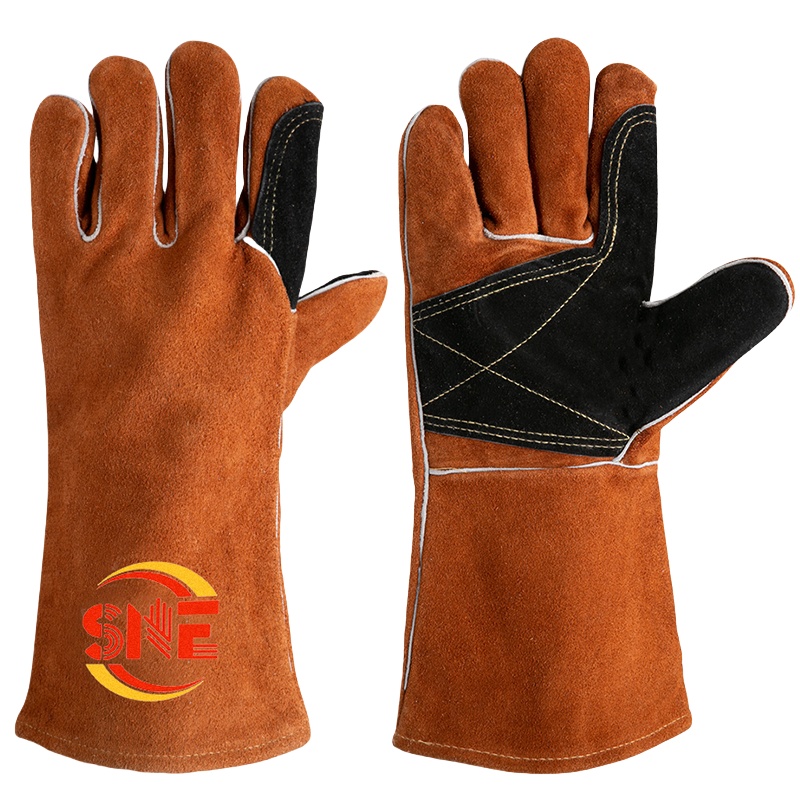
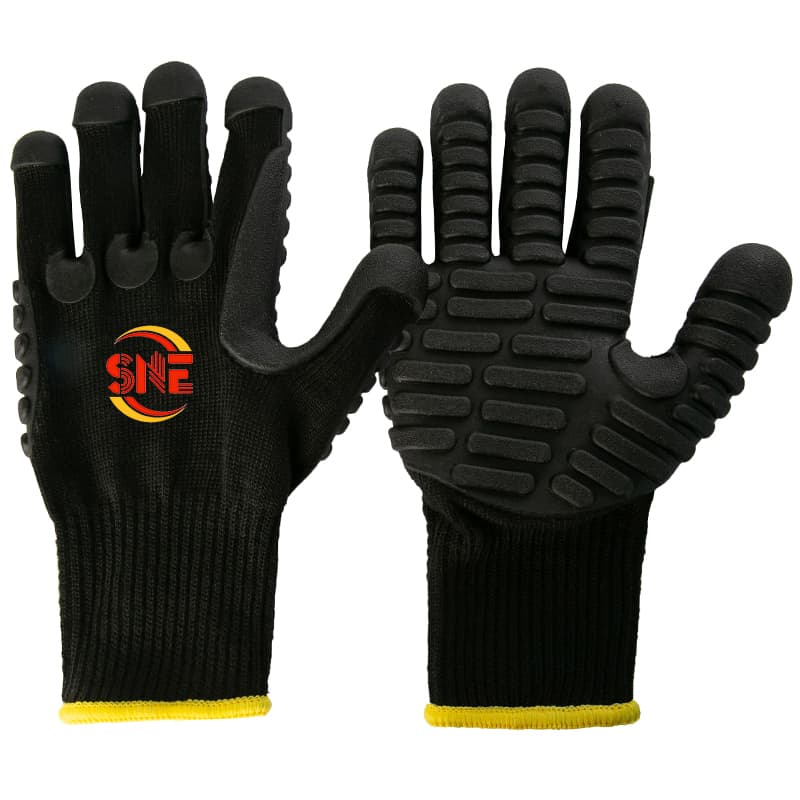
The most in-demand cold protection gloves in Germany combine thermal insulation (EN 511 rated) with mechanical protection (EN 388 rated), waterproof membranes, and high-grip coatings that maintain performance in wet and icy conditions. Based on our experience serving German clients across construction, logistics, automotive, and cold storage sectors, the German market demands gloves that balance warmth retention with dexterity — German workers are particularly discerning about hand feel and refuse to tolerate bulky gloves that impede precision tasks.
Through years of collaboration with distributors and end-user companies throughout Germany, we have identified a clear pattern: buyers in northern and coastal regions (Hamburg, Bremen, Schleswig-Holstein) prioritize wind resistance and waterproofing due to the damp maritime climate, while buyers in Bavaria and eastern Germany focus on thermal insulation for dry cold conditions that can drop well below -10 °C. Across all regions, grip performance on wet steel, icy surfaces, and oily components remains a universal requirement. The following product configurations represent our highest-demand exports to German buyers:
- 13G HPPE + Nylon + Spandex Liner with Nitrile Foam Palm Coating + Fleece/Acrylic Inner Lining — EN 511: 2×1 (Convective 2, Contact 2, Waterproof 1). EN 388: 4X42C. Cut level C. Ideal for construction, utilities, and general outdoor maintenance in moderate cold (0 °C to -10 °C). Sizes M–XXL.
- 10G Polyester + Cotton Jersey Liner with Latex Crinkle 3/4 Coating + Thinsulate-Type Thermal Insert — EN 511: 3×1 (Convective 3, Contact 3, Waterproof 1). EN 388: 2X41B. Heavy-duty warmth for logistics, warehousing, and cold storage work (-10 °C to -25 °C). Sizes L–XXL.
- 15G Nylon Liner with PU Palm Coating + Brushed Acrylic Interior — EN 511: 1×0 (Convective 1, Contact 1, Not Waterproof). EN 388: 4X31B. Lightweight cold protection for precision assembly and automotive tasks in unheated workshops (0 °C to 5 °C). Sizes S–XL.
- 13G HPPE + Kevlar + Glass Fiber Liner with Sandy Nitrile Full Coating + Fleece Lining — EN 511: 2×1. EN 388: 4X44D. Cut level D combined with cold protection and superior grip. Designed for metal fabrication, pipeline work, and oil and gas operations in winter. Sizes M–XXL.
- 7G Acrylic/Wool Loop-Pile Liner with Latex Crinkle Full Coating — EN 511: 3×0. EN 388: 2X21A. Maximum warmth for heavy-duty outdoor work in extreme cold; popular with road construction and forestry crews. Sizes L–XXL.
Why These Cold Protection Gloves Are Recommended
Each recommended specification addresses a distinct combination of cold exposure, mechanical hazard, and grip requirements governed by Germany’s EN-based regulatory framework. EN 511 is the European standard that addresses the specific requirements and test methods for gloves that protect against cold. The standard outlines three specific performance levels relating to convective cold resistance, contact cold resistance, and water permeability. Crucially, to certify a glove according to EN 511, it must also meet abrasion resistance and tear resistance according to EN 388 of at least level 1 — meaning cold protection gloves in Germany must demonstrate both thermal and mechanical competence simultaneously.
The choice of liner material, gauge, and coating technology has a direct impact on the warmth-to-dexterity ratio that German buyers scrutinize carefully. Lower gauge counts (7G, 10G) accommodate thicker thermal fibers like acrylic loop-pile and wool blends, delivering EN 511 convective cold ratings of 3 or higher for extreme environments. Higher gauge counts (13G, 15G) with brushed acrylic or fleece inner linings provide moderate warmth (EN 511 convective cold 1–2) while preserving the tactile sensitivity required for operating machinery controls, touchscreen devices, and handling small components.
| Performance Metric | Sandy Nitrile + HPPE (13G) | Latex Crinkle + Polyester (10G) | PU Palm + Nylon (15G) | Latex Crinkle + Acrylic (7G) |
|---|---|---|---|---|
| EN 511 Convective Cold | Level 2 | Level 3 | Level 1 | Level 3 |
| EN 511 Contact Cold | Level 2 | Level 3 | Level 1 | Level 3 |
| EN 511 Water Permeability | Pass (1) | Pass (1) | Fail (0) | Fail (0) |
| EN 388 Cut Resistance | Level D | Level B | Level B | Level A |
| Cold Protection Gloves Type | Multi-Hazard Winter | Heavy-Duty Thermal | Precision Cold-Weather | Extreme Cold Outdoor |
| Dexterity Rating | Good | Moderate | Excellent | Low |
| Approx. Bulk Price (€/pair) | €3.80–€6.50 | €2.80–€4.80 | €2.50–€4.00 | €2.00–€3.50 |
Use this comparison table to match your primary cold exposure level, mechanical hazard profile, and dexterity requirements to the optimal cold protection gloves specification.
Key technical factors to consider:
- Thermal liner selection: Brushed acrylic linings provide warmth-to-weight ratios superior to raw cotton, while loop-pile acrylic and wool blends maximize insulation for stationary or low-activity tasks below -15 °C.
- Coating waterproofing: Latex crinkle and sandy nitrile full coatings paired with waterproof membranes achieve EN 511 water permeability level 1, critical for Germany’s wet winter conditions.
- Grip retention in cold: Sandy nitrile and latex crinkle coatings maintain grip on wet, oily, and icy surfaces down to -20 °C, while smooth PU coatings may stiffen below -5 °C.
- Cost-effectiveness: At €2.50–€6.50 per pair in bulk (MOQ 5,000+), quality cold protection gloves prevent cold-related injuries that cost German employers thousands of euros per incident in medical expenses, lost productivity, and DGUV insurance claims.
Key Industries for Cold Protection Gloves in Germany
Cold protection gloves are essential across every German industry where workers perform manual tasks outdoors or in unheated/refrigerated environments during the extended cold season. The expanding automotive, manufacturing, and construction sectors significantly contribute to market growth as these industries rely on manual labor and advanced machinery, increasing exposure to potential risks. The following industries represent the largest demand segments:
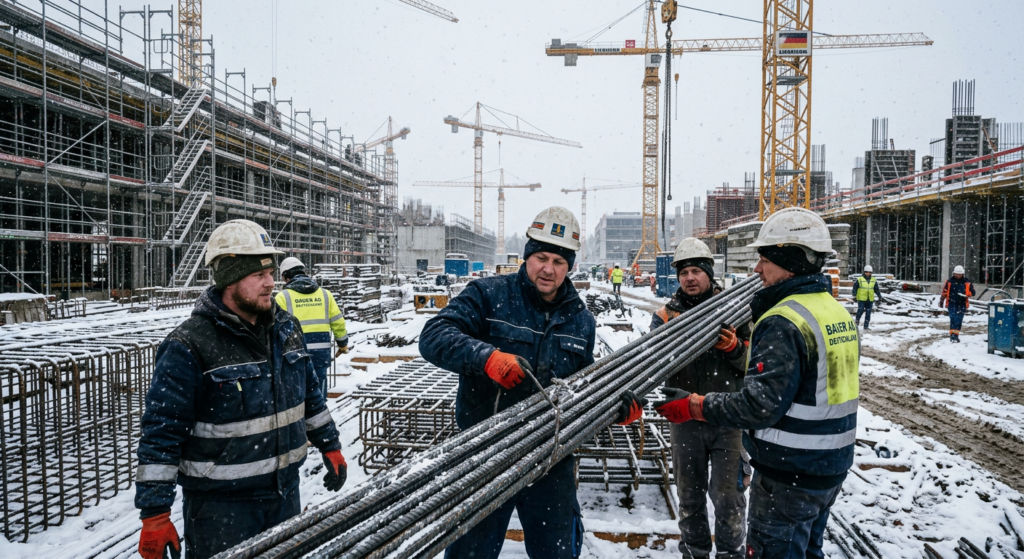
- Construction and Civil Engineering: Germany’s ongoing infrastructure renewal — including bridge rehabilitation, rail expansion, and residential development — requires year-round outdoor work. Winter concrete pouring, steel erection, and formwork assembly demand cold protection gloves with EN 511 convective cold level 2+ and latex crinkle coatings for wet-grip reliability on frozen rebar and icy scaffolding.
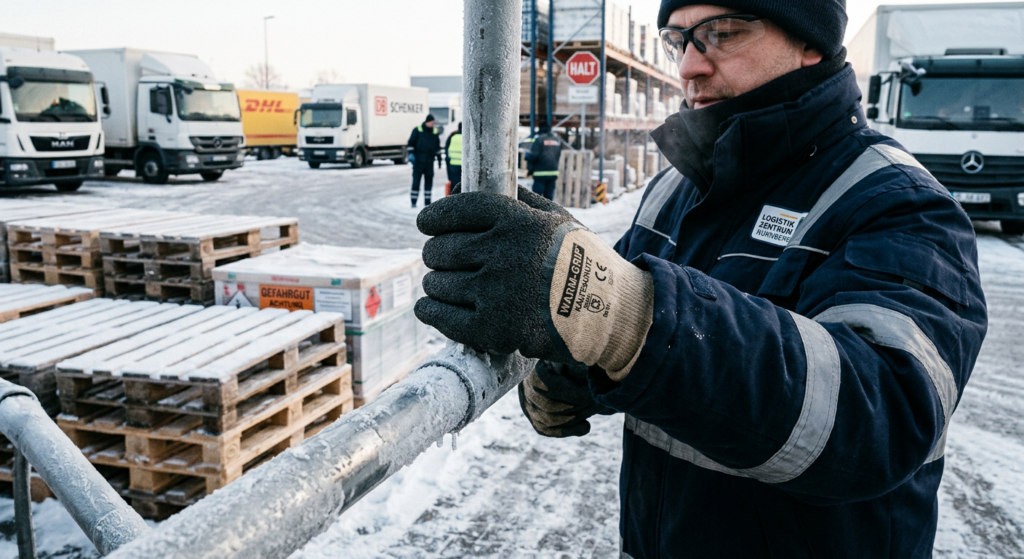
- Logistics and Cold Chain Warehousing: Germany serves as Europe’s logistics hub, with massive distribution centers and cold storage facilities operating at -18 °C to -25 °C for frozen goods. Workers handling pallets, scanning barcodes, and operating forklifts need cold protection gloves with high thermal insulation (EN 511 level 3) and touchscreen-compatible fingertips.
- Automotive Manufacturing: While primary assembly lines are indoor, many tier-1 and tier-2 suppliers operate in semi-heated facilities. Workers handling cold metal stampings, engine blocks, and chassis components during winter months require lightweight cold protection gloves (15G PU-coated) that do not sacrifice dexterity.
- Oil and Gas / Energy Infrastructure: Pipeline maintenance, offshore platform operations in the North Sea, and wind turbine installation expose workers to sustained cold, wind, and moisture. These environments demand the highest-spec cold protection gloves with EN 511 level 3, cut resistance (level D–F), and waterproofing.
- Agriculture and Forestry: Germany’s agricultural sector requires cold-weather hand protection for winter pruning, livestock handling, and forestry operations. Heavy-duty 7G–10G latex-coated gloves with loop-pile acrylic linings are standard in these rugged outdoor applications.
- Road Maintenance and Municipal Services: Snow clearing, road repair, and urban utilities maintenance during winter months create consistent demand for high-visibility, waterproof cold protection gloves across all German municipalities.
Under DGUV Regulation 1, Section 23, if insured individuals work for the employer outdoors and if there are weather-related accident and/or health hazards, the employer shall put suitable measures in place at the workplace. This explicit regulatory mandate — enforced by Berufsgenossenschaft inspectors — creates a compliance-driven procurement cycle every autumn as German employers prepare for winter operations. The market shows significant penetration across major industrial hubs such as North Rhine-Westphalia, Baden-Württemberg, and Bavaria, supported by their robust manufacturing and automotive industries.
Specific Application Scenarios for Cold Protection Gloves
Scenario 1: Cold Storage Warehouse Operations near Hamburg
In a major frozen-food distribution center outside Hamburg operating at a constant -22 °C, 60 warehouse workers perform 8-hour shifts loading and unloading palletized frozen goods. Workers use handheld RF scanners, operate ride-on pallet jacks, and manually stack cases weighing up to 25 kg. The primary hazards include frostbite from prolonged cold exposure, reduced grip from condensation forming on packaging surfaces, and impact injuries from shifting pallets. The recommended specification is a 10G polyester + cotton jersey liner with latex crinkle 3/4 coating and Thinsulate-type thermal insert — EN 511 rated 3×1, EN 388 rated 2X41B. The waterproof coating prevents moisture ingress that would destroy thermal insulation, while the crinkle texture provides reliable grip on frost-covered cardboard and shrink-wrapped pallets. Touchscreen-compatible index fingertips allow scanner operation without glove removal. Monthly consumption: approximately 400 pairs at a 3–4 week replacement cycle.
Scenario 2: Winter Bridge Rehabilitation in North Rhine-Westphalia
On a major Autobahn bridge rehabilitation project near Düsseldorf, 40 structural steel workers perform bolting, welding prep, and concrete finishing operations through the winter months when temperatures regularly hover between -5 °C and 3 °C with frequent rain. Workers handle cold steel beams, operate pneumatic torque wrenches, and tie rebar on exposed bridge decks with significant wind exposure. The recommended specification is a 13G HPPE + glass fiber + spandex liner with sandy nitrile full coating and fleece lining — EN 511 rated 2×1, EN 388 rated 4X44D. The cut level D protects against sharp steel edges and wire, while the sandy nitrile coating maintains grip on wet, oily bolt assemblies. The fleece lining and waterproof barrier prevent the rapid heat loss that wet winter conditions accelerate. Monthly consumption: approximately 250 pairs at a 2–3 week replacement cycle.
Scenario 3: Automotive Parts Handling in an Unheated Bavarian Supplier Facility
At a tier-2 automotive stamping supplier near Munich, 80 workers handle cold metal stampings, inspect components, and load shipping containers in a facility where ambient temperatures drop to 2–5 °C during December through February. Workers need to read quality inspection tablets, operate precision measuring instruments, and detect surface defects by touch. The recommended specification is a 15G nylon liner with PU palm coating and brushed acrylic interior — EN 511 rated 1×0, EN 388 rated 4X31B. The 15G knit delivers excellent tactile sensitivity for touchscreen devices and fine motor tasks, while the brushed acrylic interior provides just enough thermal buffering for extended comfort without the bulk of heavier winter gloves. Monthly consumption: approximately 350 pairs at a 5–6 week replacement cycle.
Case Studies
Case 1: National Logistics Operator, Cold Chain Division
A major German logistics operator needed 25,000 pairs annually of EN 511 level 3 cold protection gloves for their nationwide frozen-food distribution network. Their previous supplier delivered inconsistent thermal insulation between production runs, causing worker complaints and increased hand injury reports during peak winter months. After switching to a vertically integrated OEM manufacturer with batch-traceable quality controls and in-house thermal testing, they achieved consistent EN 511 performance across all deliveries and reduced cold-related hand injury claims by 40% in the first winter season.
Case 2: PPE Distributor Launching Winter Glove Product Line
A mid-sized German PPE distributor identified cold protection gloves as an underserved category for their construction and municipal services client base. They needed 4 SKUs spanning EN 511 levels 1 through 3, all with private-label packaging, German-language certification documentation, and EAN-coded individual pair packaging. Their factory OEM partner delivered the initial order of 40,000 pairs across all SKUs within 35 days, including custom box artwork, high-resolution product photography for webshop listings, and complete CE technical file documentation for EU import compliance.
Top 6 Recommended Local Suppliers in Germany
| Company Name | Core Strengths | Service Regions | Pre-sale Support | After-sale Support |
|---|---|---|---|---|
| NordTherm Arbeitsschutz | Deep Cold Protection Gloves catalog for cold chain and logistics; strong municipal contracts | Hamburg, Lower Saxony, Schleswig-Holstein | On-site thermal hazard assessments, EN 511 product matching | Dedicated account managers, seasonal restocking programs |
| BayernKraft Handschutz | Premium dexterity-focused winter gloves for automotive and precision manufacturing | Bavaria, Baden-Württemberg | Wear-trial programs, ergonomic fit evaluations | Warranty handling, technical performance reviews |
| RheinSafe Industrieschutz | Broad multi-hazard Cold Protection Gloves range for construction and energy sectors | NRW, Hessen, Rhineland-Palatinate | EN 511/EN 388 compliance consultation, bulk sampling | Batch quality audits, express replacement shipping |
| OstGuard PPE Solutions | Cost-effective bulk supply for construction and road maintenance; government tender specialist | Saxony, Brandenburg, Thuringia | Tender documentation preparation, spec sheet generation | On-site inspections, returns processing |
| HansaWinter Distribution | E-commerce fulfillment expert; Amazon.de and B2B platform integration | Nationwide via Hamburg logistics hub | Product listing content packages, certification documents | Consumer support, review management assistance |
| AlpenShield Sicherheit | Extreme cold and multi-hazard combination gloves for mining, forestry, and alpine operations | Nationwide (industrial corridor focus) | Custom spec development, risk assessment consultations | Wear-life data analysis, field performance reporting |
When evaluating any supplier of cold protection gloves, always request third-party EN 511 and EN 388 test reports from an accredited EU notified body. Verify convective cold, contact cold, and water permeability ratings alongside mechanical protection levels, and confirm batch-to-batch consistency in thermal insulation and coating adhesion.
Why Choose Snell Safety as Your Global Cold Protection Gloves Partner
Snell Safety brings deep German market expertise built through years of direct collaboration with PPE distributors, construction companies, logistics operators, and manufacturing procurement teams across Germany. We understand precisely which thermal liner configurations, coating types, and insulation levels perform best in each German application — from the heavy-duty latex-crinkle freezer gloves needed by cold chain warehouses in Hamburg to the lightweight 15G PU-coated winter gloves demanded by Bavarian automotive suppliers. With established local partners on the ground and planned overseas warehouse capacity for stock-ready delivery, we serve both end-user enterprises and distribution partners with products tailored to German workplace conditions and worker hand-feel preferences. We are actively recruiting distributors, agents, and e-commerce brand owners — offering comprehensive pre-sale empowerment (product selection guidance, technical training, market intelligence), after-sale support (quality assurance, replacement policies), dropshipping services, free product samples, and marketing material support including product photography and listing content.
Our manufacturing backbone ensures this local expertise is backed by world-class production capability. With over a decade of hands-on expertise, two facilities running 6 dedicated production lines, and a daily capacity of 150,000 pairs, our vertically integrated process (R&D → material sourcing → knitting → coating/dipping → thermal lining insertion → drying/curing → quality inspection → packaging → export) delivers consistent quality batch after batch. Our diversified coating technologies — PU, latex crinkle, nitrile foam, nitrile micro-foam, and sandy nitrile — allow us to engineer cold protection gloves optimized for any grip environment, from frozen warehouse floors to wet construction sites. ISO 9001 certification and CE marking provide the compliance documentation German importers require, while factory-direct pricing eliminates middleman margins. Explore our full product catalog or contact our team to request samples configured for the German market.
FAQ
What does the EN 511 standard mean for cold protection gloves?
EN 511 is a European standard that specifies requirements and test methods for gloves to protect against convective cold, contact cold, and water. Ratings use a three-digit system (e.g., 2×1): convective cold resistance (0–4), contact cold resistance (0–4), and water permeability (0 = fail, 1 = pass). Higher numbers indicate better cold protection. All EN 511-certified gloves must also meet minimum EN 388 mechanical requirements.
What certifications are required to import cold protection gloves into Germany?
Cold protection gloves are classified as Category II or III PPE under EU Regulation 2016/425 and must carry CE marking. They require EU Type Examination by an accredited notified body, EN 511 and EN 388 testing, and a German-language EU Declaration of Conformity. REACH compliance documentation is also mandatory for EU market access.
Which coating type is best for wet and icy conditions in Germany?
Latex crinkle coating and sandy nitrile coating provide the best grip performance on wet, icy, and frost-covered surfaces, making them ideal for outdoor construction, logistics, and cold storage applications. Latex crinkle excels in wet environments, while sandy nitrile adds superior oil resistance. PU coatings can stiffen below -5 °C and are better suited for mild cold indoor use.
How do I choose the right gauge for cold protection gloves?
For extreme cold and heavy-duty tasks (cold storage, outdoor construction), choose 7G or 10G for maximum thermal fiber content and insulation. For moderate cold and balanced dexterity (logistics, general maintenance), 13G is optimal. For mild cold and precision tasks (automotive assembly, quality inspection), 15G or 18G maximizes tactile sensitivity while still providing thermal buffering.
What is the typical price range for bulk cold protection gloves?
For factory-direct bulk orders (MOQ 5,000+ pairs), prices range from €2.00–€3.50/pair for basic 7G acrylic-lined latex gloves to €3.80–€6.50/pair for premium 13G HPPE/nitrile-coated cut-resistant winter gloves with waterproof membranes. Custom branding, specialized thermal inserts, and touchscreen-compatible fingertips typically add €0.20–€0.50/pair.
How long do cold protection gloves typically last in German winter conditions?
Service life depends on application intensity and cold exposure. In cold storage warehouses (-20 °C), expect 3–4 weeks per pair. In outdoor construction, 2–4 weeks is typical during active winter months. In automotive and light manufacturing, 5–8 weeks is achievable. Replace immediately when thermal lining compresses, coating cracks from cold cycling, or water penetration is detected.
What EN 511 rating do I need for cold storage work in Germany?
For cold storage operating at -18 °C to -25 °C, select gloves with EN 511 convective cold level 3 and contact cold level 3, with water permeability rated as pass (1). Workers handling frozen goods need maximum insulation combined with grip retention. For milder chilled storage (0 °C to -5 °C), EN 511 level 2 is typically sufficient.
Can cold protection gloves also provide cut resistance?
Yes. Many modern cold protection gloves combine EN 511 thermal protection with EN 388 cut resistance by using HPPE, Kevlar, or glass fiber in the liner alongside thermal insulation layers. For construction and metal fabrication in winter, look for gloves rated EN 511 2×1 minimum with EN 388 cut level C or D. These multi-hazard gloves eliminate the need to layer separate cut and thermal gloves.
Are touchscreen-compatible cold protection gloves available?
Yes. Gloves with conductive fingertip coatings or conductive yarn in the index finger and thumb enable touchscreen operation for tablets, RF scanners, and HMI panels. These are increasingly specified by German logistics operators, automotive manufacturers, and smart warehouse environments where workers need device interaction without removing gloves in cold conditions.
What is the difference between convective cold and contact cold in EN 511?
Convective cold resistance measures how well the glove insulates against ambient cold air and wind chill — critical for outdoor workers exposed to German winter weather. Contact cold resistance measures protection when directly touching cold objects or surfaces, such as frozen metal, cold pipes, or refrigerated goods. Most German industrial applications require both ratings at level 2 or higher for reliable all-round cold protection.
Whether you are an end-user enterprise seeking factory-direct supply of cold protection gloves, a distributor expanding your German winter product line, or an e-commerce brand owner developing a private-label thermal glove range, Snell Safety is ready to support your requirements with deep market expertise and world-class manufacturing capability. Submit your specifications or request a quote today — including free samples, custom OEM/ODM solutions, and dedicated technical consultation for the German market.
Content reviewed and updated: March 2026