Best Anti Vibration Gloves Suppliers in Germany | 2026 Guide
2026-03-30
Share This Article
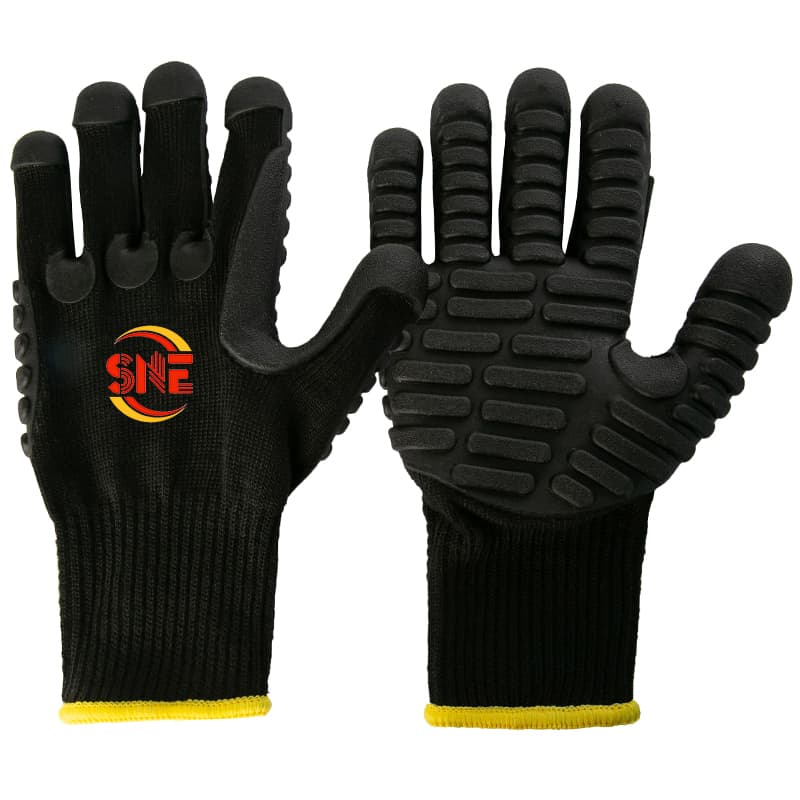
Anti vibration gloves are essential PPE for any German workplace where workers operate pneumatic drills, grinders, jackhammers, chainsaws, or other hand-held vibrating tools. With EU Directive 2002/44/EC strictly enforced through Germany’s LärmVibrationsArbSchV ordinance, employers face significant legal and financial consequences — including heavy fines and even criminal prosecution — for failing to manage hand-arm vibration (HAV) exposure. Choosing the right anti vibration gloves, certified to EN ISO 10819, is a critical part of any compliant vibration risk management strategy.
Whether you are a PPE distributor expanding your product line, an HSE procurement officer at a manufacturing or construction firm, or a safety brand owner developing private-label solutions, this guide delivers actionable intelligence on product types, technical standards, key industries, and supplier options in Germany for 2026. Need immediate help selecting the right anti vibration gloves for your specific application? Contact our team at Snell Safety — we have extensive experience serving German clients and can recommend product configurations tailored to local workplace conditions, climate, and regulatory requirements.

Quick Answer
For sourcing anti vibration gloves in Germany, consider established local PPE distributors with broad EN ISO 10819-certified product ranges and strong regional logistics, as well as Chinese manufacturers who specialize in customized products with competitive pricing and full international certifications (ISO 9001/CE). A balanced procurement strategy — pairing a local distributor for fast restocking with a factory-direct OEM partner for custom bulk orders — typically delivers the optimal combination of speed, specification control, and cost efficiency.
Market Overview
The Global Anti-Vibration Gloves Market is projected to grow from USD 614 million in 2024 to USD 1,375 million by 2035, at a CAGR of 7.6% during the forecast period 2025–2035. The market in Europe is projected to grow at a CAGR of 5.7% during the forecast period, with Germany as the region’s largest single-country market for protective gloves, dominating in the Europe region due to increasing automotive production.
This growth is driven by Germany’s rigorous enforcement of vibration safety regulations. Employers are required to assess, document, and implement appropriate protective measures against vibration and noise exposure in accordance with EU Directive 2002/44/EC and the Noise and Vibration Occupational Safety Ordinance (LärmVibrationsArbSchV). The directive sets a hand-arm vibration exposure action value of 2.5 m/s² A(8) and an exposure limit value of 5.0 m/s² A(8) over an eight-hour reference period. The consequences range from heavy fines to criminal prosecution and, in the worst case, can threaten the very existence of a business. With 360,000 firms employing 2.6 million people in Germany’s construction sector alone — plus millions more in manufacturing, automotive, and forestry — demand for certified anti vibration gloves remains robust and growing.
What Types of Anti Vibration Gloves Are Needed in Germany
The most in-demand anti vibration gloves in the German market must meet EN ISO 10819:2013 requirements while simultaneously providing mechanical protection under EN 388. Based on our experience serving Germany clients across construction, automotive, manufacturing, forestry, and road maintenance sectors, we consistently see demand for multi-hazard gloves that combine vibration dampening with cut resistance, impact protection, or weather resistance — rather than single-function anti vibration gloves alone.
German buyers are especially attentive to the balance between vibration attenuation and dexterity. To be referred to as an anti-vibration glove, the following criteria must be met: TRM value shall not be less or equal to ≤ 0.9 (total vibration transmission between 25 Hz–200 Hz), TRH value shall not be less or equal to ≤ 0.6 (total vibration transmission between 200 Hz–1.25 kHz). The thickness of the damping material in the palm shall not exceed a thickness of 8 mm. Workers in precision environments — automotive assembly, electronics manufacturing — strongly prefer slimmer padding profiles (4–5 mm) that maximize tool feel, while construction and demolition workers tolerate thicker padding (6–8 mm) for greater shock absorption. Germany’s cold winters also create seasonal demand for thermal-insulated anti vibration gloves with fleece liners.
The following configurations represent the highest-demand anti vibration gloves we supply to German buyers:
- Gel-Padded Palm + Synthetic Leather + Spandex Back (EN ISO 10819 + EN 388: 3121X) — The all-purpose workhorse for general construction, maintenance, and utility work. Gel polymer pads (5–6 mm) in palm and fingers, breathable spandex back, reinforced fingertips. Sizes M–XXL.
- TPR Impact + Vibration-Dampening Foam Palm + HPPE Liner (EN ISO 10819 + EN 388: 4X43CP) — Multi-hazard anti vibration gloves combining cut level C, back-of-hand TPR impact protection, and foam vibration-dampening pads. Ideal for oil & gas, heavy construction, and mining operations in Germany.
- Nitrile Foam Coated + Vibration-Dampening Gel Insert + 13G HPPE Liner (EN ISO 10819 + EN 388: 4X42C) — A hybrid solution pairing nitrile foam grip with integrated gel vibration pads. Excellent oil grip for automotive stamping and CNC machining environments where workers use pneumatic tools on oiled metal.
- Thermal Insulated Anti Vibration Gloves + Waterproof Membrane (EN ISO 10819 + EN 511) — Cold-weather variant with fleece liner, waterproof breathable membrane, and 6–8 mm vibration-dampening padding. Essential for outdoor construction, forestry, and road maintenance during Germany’s November–March cold season.
- Lightweight Anti Vibration Gloves + PU Palm Coating + Nylon/Spandex Liner (EN ISO 10819 + EN 388: 2131X) — Precision-dexterity variant for electronics assembly, automotive quality inspection, and maintenance tasks where workers handle power tools intermittently. Thinner 4 mm padding prioritizes tactile feedback.
Why These Anti Vibration Gloves Are Recommended
Each recommended specification addresses distinct hazard profiles grounded in the dual-standard framework that German PPE regulations demand: EN ISO 10819:2013 (with Amendment 1:2019) for vibration transmissibility performance, and EN 388:2016 for mechanical protection. In accordance with ISO 10819, the vibration reduction criteria for an anti-vibration glove are: TRM < 1.0 and TRH < 0.6. In the high-frequency range, the glove’s overall effect must be the reduction of the frequency-weighted vibration by at least 40%. However, it is critical that buyers understand the limitations: these gloves can reduce the health risks related to vibration exposure, like white fingers, but don’t eliminate the risks. The gloves reduce the vibrations but only in frequencies over 150 Hz. This means anti vibration gloves are most effective for high-frequency tools (grinders, polishers, sanders) and should always be combined with organizational controls such as job rotation and exposure time limits.
The multi-hazard approach — combining vibration dampening with cut resistance, impact protection, or thermal insulation in a single glove — delivers superior total cost of ownership compared to issuing separate gloves for each hazard. German workers handling pneumatic drills on a construction site face simultaneous risks of vibration exposure, impact from falling debris, and cuts from rebar and steel reinforcement. A single TPR-impact + cut-resistant + vibration-dampening glove eliminates the need for layering or switching gloves mid-task, improving compliance rates and reducing per-worker PPE spend by 25–40%.
| Anti Vibration Gloves Type | Vibration Dampening | EN 388 Rating | Best Application | Padding Thickness | Approx. Cost/Pair (Bulk) |
|---|---|---|---|---|---|
| Gel-Padded General Purpose | EN ISO 10819 Certified | 3121X | Construction / Maintenance | 5–6 mm | €8–€14 |
| Anti Vibration Gloves + TPR Impact | EN ISO 10819 Certified | 4X43CP | Oil & Gas / Heavy Industry | 6–7 mm | €12–€20 |
| Nitrile Foam + Gel Insert | EN ISO 10819 Certified | 4X42C | Automotive / CNC Machining | 5 mm | €10–€16 |
| Thermal Insulated AV | EN ISO 10819 + EN 511 | 2X21X | Outdoor / Winter Work | 6–8 mm | €14–€22 |
| Lightweight PU Palm AV | EN ISO 10819 Certified | 2131X | Electronics / Precision Work | 4 mm | €7–€12 |
Use this table to match your workers’ primary vibration exposure and secondary hazards to the optimal anti vibration gloves specification and budget range.
Key performance considerations when selecting anti vibration gloves for the German market:
- Vibration frequency matching: Anti vibration gloves perform best at frequencies above 150 Hz. For low-frequency tools (jackhammers at 25–80 Hz), organizational controls are more effective than gloves alone.
- Dexterity vs. dampening trade-off: Every additional millimeter of padding reduces vibration transmissibility but also reduces tactile sensitivity. German automotive assembly workers typically prefer 4–5 mm padding, while demolition crews accept 7–8 mm.
- Durability under abrasion: Gel polymer pads degrade faster under heavy abrasion. For abrasive environments (concrete, metalwork), choose gloves with reinforced synthetic leather overlays that protect the dampening layer.
- Cold weather amplification: Cold temperatures exacerbate HAVS symptoms by constricting blood vessels. Thermal anti vibration gloves with wind/waterproof membranes are essential PPE for outdoor winter work across Germany.
Key Industries for Anti Vibration Gloves in Germany
Anti vibration gloves are mandatory PPE across every German industry where workers regularly operate hand-held vibrating tools or machinery. The anti vibration gloves market is driven by increasing workplace safety regulations, rising industrial and construction activities, growing awareness of hand-arm vibration syndrome, and demand for ergonomic protective equipment across manufacturing, mining, and automotive sectors. The following industries represent the highest-demand segments in Germany:
- Construction & Civil Engineering: With 2.6 million workers, Germany’s construction sector is the largest single consumer of anti vibration gloves. Workers operating jackhammers, concrete breakers, plate compactors, and impact drills face daily HAV exposure well above the 2.5 m/s² action value. Multi-hazard anti vibration gloves with cut resistance (EN 388 level C–D) and impact protection (TPR) are standard specifications on major infrastructure projects.
- Automotive Manufacturing & Supply Chain: Germany’s automotive industry employs hundreds of thousands of production workers who use pneumatic ratchets, impact wrenches, orbital sanders, and grinders daily. Lightweight anti vibration gloves (4–5 mm padding) with nitrile or PU coatings and good oil grip are the dominant specification — dexterity is critical for assembly precision.
- Forestry & Landscaping: Chainsaw operators and landscaping crews face intense vibration exposure. Germany’s Federal Forest Inventory covers approximately 11.4 million hectares, employing tens of thousands of forestry workers who require thermal-insulated, waterproof anti vibration gloves with high-frequency dampening tailored to chainsaw vibration profiles.
- Mining & Quarrying: Operators of pneumatic rock drills, demolition breakers, and vibrating compactors in German quarries and underground mining operations require heavy-duty anti vibration gloves with TPR impact protection and cut level D–F resistance.
- Road Construction & Maintenance: Asphalt compaction, concrete cutting, and curb grinding expose workers to sustained high-amplitude vibration. Anti vibration gloves with high-visibility features and waterproof membranes are specified for roadwork crews across the Autobahn maintenance network.
- Manufacturing & Mechanical Engineering: CNC operators, die grinders, deburring technicians, and polishing specialists across Germany’s Mittelstand manufacturers use medium-frequency vibrating tools that are well-suited to anti vibration glove attenuation. Nitrile-coated variants with integrated gel pads dominate this segment.
- Utilities & Energy: Wind turbine installation and maintenance technicians, electrical utility crews, and pipeline workers use impact wrenches and vibrating cutters at height and in confined spaces, requiring compact anti vibration gloves with excellent grip and touchscreen compatibility for digital work order systems.
Germany’s regulatory enforcement is a key growth driver. If inadequate protective measures lead to a workplace accident or occupational illness, those responsible may face criminal prosecution. According to German customs authorities, imprisonment is possible in such cases. German Berufsgenossenschaften (employers’ liability insurance associations) are entitled to demand compensation if breaches of duty are proven. This creates strong institutional incentives for employers to procure high-quality, certified anti vibration gloves and maintain rigorous HAVS prevention programs. Additionally, the growth of renewable energy infrastructure — particularly wind farm construction and maintenance — is creating new demand verticals for specialized anti vibration PPE across northern and coastal Germany.
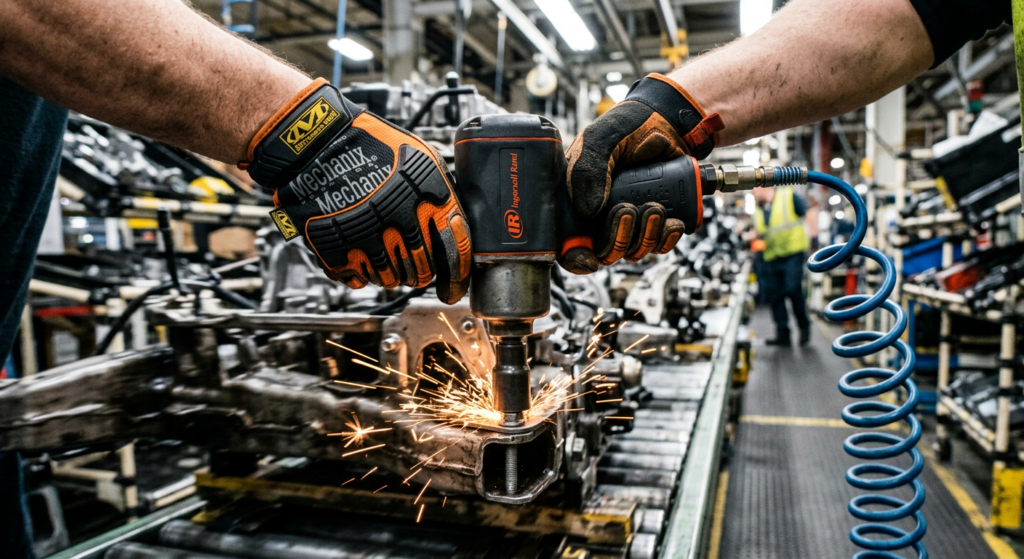
Specific Application Scenarios for Anti Vibration Gloves
Scenario 1: Road Rehabilitation Project in Bavaria
A road construction crew of 35 workers is resurfacing a 12 km section of Bundesstraße in southern Bavaria. Daily tasks include operating concrete saws (vibration emission 8–12 m/s²), pneumatic breakers (15–25 m/s²), and plate compactors (4–8 m/s²). Workers face HAV exposure well above the 5.0 m/s² limit value within 30–60 minutes of continuous tool use. The site safety plan specifies heavy-duty gel-padded anti vibration gloves (6–7 mm dampening, EN ISO 10819 certified) combined with mandatory 10-minute rest breaks every 30 minutes of tool operation. In the October–March season, the crew switches to thermal-insulated anti vibration gloves with waterproof membranes — cold temperatures significantly worsen HAVS symptoms, and Bavaria’s alpine climate demands robust cold protection. Monthly consumption runs approximately 300 pairs across two shift rotations, with replacement every 3–4 weeks due to abrasive wear from concrete and asphalt contact.
Scenario 2: Automotive Assembly Plant in Baden-Württemberg
A Tier-1 automotive supplier operates a powertrain assembly line where 120 operators use pneumatic torque wrenches (vibration emission 3–6 m/s²), orbital sanders (5–9 m/s²), and die grinders (4–8 m/s²) across eight-hour shifts. Workers need excellent dexterity to handle precision fasteners and perform visual quality checks, making thick-padded gloves impractical. The plant specifies lightweight anti vibration gloves with 4 mm gel inserts, PU-coated palms for oil grip, and nylon/spandex liners for breathability (EN ISO 10819 + EN 388: 2131X). A vibration exposure management software system tracks each worker’s cumulative A(8) dose; when approaching the 2.5 m/s² action value, workers rotate to non-vibrating tasks. Monthly glove consumption is approximately 500 pairs, replaced on a 2–3 week cycle.
Scenario 3: Wind Farm Maintenance in Lower Saxony
A wind turbine service team of 12 technicians performs scheduled maintenance on a 40-turbine offshore wind farm in the North Sea. Technicians work at heights of 80–150 metres, using pneumatic impact wrenches to torque turbine bolts, vibrating grinders for rust removal, and hydraulic tensioning tools. In addition to vibration hazards, workers face high-altitude wind chill, moisture exposure, and impact risks from tools and falling hardware. The maintenance contractor specifies multi-hazard anti vibration gloves with TPR back-of-hand impact protection, cut level C HPPE liner, waterproof membrane, and 5 mm vibration-dampening gel (EN ISO 10819 + EN 388: 4X42CP + EN 511). Touchscreen-compatible fingertips allow technicians to operate digital maintenance tablets without removing gloves — a critical safety feature at height. Glove consumption is approximately 50 pairs monthly per team.
Case Studies
Case 1: Infrastructure Contractor in North Rhine-Westphalia
A major road construction contractor needed 40,000 pairs annually of heavy-duty anti vibration gloves (EN ISO 10819 + EN 388: 3X32X) with private-label branding for distribution across 15 regional project sites. Their previous supplier delivered inconsistent gel pad thickness between batches, resulting in failed on-site EN ISO 10819 compliance spot checks. After switching to a vertically integrated factory-direct OEM partner with in-line vibration transmissibility testing, the contractor achieved batch-to-batch pad thickness consistency within ±0.3 mm and reduced per-pair procurement cost by 22%.
Case 2: PPE Distributor Expanding Anti Vibration Product Line
A mid-sized German PPE distributor identified anti vibration gloves as a high-growth category for their construction and automotive client base. They needed 5 SKUs — from lightweight precision variants to heavy-duty thermal-insulated models — with custom packaging and German-language CE/EN ISO 10819 documentation. Their factory OEM partner delivered prototypes within 14 days, completed a 60,000-pair initial production run in 35 days, and provided full marketing material support including product photography and technical data sheets, enabling a successful product launch within one quarter.
Top 6 Recommended Local Suppliers in Germany
| Company Name | Core Strengths | Service Regions | Pre-sale Support | After-sale Support |
|---|---|---|---|---|
| RheinGuard Arbeitsschutz | Broad Anti Vibration Gloves catalog, strong construction sector network | NRW, Hessen, Rhineland-Palatinate | On-site vibration risk assessments, EN ISO 10819 sample kits | Dedicated account managers, HAVS compliance consulting |
| BayernPro Sicherheit | Premium multi-hazard AV gloves, deep automotive OEM relationships | Bavaria, Baden-Württemberg | Application-specific product matching, trial programs | Warranty processing, batch quality auditing |
| NordShield PPE Solutions | Forestry and outdoor Anti Vibration Gloves specialist | Hamburg, Lower Saxony, Schleswig-Holstein | Cold-weather product testing, MOQ flexibility | Same-week replacement shipments, returns handling |
| SachsenSafe Handschutz | Cost-effective bulk supply for road construction projects | Saxony, Thuringia, Brandenburg | Tender documentation support, spec sheets | On-site quality checks, complaint resolution |
| HansaProtect Distribution | E-commerce fulfillment, Amazon.de marketplace integration | Nationwide via Hamburg logistics center | Product listing content, certification documentation | Customer service support, review management |
| AlpenWerk Industrieschutz | Heavy-duty AV gloves for mining, tunneling, energy sector | Nationwide (industrial corridor focus) | Vibration exposure analysis consultations | Performance tracking, KPI reporting |
When evaluating suppliers, always request EN ISO 10819 test certificates from an accredited laboratory, verify that gel pad thickness and transmissibility values are consistent across production batches, and confirm the supplier provides EU Declaration of Conformity documentation in German as required under Regulation (EU) 2016/425.
Why Choose Snell Safety as Your Global Anti Vibration Gloves Partner
Snell Safety brings deep German market expertise developed through years of direct collaboration with distributors, construction contractors, automotive suppliers, and industrial safety procurement teams across the country. We understand which vibration-dampening pad configurations, liner materials, coating types, and hand-feel profiles perform best in each German application scenario — from the lightweight PU-palm precision variants preferred by Stuttgart-region automotive plants to the heavy-duty thermal-insulated anti vibration gloves demanded by northern Germany’s outdoor construction and wind energy sectors. With established local partners and planned overseas warehouse capacity for stock-ready delivery, we serve both end-user enterprises and distribution partners with products precisely tailored to German workplace conditions and regulatory requirements. We are actively recruiting distributors, agents, and e-commerce brand owners — offering comprehensive pre-sale empowerment (product selection guidance, technical training, market intelligence), after-sale support (quality assurance, replacement policies), dropshipping services, free product samples, and marketing material support.
Our manufacturing strength backs this market expertise with production capacity and quality systems that deliver at scale. With over a decade of hands-on expertise, two facilities running 6 dedicated production lines, and a daily capacity of 150,000 pairs, our vertically integrated process (R&D → material sourcing → knitting → coating/dipping → assembly → quality inspection → packaging → export) ensures consistent batch-to-batch quality with fast turnaround. ISO 9001 certification and CE marking provide the compliance documentation German importers require, while factory-direct pricing eliminates middleman margins for significant cost advantages on OEM/ODM bulk orders. Browse our full product catalog or contact our team to request samples configured for your German market needs.
FAQ
What is EN ISO 10819 and why does it matter for anti vibration gloves?
EN ISO 10819:2013 is the international standard that tests and certifies a glove’s ability to reduce vibration transmitted from a tool handle to the palm. To qualify as anti vibration gloves, products must achieve TRM ≤ 0.9 (25–200 Hz band) and TRH ≤ 0.6 (200–1,250 Hz band), with dampening material no thicker than 8 mm covering the full palm and fingers.
What vibration exposure limits apply in German workplaces?
Under EU Directive 2002/44/EC, transposed into German law as LärmVibrationsArbSchV, the hand-arm vibration exposure action value is 2.5 m/s² A(8) and the exposure limit value is 5.0 m/s² A(8). Exceeding the action value triggers mandatory risk reduction measures; exceeding the limit value requires immediate corrective action by the employer.
Which industries in Germany require anti vibration gloves most?
The top consumers are construction (jackhammers, breakers, compactors), automotive manufacturing (pneumatic wrenches, sanders), forestry (chainsaws), mining (rock drills), road maintenance (concrete saws), and energy/utilities (impact wrenches). Any workplace where workers operate hand-held vibrating tools above the 2.5 m/s² action value should provide certified anti vibration gloves.
How long do anti vibration gloves typically last?
Lifespan depends on use intensity. In heavy construction, anti vibration gloves typically last 3–4 weeks before gel pad degradation reduces dampening effectiveness. In automotive assembly with lighter tool use, 4–6 weeks is common. Replace immediately when padding feels compressed, stitching loosens, or coating wears through.
Can anti vibration gloves fully prevent HAVS?
No. Anti vibration gloves reduce vibration transmissibility primarily at frequencies above 150 Hz and offer limited protection at low frequencies typical of jackhammers and breakers. They should always be used as part of a comprehensive vibration management program including engineering controls, exposure time limits, job rotation, and regular health surveillance.
What certifications are required to import anti vibration gloves into Germany?
Anti vibration gloves must comply with EU Regulation 2016/425 (PPE Regulation) and carry CE marking. They require EU Type Examination by an accredited notified body, EN ISO 10819 certification for vibration dampening, and typically EN 388 certification for mechanical protection. A German-language EU Declaration of Conformity and REACH compliance documentation are mandatory.
What is the price range for bulk anti vibration gloves orders?
Lightweight general-purpose anti vibration gloves range from €7–€14/pair at MOQs of 5,000+ pairs. Mid-range multi-hazard variants (cut-resistant + AV) cost €10–€16/pair. Premium TPR-impact + thermal + AV gloves run €14–€22/pair. Custom OEM branding typically adds €0.20–€0.50/pair depending on artwork and packaging complexity.
How do I choose the right padding thickness for anti vibration gloves?
For precision assembly and tool handling requiring fine dexterity, choose 4 mm padding. For general construction and maintenance, 5–6 mm provides a good balance of dampening and hand function. For heavy demolition and high-vibration tools like breakers, 7–8 mm (maximum allowed under EN ISO 10819) maximizes vibration attenuation. Always test samples with actual tools before committing to bulk orders.
What is the difference between anti vibration gloves and impact-resistant gloves?
Anti vibration gloves use viscoelastic gel or foam padding in the palm to attenuate repetitive vibration frequencies transmitted from tool handles. Impact-resistant gloves use rigid TPR (thermoplastic rubber) guards on the back of the hand to protect knuckles and fingers from single-event crush or strike impacts. For maximum protection, multi-hazard gloves combining both technologies are recommended.
Are there seasonal considerations for anti vibration gloves in Germany?
Yes. Cold temperatures significantly worsen HAVS symptoms by constricting blood vessels and reducing circulation to the fingers. During Germany’s November–March winter months, thermal-insulated anti vibration gloves with wind/waterproof membranes (certified to EN 511) are strongly recommended for all outdoor vibrating-tool work. Fleece liners add warmth without significantly increasing bulk.
Whether you are an end-user enterprise seeking factory-direct supply, a distributor expanding your German anti vibration gloves portfolio, or an e-commerce brand owner building a private-label product line, Snell Safety is ready to support your requirements. Submit your specifications or request a quote today — including free samples, custom OEM/ODM solutions, and dedicated technical consultation for the German market.
Content reviewed and updated: March 2026