Beste Sicherheitshandschuhe Hersteller Lieferanten in Deutschland | 2026 Leitfaden
2026-04-08
Diesen Artikel teilen
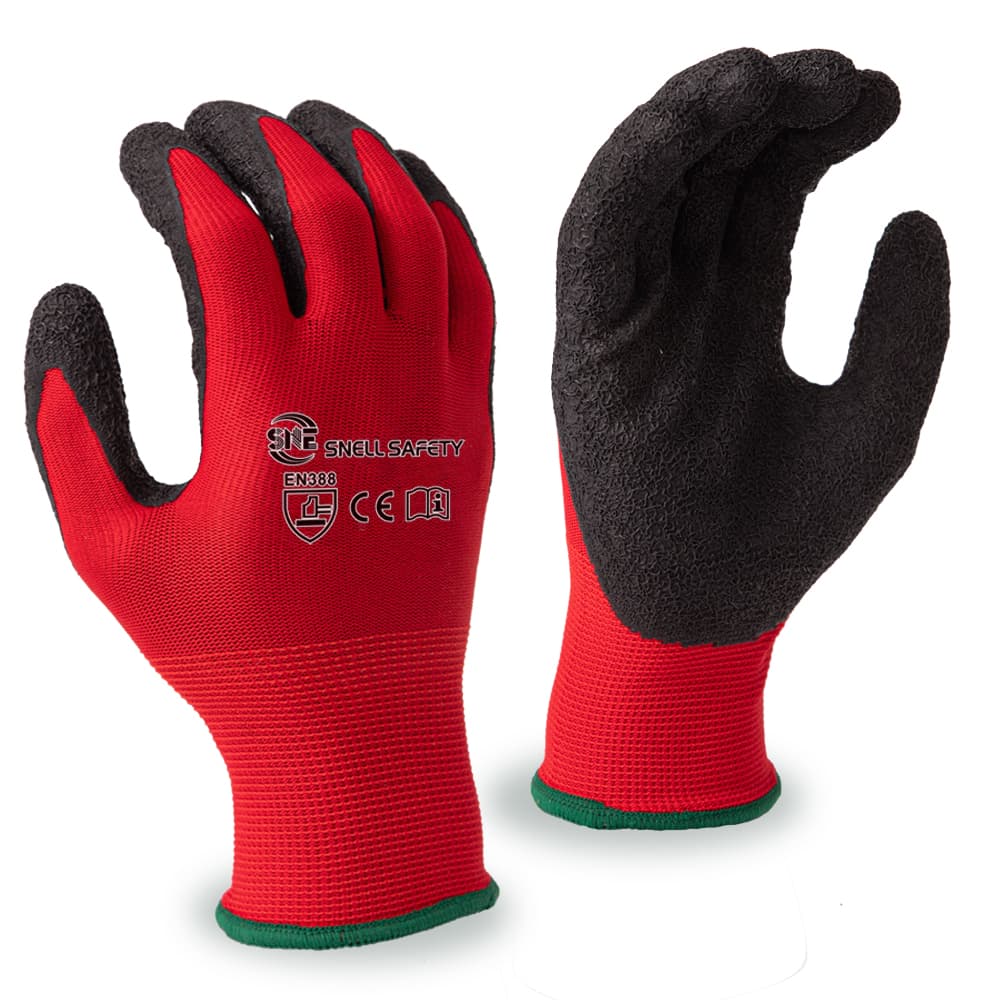
Choosing the right safety gloves manufacturer for the German market requires careful evaluation of product certifications, coating technologies, and the supplier’s ability to meet the demanding standards of Europe’s largest industrial economy. Whether you procure for automotive assembly lines in Stuttgart, chemical plants in the Rhineland, or logistics hubs in Hamburg, the glove specifications you select directly affect worker safety, regulatory compliance, and total cost of ownership.
If you are sourcing safety gloves for the German market, Kontakt zu unserem Team at Snell Safety for expert product selection guidance, custom OEM/ODM solutions, or a competitive quotation. With years of experience serving German buyers across automotive, manufacturing, construction, and oil & gas sectors, we can recommend the best product configurations tailored to your specific workplace requirements.
Schnelle Antwort
For sourcing safety gloves in Germany, consider established local PPE distributors with wide EN 388-certified catalogs and regional warehousing across industrial hubs like NRW, Bavaria, and Baden-Württemberg. Additionally, Chinese manufacturers who specialize in customized products with competitive pricing and full international certifications (ISO 9001/CE) are excellent for OEM/ODM, private-label, and high-volume bulk programs. Combining local distributors for rapid replenishment with a certified factory-direct safety gloves manufacturer for custom orders delivers the best value.
Marktübersicht
Der Markt für Sicherheitshandschuhe in Deutschland wird voraussichtlich von 1.068,97 Mio. USD im Jahr 2023 auf geschätzte 2.100,86 Mio. USD im Jahr 2032 wachsen, was einer durchschnittlichen jährlichen Wachstumsrate (CAGR) von 7,78% entspricht. This strong trajectory makes Germany the largest single-country market for safety gloves in Europe. Within this market, nitrile gloves are expected to grow at the fastest CAGR of 8.3% over the forecast period, driven by their superior chemical resistance and versatility in industrial applications. Germany’s robust automotive and chemical sectors are fueling demand for specialized gloves that boast a combination of protective features.
Germany’s robust framework for occupational safety regulations significantly drives the demand for safety gloves, with the country’s adherence to stringent EU directives, such as Regulation (EU) 2016/425 on personal protective equipment (PPE), mandating the use of high-quality safety gloves across industries. In 2023, a total of 783,426 reportable accidents at work occurred in Germany’s industrial and public sectors. Hand injuries constitute up to 30% of the total cases treated in emergency departments, underscoring why every safety gloves manufacturer serving this market must prioritize EN 388 certification and consistent product quality.
What Types of Safety Gloves Are Most in Demand in Germany
The most sought-after safety gloves in Germany feature nitrile, PU, and latex coatings on seamless-knit liners, engineered for the country’s precision-oriented manufacturing culture, cold winters, and stringent EN 388 compliance requirements. Based on our experience serving German clients at Snell Sicherheit, we consistently see demand shaped by the dual priorities of high mechanical protection and exceptional dexterity — German workers expect gloves that protect without compromising the fine motor control needed in automotive assembly, precision engineering, and chemical handling.
Through years of collaboration with PPE distributors, HSE departments, and procurement teams across Germany, we have identified clear product preferences tied to regional industries and seasonal conditions. Automotive Tier 1 and Tier 2 suppliers in Bavaria and Baden-Württemberg require thin-gauge, high-dexterity PU or nitrile foam coated gloves for parts inspection. Heavy manufacturing and metal fabrication operations across NRW demand cut-resistant HPPE liners with sandy nitrile coatings. Construction companies working through cold German winters from November to March need latex crinkle or nitrile micro-foam coatings that maintain grip in wet, cold conditions. German workers also strongly prefer snug-fitting gloves with spandex-blended liners that prevent hand fatigue during full 8-hour shifts — a preference that directly informs our liner gauge recommendations of 13G, 15G, and 18G.
Here are the top product types we supply most frequently to Germany:
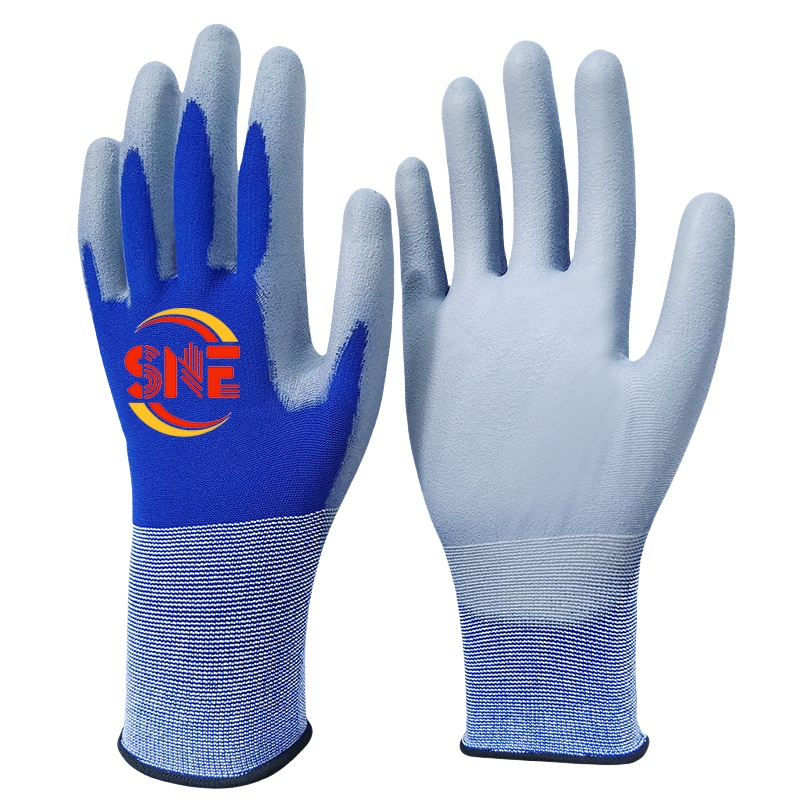
- 13G Nylon-Spandex Liner + PU Palm Coating (EN 388: 4131) — The workhorse general purpose glove for light assembly, electronics, automotive parts handling, and quality inspection. Excellent dexterity, dry-grip precision, and all-day comfort in sizes S–XXL.
- 15G HPPE Liner + Sandy Nitrile Palm Coating (EN 388: 4X43C) — Cut-resistant safety glove for metal stamping, machined parts handling, and glass processing. Sandy nitrile micro-channels maintain firm grip on oily or dry surfaces, with EN 388 ISO 13997 cut level C.
- 13G Polyester Liner + Nitrile Micro-Foam Palm Coating (EN 388: 4121) — Versatile multi-environment glove ideal for logistics, warehouse operations, and light manufacturing. Micro-foam technology delivers excellent grip in damp conditions with superior breathability.
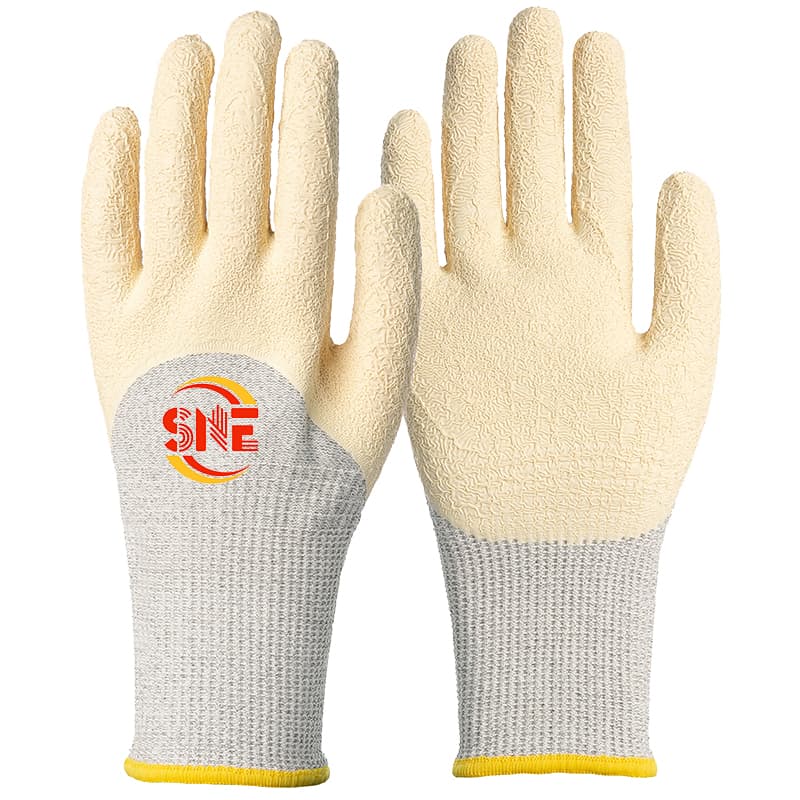
- 10G Cotton-Polyester Liner + Latex Crinkle Coating (EN 388: 2142) — Heavy-duty construction and masonry glove providing outstanding wet grip and abrasion resistance. The thicker 10G gauge offers warmth in cold German winters while the crinkle latex channels moisture away from the grip surface.
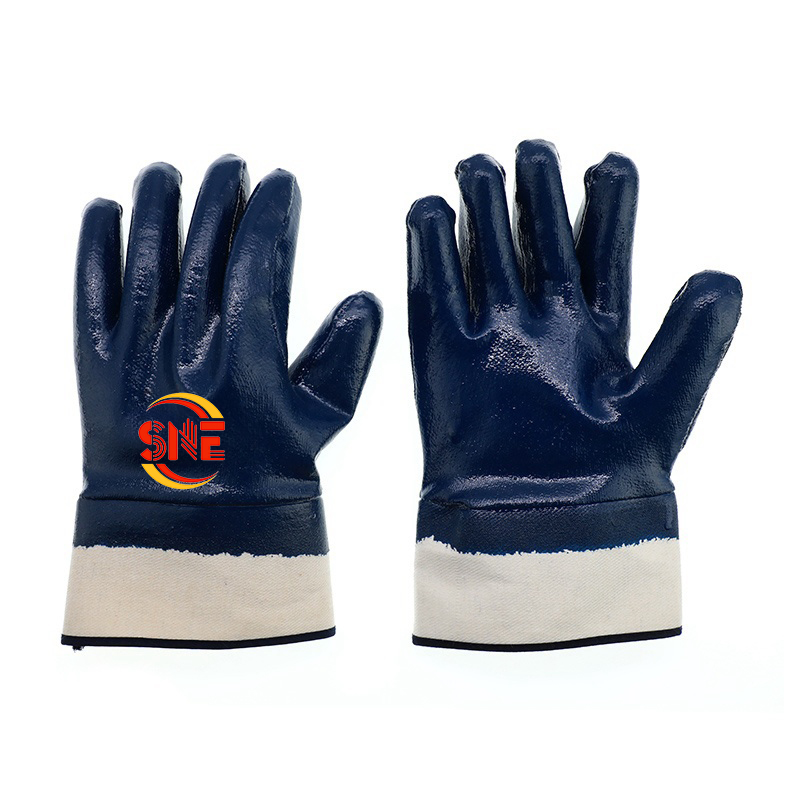
- 13G HPPE-Glass Fiber Liner + Sandy Nitrile Full Coating + TPR Back (EN 388: 4X44DP) — Impact-resistant safety glove for oil and gas operations, pipeline maintenance, and heavy machinery work. TPR dorsal protection absorbs crush and strike energy while the full nitrile coating resists oils and solvents.
Why These Safety Glove Types Are Recommended
These product configurations are recommended because they address the specific mechanical hazards, climate conditions, and regulatory requirements of the German industrial environment while maximizing worker comfort and cost-effectiveness. EN 388 is a European safety standard for protective work gloves, providing comprehensive assessment for their resistance to mechanical risks. Every safety gloves manufacturer supplying Germany must ensure products are tested and certified to EN 388:2016+A1:2018, as since 21st April 2019 it has been illegal to place gloves for mechanical protection on the EU market that have not been certified against this standard.
The coating technologies we recommend each serve distinct performance profiles. PU palm coatings excel in dry, precision environments — delivering level 4 abrasion resistance (8,000+ cycles) with superior tactile sensitivity for electronic and automotive assembly. Nitrile foam and micro-foam coatings provide reliable grip in mixed dry/wet conditions while maintaining breathability for extended wear. Sandy nitrile coatings offer the strongest grip in oily environments, making them essential for metal fabrication and automotive maintenance. Latex crinkle coatings remain the preferred choice for construction and outdoor work, especially during Germany’s cold season, because they maintain flexibility at temperatures as low as −10°C while channeling water away from the grip surface.
Key performance metrics to evaluate when selecting a safety gloves manufacturer for the German market:
- Abriebfestigkeit: EN 388 Level 4 (8,000+ cycles) is the standard for industrial applications; ensures 2–3 months of service life under moderate use conditions.
- Schnittfestigkeit: EN 388 ISO 13997 cut levels A through F — Level C (5.0–10.0 N) is the minimum for metal handling; Level D–E (10.0–22.0 N) for heavy sheet metal and glass processing.
- Coating grip performance: PU for dry precision work; nitrile foam/micro-foam for mixed conditions; sandy nitrile for oily grip; latex crinkle for wet outdoor conditions.
- Liner gauge and dexterity: 18G for electronics and fine assembly; 15G for automotive and precision engineering; 13G for general industrial; 10G for heavy construction.
| Art der Beschichtung | Best Conditions | Abrasion (EN 388) | Geschicklichkeit | Atmungsaktivität | Safety Gloves Manufacturer Application |
|---|---|---|---|---|---|
| PU-Handfläche | Dry environments | Level 4 | Ausgezeichnet | Sehr gut | Electronics, automotive assembly |
| Nitrilschaum | Light oily / damp | Level 4 | Hoch | Gut | General manufacturing, MRO |
| Nitrile Micro-Foam | Mixed wet/dry | Level 4 | Hoch | Sehr gut | Logistics, warehouse, light industrial |
| Sandiges Nitril | Heavy oil/grease | Level 4 | Mittel | Mäßig | Metal fabrication, oil & gas |
| Latex Crinkle | Wet / cold outdoor | Level 3–4 | Mittel | Mäßig | Construction, masonry, landscaping |
Use this table to match your workplace conditions and primary hazards to the optimal coating technology when evaluating any safety gloves manufacturer.
Key Industries Driving Safety Gloves Demand in Germany
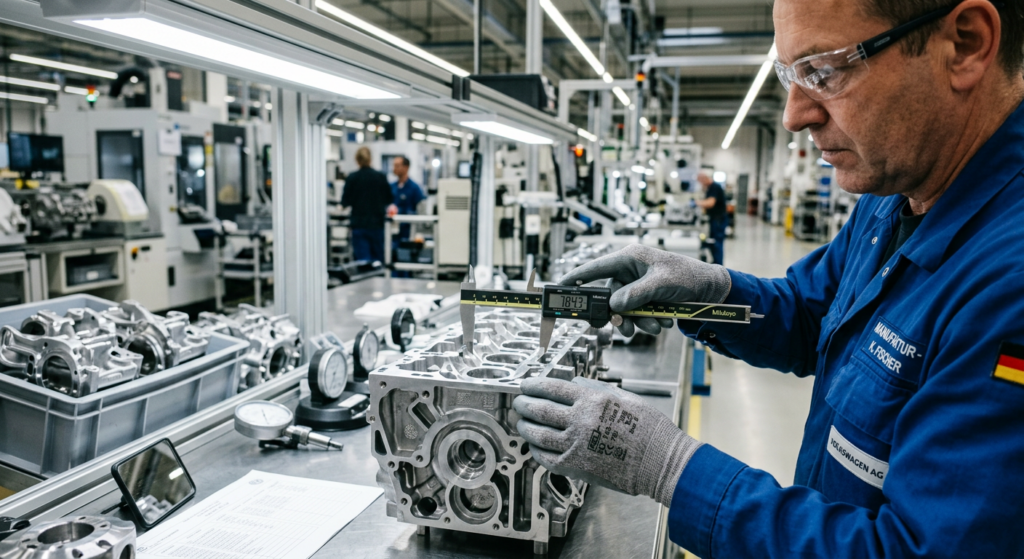
Germany’s industrial economy — the largest in Europe — generates enormous and sustained demand for safety gloves across multiple high-value sectors. As a leading safety gloves manufacturer serving this market, we see procurement volumes driven by Germany’s world-class automotive, chemical, mechanical engineering, construction, and logistics industries, each with distinct glove performance requirements.
- Automobilherstellung: Germany’s automotive industry, centered in Stuttgart, Munich, Wolfsburg, and Ingolstadt, is the single largest consumer of safety gloves. Assembly workers handling stamped metal parts, wiring harnesses, and painted body panels require thin-gauge PU and nitrile foam gloves (13G–18G) with anti-static properties and EN 388 cut levels B–C for edge protection.
- Chemical and Petrochemical Processing: Chemical plants in Ludwigshafen, Leverkusen, and the Rhineland handle solvents, acids, and industrial lubricants requiring dual-certified gloves (EN 388 + EN ISO 374-1) with nitrile full-dip or 3/4 coatings for chemical splash resistance alongside mechanical protection.
- Mechanical Engineering: The market shows significant penetration across major industrial hubs such as North Rhine-Westphalia, Baden-Württemberg, and Bavaria, supported by their robust manufacturing and automotive industries. MRO technicians servicing CNC machines, hydraulic presses, and industrial robots require cut-resistant HPPE liners (EN 388 cut level C–D) paired with nitrile coatings for oil grip and tool-handling dexterity.
- Bauwesen: Germany’s construction sector generates over 100,000 workplace accidents annually. Workers need heavy-duty 10G latex crinkle or nitrile coated gloves with high abrasion and puncture resistance for rebar handling, concrete work, masonry, and scaffolding operations.
- Logistik und Lagerwesen: Germany’s position as Europe’s logistics hub, with major distribution centers in Hamburg, Frankfurt, and Leipzig, drives demand for lightweight 13G–15G nitrile micro-foam gloves — many now requiring touchscreen compatibility for tablet and scanner use.
- Oil, Gas, and Mining: Refinery and pipeline operations across northern Germany and offshore platforms require heavy-duty TPR impact-resistant gloves with full nitrile dip coatings (EN 388: 4X44DP) to protect against crush hazards, hydrocarbons, and abrasive surfaces.
- Metal Fabrication and Stamping: Sheet metal and precision machining operations across NRW and Bavaria demand the highest cut resistance levels (EN 388 cut D–F) with sandy nitrile palm coatings for handling sharp-edged, oily workpieces.
The industrial safety gloves market in Germany is anticipated to experience substantial and promising growth from 2025 to 2034, driven by increasing industrial activities, stricter safety regulations, and a growing emphasis on workplace safety standards. Germany’s focus on technological innovation and high-quality manufacturing processes encourages the adoption of advanced safety gloves with enhanced cut, chemical, and impact protection. For any safety gloves manufacturer, understanding these industry-specific requirements is essential to winning and retaining German procurement contracts.
Spezifische Anwendungsszenarien
Scenario 1: Automotive Wiring Harness Assembly in Bavaria
At a Tier 1 wiring harness supplier near Regensburg, 200 assembly workers handle copper terminals, plastic connectors, and thin-gauge wires throughout 8-hour rotating shifts. The primary hazards are sharp terminal edges that cause micro-cuts and repetitive-motion fatigue from fine manipulations. Workers wear 18G nylon-spandex liner gloves with PU fingertip coating (EN 388: 4131) — the ultra-thin 18G gauge provides near-barehand sensitivity for inserting terminals into connector housings, while the PU coating protects fingertips against abrasion and micro-cuts. Each worker uses approximately 1 pair per week, and the gloves must leave zero residue on electrical contact surfaces.
Scenario 2: Commercial Construction in Hamburg
On a mixed-use high-rise construction site in Hamburg’s HafenCity, 120 workers perform rebar tying, concrete formwork assembly, and scaffolding erection through Germany’s wet, cold winter months. Hazards include sharp rebar ends, rough concrete surfaces, impact from dropped tools, and wet/frozen conditions that compromise grip. The recommended specification is 10G cotton-polyester liner with latex crinkle 3/4 coating (EN 388: 2242) — the crinkle texture channels rainwater away from the grip zone, the thicker 10G liner provides insulation and cushioning, and the 3/4 dip coverage protects the back of the hand from concrete splash while allowing moisture to escape through the un-coated cuff area.
Scenario 3: Metal Stamping Press Operation in NRW
At a precision metal stamping facility near Düsseldorf producing automotive brackets and housing components, 60 press operators load raw sheet metal blanks into progressive stamping dies, remove stamped parts, and perform first-piece inspections. Workers face severe laceration hazards from razor-sharp sheet metal edges coated in stamping lubricant. The recommended specification is 15G HPPE liner with sandy nitrile palm coating (EN 388: 4X43C) — the HPPE fiber delivers cut level C resistance against sharp stamped edges, while the sandy nitrile texture provides reliable grip on lubricant-coated metal, preventing dangerous slips that could pull fingers into die clearances.
Fallstudien
Case 1: National PPE Standardization for German Logistics Network
A major German third-party logistics provider operating 14 distribution centers needed to standardize safety gloves across all sites, replacing 8 inconsistent regional specifications. Working with a factory-direct safety gloves manufacturer, they developed a custom 13G polyester-spandex liner with nitrile micro-foam palm coating featuring conductive fingertips for scanner use and company-branded wristband color coding by department. The unified program reduced annual glove procurement costs by 22% while increasing worker satisfaction scores.
Case 2: Private-Label Cut-Resistant Gloves for German Distributor
A mid-sized German PPE distributor identified strong demand from its Mittelstand manufacturing clients for premium cut-resistant gloves at competitive prices. They partnered with an OEM safety gloves manufacturer to develop 4 SKUs — 13G HPPE nitrile foam (cut B), 15G HPPE sandy nitrile (cut C), 13G HPPE-glass fiber sandy nitrile (cut D), and 13G Kevlar latex crinkle (cut C, heat-resistant). All carried bilingual DE/EN packaging with full CE/EN 388 documentation. The initial 40,000-pair order shipped within 22 days.
Top 6 der empfohlenen lokalen Anbieter in Deutschland
| Name des Unternehmens | Zentrale Stärken | Service-Regionen | Vorverkaufsunterstützung | After-Sale-Unterstützung |
|---|---|---|---|---|
| RheinSchutz Arbeitsschutz GmbH | Broad EN 388-certified Safety Gloves Manufacturer portfolio for automotive and chemical sectors | NRW, Hessen, Rheinland Pfalz | On-site hazard assessments, EN 388 compliance consulting | Quarterly usage analysis, dedicated account managers |
| BayernSafe Industrieschutz | Premium cut-resistant and anti-static gloves for precision engineering and electronics | Bayern, Baden-Württemberg | Ergonomic fit testing, cut hazard evaluation | Field quality audits, warranty replacement |
| NordPro PPE Handel | Multi-category Safety Gloves Manufacturer catalog for logistics, maritime, and food processing | Hamburg, Niedersachsen, Schleswig-Holstein | Technical datasheets, import compliance guidance | Express-Ersatzversand, Retourenbearbeitung |
| SachsenGuard Handschutz | Cost-effective bulk supply for Mittelstand manufacturing and construction | Sachsen, Brandenburg, Thüringen | Government tender support, MOQ-flexible quoting | On-site inventory management, batch traceability |
| HansaPPE Vertrieb | E-commerce-optimized packaging with Amazon.de and B2B platform integration | Bundesweit über das Drehkreuz Hamburg | Produktlistungsinhalte, Zertifikationsdokumentation | Consumer review management, fulfillment support |
| AlpenTech Schutzausrüstung | Heavy-duty impact-resistant and heat-resistant gloves for oil & gas and metalworking | Bavaria, Alpine industrial regions | Application-specific TPR glove recommendations | Seasonal stock planning, performance monitoring |
When evaluating any safety gloves manufacturer or supplier, always verify EN 388 test reports from EU-accredited notified bodies and request the German-language EU Declaration of Conformity, REACH compliance documentation, and SVHC substance declarations.
Why Choose Snell Safety as Your Global Safety Gloves Partner
Snell Sicherheit brings deep German market expertise built through years of collaboration with PPE distributors, automotive OEMs, construction companies, and HSE procurement teams across Germany. We know precisely which coating technologies, liner compositions, and gauge configurations perform best on German factory floors and construction sites — from the 18G PU-coated precision gloves demanded by Bavarian automotive assemblers to the 10G latex crinkle construction gloves used through NRW’s cold, wet winters. Our products are tailored to the hand-feel preferences of German workers, who consistently prioritize snug fit, high dexterity, and all-day comfort. With established local partners in Germany and planned overseas warehouse capacity for stock-ready delivery, we serve both end-user enterprises and distribution channels with localized support. We are actively recruiting distributors, agents, and e-commerce brand owners — offering comprehensive pre-sale empowerment (product selection guidance, technical training, market intelligence), after-sale support (quality assurance, replacement policies), dropshipping services, free samples, and marketing material support for online sellers.
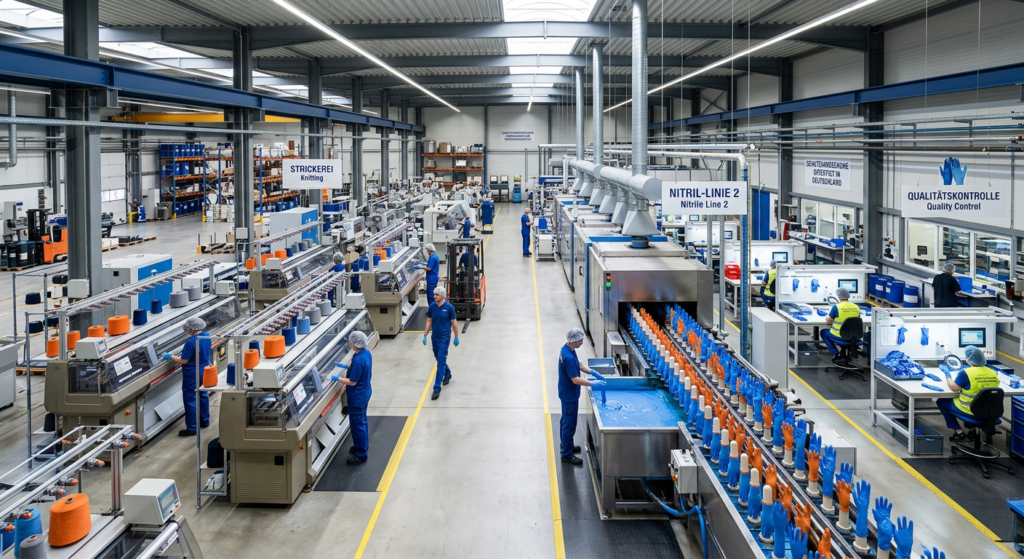
Our manufacturing strength underpins this market knowledge. With over a decade of production expertise, 6 dedicated production lines, and a daily capacity of 150,000 pairs, our vertically integrated process (R&D → material sourcing → knitting → coating/dipping → drying/curing → quality inspection → packaging → export) ensures consistent quality at factory-direct pricing. We offer the full range of coating technologies — PU, nitrile foam, nitrile micro-foam, sandy nitrile, and latex crinkle — on liners from 7G to 18G in nylon, polyester, HPPE, HPPE-glass fiber, Kevlar, spandex, and cotton jersey, all carrying ISO 9001 and CE certifications. Browse our complete Produktkatalog oder Kontakt zu unserem Team to request free samples and a custom quotation.
| Fähigkeit | Snell Safety Details |
|---|---|
| Daily Capacity | 150,000 pairs across 6 dedicated production lines |
| Beschichtungstechnologien | PU, nitrile foam, micro-foam, sandy nitrile, latex crinkle, smooth nitrile |
| Liner Gauge Range | 7G, 10G, 13G, 15G, 18G |
| Materialien der Auskleidung | Nylon, polyester, HPPE, HPPE-glass fiber, Kevlar, spandex, cotton jersey |
| Schnittfestigkeit | EN 388 cut levels A1–F; ANSI/ISEA 105 levels A1–A9 |
| Zertifizierungen | ISO 9001, CE marking (EN 388:2016+A1:2018, EU 2016/425) |
| Services | OEM/ODM, private label, bulk wholesale, custom branding, dropshipping |
Use this table to confirm whether Snell Safety’s manufacturing capabilities align with your safety gloves procurement requirements for the German market.
FAQ
What EN 388 rating should I look for when buying safety gloves in Germany?
EN 388:2016+A1:2018 rates gloves on abrasion (1–4), blade cut (1–5), tear (1–4), puncture (1–4), ISO 13997 cut (A–F), and impact (P). For general manufacturing, look for 4131 minimum. For metal handling, aim for 4X43C or higher. The “P” marking indicates impact protection is tested and passed.
Welche Zertifizierungen sind für den Import von Sicherheits-Handschuhen nach Deutschland erforderlich?
Safety gloves must comply with EU Regulation 2016/425 and carry CE marking. Category II PPE (mechanical risk) requires EU Type Examination by an accredited notified body, EN 388:2016+A1:2018 testing, a German-language EU Declaration of Conformity, and REACH compliance documentation with SVHC substance declarations.
Which coating type is best for oily environments?
Sandy nitrile provides the strongest grip in heavy oil and grease conditions. Nitrile foam offers good grip in light-to-medium oily settings with better dexterity. For full oil immersion, smooth nitrile full-dip coatings provide the most complete barrier. PU coatings are not recommended for oily environments as they degrade on oil contact.
Wie wähle ich das richtige Messgerät für meine Branche?
For electronics and precision assembly, 18G offers near-barehand dexterity. For automotive manufacturing and general engineering, 15G balances dexterity with durability. For standard industrial tasks, 13G is the most versatile. For heavy construction and cold outdoor work, 10G or 7G provides extra thickness, warmth, and cushioning.
What is the price range for bulk safety gloves orders from a manufacturer?
For factory-direct orders (typical MOQ 5,000–10,000 pairs), 13G nylon-PU gloves range from €0.20–€0.45 per pair. Nitrile foam general purpose gloves cost €0.30–€0.55 per pair. Cut-resistant HPPE-nitrile models range from €0.80–€1.50 per pair. Heavy-duty TPR impact gloves cost €1.70–€3.50 per pair. Custom branding adds €0.05–€0.15.
Welchen Schnittschutzniveau brauche ich für Bauarbeiten in Deutschland?
For general construction (concrete, masonry, scaffolding), EN 388 cut level B (2.5–5.0 N) is typically sufficient. For rebar handling and metal structure work, cut level C (5.0–10.0 N) is recommended. For sheet metal roofing and glass installation, cut level D or E (10.0–22.0 N) provides the necessary protection.
How long do safety gloves typically last in industrial use?
Service life varies by application intensity. Thin-gauge PU assembly gloves last 1–3 weeks under light use. General purpose nitrile foam gloves last 2–4 weeks. Cut-resistant gloves in metal handling last 1–2 weeks. Heavy-duty construction gloves last 1–3 weeks. Replace gloves immediately when coating shows peeling, holes, or grip loss.
Are touchscreen-compatible safety gloves available for logistics operations?
Yes. Modern safety gloves incorporate conductive fibers (silver-coated nylon or carbon fiber) in the thumb and index fingertip zones, enabling capacitive touchscreen operation without glove removal. These are increasingly specified in German logistics, warehouse, and smart factory environments where workers use tablets, barcode scanners, and smartphones throughout shifts.
Was ist der Unterschied zwischen Nitril-Schaum- und Nitril-Mikroschaum-Beschichtungen?
Nitrile foam features a sponge-like cellular structure that provides moderate oil grip with excellent breathability. Nitrile micro-foam uses finer, denser cells for improved wet grip and liquid repellency while maintaining high breathability. Micro-foam is generally preferred in mixed wet/dry conditions, while foam excels in dry-to-light-damp environments.
What DGUV regulations apply to safety gloves procurement in Germany?
Under DGUV Regel 112-195, employers must conduct workplace hazard assessments, provide CE-certified gloves at no cost, ensure proper fit through sizing trials, deliver user training, and document the glove selection rationale. The assessment must identify specific mechanical, chemical, or thermal hazards and match glove specifications accordingly.
Whether you are an end-user enterprise seeking reliable factory-direct supply, a PSE distributor expanding your German product portfolio, or an e-commerce brand building a private-label safety gloves line, Snell Sicherheit is ready to support you with precisely tailored products, competitive pricing, and comprehensive partner empowerment. Reichen Sie Ihre Spezifikationen ein oder fordern Sie noch heute ein Angebot an – inklusive kostenloser Muster, kundenspezifischer OEM/ODM-Lösungen und dedizierter techn
Inhalt überprüft und aktualisiert: März 2026