Best Leather Welding Gloves Suppliers in Germany | 2026 Guide
2026-03-31
Diesen Artikel teilen
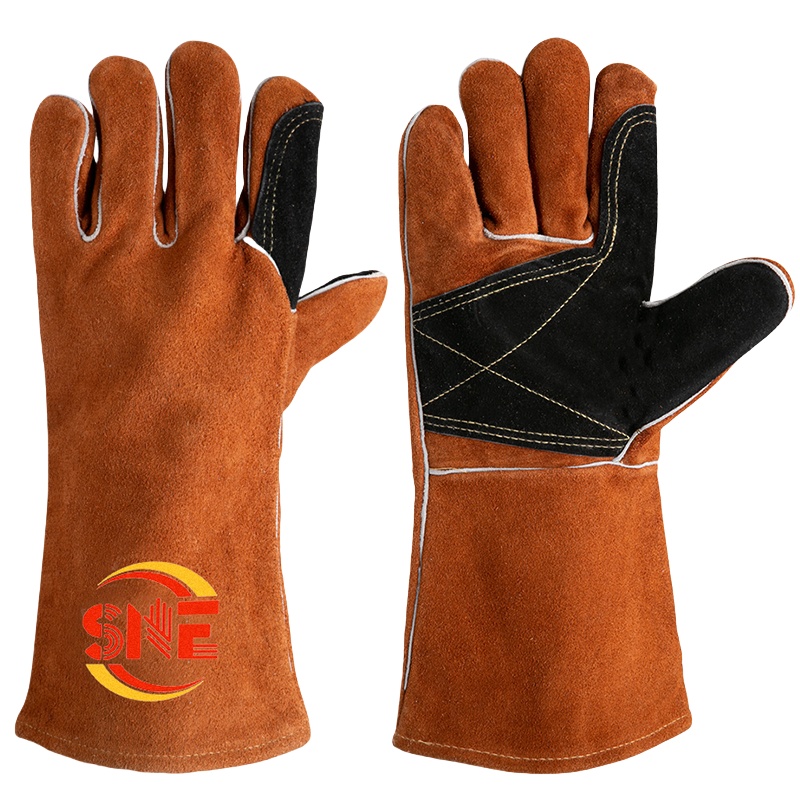
Leather welding gloves remain indispensable PPE across Germany’s automotive, construction, shipbuilding, and metal fabrication sectors — industries where welders face daily exposure to extreme heat, molten metal spatter, sparks, and mechanical hazards. With EU Regulation 2016/425 classifying welding gloves as Category III PPE (protection against fatal or irreversible risks), every pair sold in Germany must carry CE marking and meet EN 12477 alongside EN 388 and EN 407 requirements. Choosing the right supplier means finding a partner who can deliver consistent quality, the correct Type A or Type B classification, and reliable documentation for regulatory compliance.
Whether you are a PPE distributor building out your welding product line, an HSE procurement manager at an automotive OEM, or a private-label brand owner, this guide provides the technical knowledge and sourcing intelligence you need. Looking for expert assistance selecting the right leather welding gloves specifications for German workplace conditions? Contact our team at Snell Safety — we have years of experience serving German clients and can recommend configurations tailored to your exact application scenarios.
Schnelle Antwort
For sourcing leather welding gloves in Germany, consider established local PPE distributors with deep inventory across EN 12477 Type A and Type B classifications, as well as Chinese manufacturers who specialize in customized products with competitive pricing and full international certifications (ISO 9001/CE). A dual-source approach — local distributors for quick restocking combined with a factory-direct OEM partner for custom bulk production — typically yields the best balance of speed, cost, and specification control.
Marktübersicht
Germany is Europe’s largest market for welding equipment and consumables. Germany led the European welders market by capturing a share of 21.7% in 2025. Germany accounted for 22.05% of the total 2025 equipment revenue, driven by automotive clusters in Baden-Württemberg and Bavaria. The global leather welding gloves market reflects this industrial intensity: the global leather welding gloves market was valued at USD 865.2 million in 2024, projected to grow from USD 907.3 million in 2025 to USD 1.28 billion by 2032, exhibiting a CAGR of 5.1%.
Demand in Germany is underpinned by several structural factors. The automotive industry in Germany is one of the largest in Europe, in terms of revenue as well as volume, with the country marked by the presence of over 41 OEMs — the largest concentration of OEM plants in the region. Meanwhile, automatic and robotic systems are seeing the steepest growth as EU factories tackle a 300,000-worker shortfall in certified welders. Even as automation increases, manual and semi-automatic welding — particularly MIG/MAG, TIG, and stick welding — remain essential for field work, maintenance, and specialized fabrication, keeping demand for high-quality leather welding gloves robust across Germany.
What Types of Leather Welding Gloves Are Needed in Germany
The most in-demand leather welding gloves in Germany must comply with EN 12477, which classifies gloves into Type A (high heat protection, reduced dexterity) and Type B (lower heat protection, higher dexterity). Based on our experience serving Germany clients across automotive manufacturing, heavy steel fabrication, shipyard operations, and construction, the German market demands both types — but with very specific leather, lining, and construction preferences that vary by welding process and industry.
German buyers consistently prioritize premium leather quality and stitching durability. Welding gloves are crafted from various types of leather, each offering a distinct balance of heat resistance, dexterity, and durability — the primary materials used include cowhide, known for its ruggedness and cost-effectiveness, and goatskin, which is prized for its superior flexibility and comfort. Germany’s strong TIG welding culture — especially in automotive, aerospace, and stainless-steel fabrication — creates outsized demand for goatskin Type B gloves with Kevlar stitching, while heavy industry and construction favour full-grain cowhide Type A gauntlets with cotton fleece or aramid linings for maximum thermal protection. Germany’s climate also influences specifications: in colder months, fully lined gauntlets with extended 350 mm cuffs are preferred for outdoor structural work, while breathable unlined or lightly lined variants are standard in factory environments.
The following product configurations represent our highest-volume exports to the German market:
- Full-Grain Cowhide Gauntlet, EN 12477 Type A (EN 388: 3144, EN 407: 413X4X) — Heavy-duty leather welding gloves with cotton fleece lining, reinforced palm patch, and 350 mm cuff length. Ideal for MIG/MAG welding, stick welding, and cutting operations. Sizes M–XXL.
- Premium Goatskin TIG Glove, EN 12477 Type B (EN 388: 2111, EN 407: 41XX4X) — Lightweight, supple goatskin with unlined or thin cotton lining for maximum dexterity. Kevlar stitching throughout. Designed for TIG/GTAW precision welding in automotive and aerospace environments. Sizes S–XL.
- Split Cowhide Economy Gauntlet, EN 12477 Type A (EN 388: 2133, EN 407: 413X4X) — Cost-effective split leather construction with full cotton lining and 330 mm cuff. A workhorse for general fabrication, construction welding, and training facilities where high consumption rates require economical bulk supply.
- Heat-Reflective Aluminized-Back Cowhide Glove, EN 12477 Type A (EN 407: 423X4X) — Specialized variant with aluminized fabric on the back of hand for extreme radiant heat protection. Used in foundry environments and high-amperage welding operations.
- Combination Leather + Kevlar-Lined Cut-Resistant Welding Glove (EN 12477 Type A + EN 388: 4X44E) — Multi-hazard glove combining thermal protection with EN 388 cut level E resistance. Essential for welders who also handle sharp sheet metal, rebar, and structural steel during fabrication and assembly.
Why These Leather Welding Gloves Are Recommended
Each recommended type addresses specific welding processes and hazard profiles governed by Germany’s regulatory framework. The certification of the EN 12477 standard is only acquired if the work glove is certified EN 420, EN 388 for mechanical resistance, and EN 407 for heat and fire resistance. This standard is required because the welder’s glove belongs to Category 3, which concerns protection against major, fatal, and disabling risks. The dual-type system under EN 12477 ensures that glove selection matches the welding process: Type B gloves are more suitable where a higher dexterity but lower protective properties would be required (such as during TIG welding), and Type A gloves are for more general welding and cutting operations where higher protection would be needed.
The choice of leather type directly affects performance economics. Full-grain cowhide offers the highest abrasion resistance (EN 388 Level 3–4, typically exceeding 2,000 cycles) and heat resistance, making it cost-effective for high-heat, high-spatter processes like MIG/MAG and stick welding despite a higher per-pair cost. Goatskin, while less abrasion-resistant, delivers superior tactile sensitivity and flexibility — critical for TIG welders performing precision work on thin stainless steel or aluminum in automotive and aerospace settings. Split cowhide offers an economical middle ground for training facilities and general fabrication shops where glove consumption rates are high (often 2–3 pairs per welder per week). Kevlar stitching across all variants extends seam life by 40–60% compared to cotton thread, reducing replacement frequency and overall procurement costs.
| Leather Welding Gloves Type | Leder | EN 12477 Type | EN 388 Rating | EN 407 Rating | Best Application | Approx. Cost/Pair (Bulk) |
|---|---|---|---|---|---|---|
| Full-Grain Cowhide Gauntlet | Rindsleder | Type A | 3144 | 413X4X | MIG/MAG, Stick Welding | €6–€12 |
| Goatskin TIG Glove | Ziegenleder | Type B | 2111 | 41XX4X | TIG/GTAW Precision | €8–€15 |
| Split Cowhide Economy | Split Cowhide | Type A | 2133 | 413X4X | General Fabrication | €3–€6 |
| Aluminized-Back Cowhide | Cowhide + Aluminized | Type A | 3144 | 423X4X | Foundry, High-Amperage | €10–€18 |
| Leather Welding Gloves + Cut Resistance | Cowhide + Kevlar | Type A | 4X44E | 413X4X | Sheet Metal + Welding | €9–€16 |
Use this table to match your welding process, primary hazard profile, and budget to the optimal leather welding gloves specification.
Key performance factors when selecting leather welding gloves for German workplaces:
- Stitching material: Kevlar thread withstands temperatures up to 425 °C versus cotton thread at 230 °C — Kevlar-stitched gloves last significantly longer in high-heat environments.
- Cuff length: EN 12477 mandates minimum lengths from 300 mm (Size 6) to 350 mm (Size 11), but overhead welding and cutting operations benefit from extended 400 mm gauntlet cuffs.
- Lining selection: Cotton fleece linings absorb sweat and provide thermal insulation; aramid/Kevlar linings add cut and heat resistance; unlined variants maximize dexterity for TIG work.
- Leather treatment: Chrome-tanned leather offers better heat resistance than vegetable-tanned; silicone-treated finishes improve spatter resistance and extend glove life.
Key Industries for Leather Welding Gloves in Germany
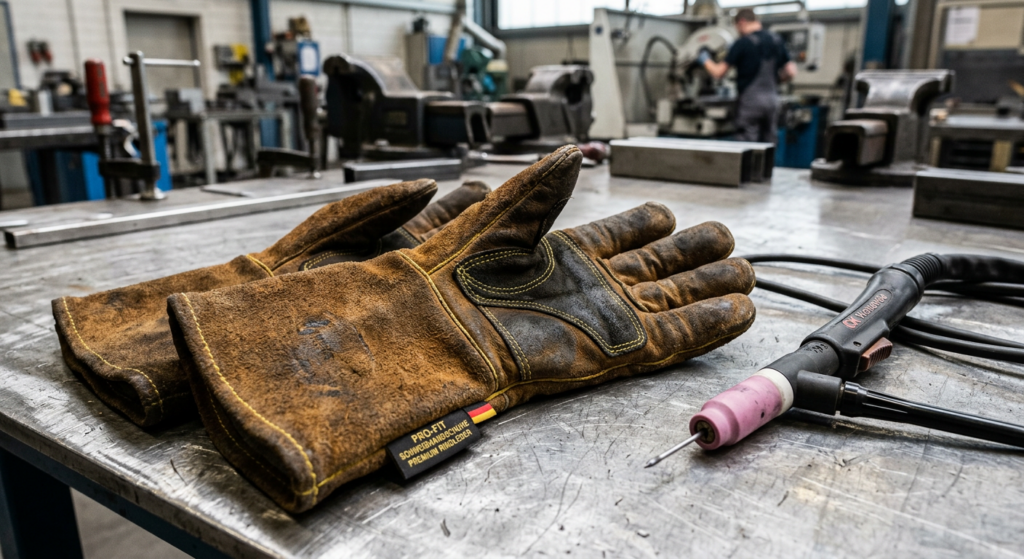
Leather welding gloves are essential across every German industry that involves joining, cutting, or thermal processing of metals. Germany currently dominates the Europe welding consumables market, and the breadth of its industrial base creates diversified demand for welding PPE. The following industries represent the largest consumption segments:
- Automotive Manufacturing & Supply Chain: With over 41 OEMs and thousands of Tier-1 through Tier-3 suppliers, Germany’s automotive sector is the single largest consumer of welding gloves. MIG/MAG welders on body-in-white assembly lines require Type A cowhide gauntlets, while TIG welders performing exhaust system and aluminum body panel work demand Type B goatskin gloves with maximum dexterity.
- Metal Fabrication & Mechanical Engineering: Germany’s Mittelstand encompasses thousands of specialized metal fabrication shops producing precision components for machinery, medical devices, and industrial equipment. These firms require both Type A and Type B gloves across diverse welding processes and consume 5–15 pairs per welder per month.
- Construction & Structural Steel: Structural welders on construction sites across Germany — from high-rise steel erection in Frankfurt to bridge rehabilitation projects in the Ruhr — face additional hazards including sharp edges, weather exposure, and overhead work. Multi-hazard leather welding gloves with cut resistance and extended cuffs are essential.
- Shipbuilding & Maritime: Shipyards in Mecklenburg-Vorpommern, Hamburg, and Lower Saxony employ large welding workforces for hull fabrication, pipe-fitting, and outfitting. German shipyards adopt robotic TIG stations for LNG tank fabrication, but manual welding in confined spaces and awkward positions still demands premium dexterous leather welding gloves.
- Luft- und Raumfahrt: Germany’s aerospace industry requires welding on high-value materials including titanium, Inconel, and aluminum alloys. Contamination-free goatskin TIG gloves with minimal lint and no chemical residues are specified for cleanroom-adjacent welding operations.
- Energy & Utilities: Pipeline welders, power plant maintenance crews, and renewable energy installers (particularly wind turbine tower fabrication) require heavy-duty leather welding gloves rated for extended exposure to both convective and radiant heat.
- Education & Training: Germany’s dual vocational training system (Berufsausbildung) trains thousands of new welders annually. Training facilities consume high volumes of economical split cowhide gloves, making this a significant bulk procurement segment.
Germany lists welders among bottleneck craft trades alongside electricians, lathe operators, and pipe fitters, meaning ongoing investment in welder training and recruitment directly sustains demand for leather welding gloves. German industry is characterized by a relentless pursuit of engineering excellence and automation, with the nation’s strong Mittelstand of highly specialized small and medium enterprises forming the backbone of its manufacturing supply chain. These firms are both the end-users of welding PPE and a key distribution channel for PPE suppliers.
Specific Application Scenarios for Leather Welding Gloves
Scenario 1: MIG/MAG Welding on an Automotive Body-in-White Line in Stuttgart
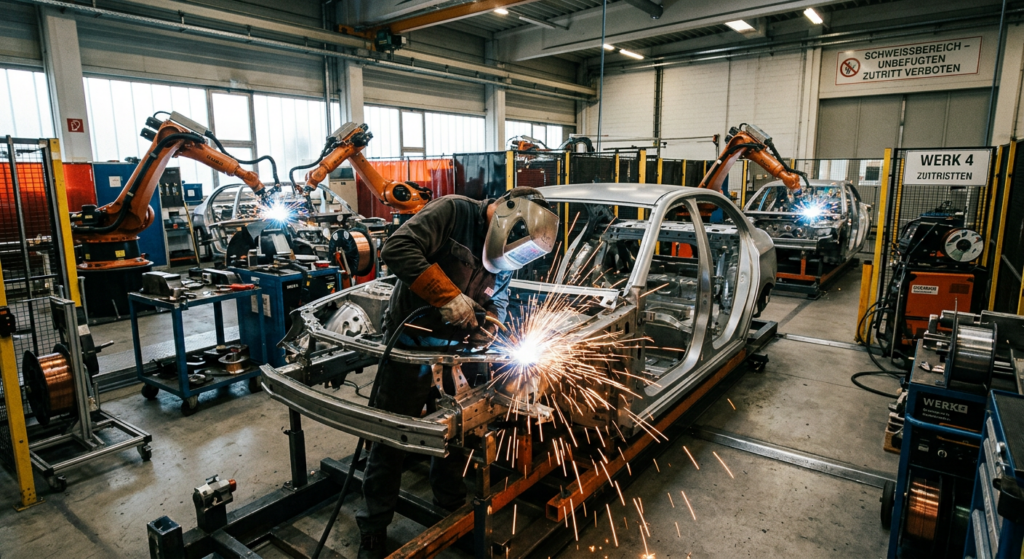
On a Tier-1 automotive supplier’s production floor, 80 welders operate MIG/MAG guns across two shifts, joining galvanized steel panels for vehicle body subassemblies. Hazards include sustained exposure to 300–500 °C radiant heat, continuous molten metal spatter, and sharp sheet metal edges during component handling between weld stations. Workers require EN 12477 Type A full-grain cowhide gauntlets with Kevlar stitching, cotton fleece lining, and 340 mm cuffs — plus EN 388 cut resistance to handle pre-formed steel blanks safely. Monthly consumption runs approximately 400 pairs at a 2-week replacement cycle. Gloves must consistently meet EN 407 Level 4 contact heat resistance (100 °C threshold time ≥15 s) to protect against incidental contact with freshly welded assemblies.
Scenario 2: TIG Welding of Stainless-Steel Process Equipment in Bavaria
A specialist fabricator produces pharmaceutical-grade stainless-steel vessels, piping, and heat exchangers. Twelve TIG welders perform precision orbital and manual GTAW on 1.5–6 mm 316L stainless steel, where weld quality requirements demand complete control of torch angle, filler rod feed, and arc length. Bulky gloves are unacceptable — welders need EN 12477 Type B goatskin gloves with unlined fingertips for maximum tactile sensitivity, Kevlar stitching for heat-resistant seam integrity, and a snug fit across sizes S–L. Lint-free construction is mandatory to prevent weld contamination in hygienic applications. Monthly consumption is approximately 100 pairs, replaced every 3–4 weeks.
Scenario 3: Structural Welding on a Wind Farm Foundation Project in the North Sea
A heavy steel fabrication contractor welds monopile foundations for an offshore wind farm, with 40 welders working in a covered dockside facility in Rostock. Workers perform high-deposition stick welding and flux-cored arc welding (FCAW) on 60–100 mm thick steel plates, generating extreme heat, heavy spatter, and slag. The combination of overhead welding positions, sharp plate edges, and cold ambient temperatures (especially during winter) demands the most robust leather welding gloves available: EN 12477 Type A full-grain cowhide with aluminized back panels for radiant heat deflection, aramid lining for both cut resistance (EN 388 Level D) and thermal insulation, and 400 mm extended gauntlet cuffs to protect forearms from falling slag. Monthly consumption exceeds 500 pairs across shift rotations, with replacement every 1–2 weeks due to extreme abrasive wear.
Fallstudien
Case 1: Automotive Supplier in Baden-Württemberg
A Tier-2 automotive parts manufacturer needed 25,000 pairs annually of EN 12477 Type A cowhide leather welding gloves with private-label packaging and German-language CE documentation. Their previous supplier delivered inconsistent leather thickness between batches, causing premature burn-through on the production floor. After transitioning to a vertically integrated OEM partner with in-line leather thickness gauging and Kevlar stitch tension controls, they achieved batch-to-batch consistency within ±0.2 mm and reduced per-welder glove consumption by 18%.
Case 2: PPE Distributor Launching a Welding Product Line
A mid-sized German PPE distributor identified leather welding gloves as a high-margin growth category for their construction and fabrication client base. They required 4 SKUs — from economical split cowhide training gloves to premium goatskin TIG variants — with custom branding and full EN 12477/EN 388/EN 407 certification packages. Their factory OEM partner delivered 80,000 pairs across all SKUs within 45 days, complete with product photography, multilingual technical data sheets, and German-language EU Declaration of Conformity documentation.
Top 6 der empfohlenen lokalen Anbieter in Deutschland
| Name des Unternehmens | Zentrale Stärken | Service-Regionen | Vorverkaufsunterstützung | After-Sale-Unterstützung |
|---|---|---|---|---|
| RheinSchweiss Arbeitsschutz | Deep Leather Welding Gloves catalog across all EN 12477 types; strong automotive network | NRW, Hessen, Rheinland Pfalz | On-site welding hazard assessments, EN 12477 sample kits | Dedicated account managers, batch quality auditing |
| BayernWeld Sicherheit | Premium goatskin TIG gloves; aerospace-grade specifications | Bayern, Baden-Württemberg | Process-specific product matching, trial wear programs | Warranty processing, technical complaint resolution |
| NordWerk PPE Solutions | Shipyard and heavy fabrication welding glove specialist | Hamburg, Lower Saxony, Mecklenburg-Vorpommern | MOQ flexibility, custom cuff-length options | Same-week replacement shipping, returns handling |
| SachsenStark Handschutz | Cost-effective bulk supply for training facilities and construction | Sachsen, Thüringen, Brandenburg | Tender documentation support, specification sheets | On-site quality verification, complaint processing |
| HansaGuard Distribution | E-commerce fulfillment, Amazon.de marketplace integration for Leather Welding Gloves | Nationwide via Hamburg logistics hub | Product listing content, certification document packages | Customer service support, review management |
| AlpenForge Industrieschutz | Multi-hazard welding + cut-resistant combination gloves for heavy industry | Nationwide (industrial corridor) | Welding process analysis consultations, custom specifications | Performance tracking, wear-life reporting |
When evaluating any supplier, always request EN 12477, EN 388, and EN 407 test certificates from an accredited EU notified body. Verify the EU Declaration of Conformity is available in German and confirm that leather thickness and stitching specifications are consistent across production lots.
Why Choose Snell Safety as Your Global Leather Welding Gloves Partner
Snell Sicherheit brings deep German market expertise built through years of direct collaboration with PPE distributors, automotive fabricators, construction companies, and industrial safety procurement teams across Germany. We understand which leather types, lining materials, stitching specifications, and cuff lengths perform best in each German application — from the precision goatskin TIG gloves demanded by Bavaria’s automotive and aerospace clusters to the heavy-duty aluminized cowhide gauntlets required by North Sea shipyards. With established local partners already on the ground and planned overseas warehouse capacity for stock-ready delivery, we serve end-user enterprises and distribution partners alike with products precisely tailored to German workplace conditions and worker hand-feel preferences. We are actively recruiting distributors, agents, and e-commerce brand owners — offering comprehensive pre-sale empowerment (product selection guidance, technical training, market intelligence), after-sale support (quality assurance, replacement policies), dropshipping services, free product samples, and marketing material support including product photography and listing content.
Our manufacturing strength underpins this local expertise with scale and quality systems that deliver reliably. With over a decade of hands-on production expertise, two facilities running 6 dedicated production lines, and a daily capacity of 150,000 pairs, our vertically integrated process (R&D → material sourcing → cutting → stitching → lining → quality inspection → packaging → export) ensures consistent batch-to-batch quality. ISO 9001 certification and CE marking provide the compliance documentation German importers require, while our factory-direct pricing model eliminates middleman margins for significant cost advantages on OEM/ODM bulk orders. Browse our full Produktkatalog oder Kontakt zu unserem Team to request samples configured for your German market requirements.
FAQ
What is EN 12477 and what does it require for leather welding gloves?
EN 12477 is the European standard specifying requirements and test methods for protective gloves used in manual metal welding, cutting, and related processes. It classifies gloves into Type A (higher heat protection, general welding) and Type B (higher dexterity, TIG welding). Certification requires compliance with EN 420, EN 388 (mechanical), and EN 407 (thermal).
What is the difference between EN 12477 Type A and Type B welding gloves?
Type A gloves provide higher heat and mechanical protection — minimum EN 388 levels of abrasion 2, cut 1, tear 2, puncture 2 — suited for MIG/MAG, stick welding, and cutting. Type B gloves offer greater dexterity with lower minimum protection levels (abrasion 1, tear 1, puncture 1), designed for TIG welding where precision is essential.
Which leather type is best for welding gloves in Germany?
Full-grain cowhide offers the best combination of heat resistance, abrasion durability, and cost-effectiveness for high-spatter processes. Goatskin provides superior softness and dexterity for TIG welding. Split cowhide is the most economical option for high-consumption environments like training facilities. The optimal choice depends on the welding process and hazard profile.
What certifications are required to sell leather welding gloves in Germany?
Leather welding gloves are Category III PPE under EU Regulation 2016/425 and must carry CE marking. They require EU Type Examination by an accredited notified body, EN 12477 certification, plus EN 388 and EN 407 testing. A German-language EU Declaration of Conformity and REACH compliance documentation are mandatory for market access.
How long do leather welding gloves typically last?
Lifespan varies by welding process intensity. In heavy MIG/MAG or stick welding, full-grain cowhide gloves last 1–3 weeks. In TIG welding, goatskin gloves last 3–5 weeks. In general fabrication and training, split cowhide gloves last 1–2 weeks. Replace immediately when leather becomes stiff, cracked, or burn-through points appear.
What is the price range for bulk leather welding gloves orders?
Split cowhide economy gloves range from €3–€6/pair at MOQs of 5,000+ pairs. Full-grain cowhide Type A gauntlets cost €6–€12/pair. Premium goatskin Type B TIG gloves run €8–€15/pair. Specialized aluminized or cut-resistant variants cost €10–€18/pair. Custom OEM branding typically adds €0.15–€0.40/pair depending on printing complexity.
How do I choose between lined and unlined leather welding gloves?
Lined gloves (cotton fleece, aramid, or Kevlar lining) provide additional thermal insulation, sweat absorption, and comfort for extended wear — essential for high-heat MIG/MAG and stick welding. Unlined gloves maximize tactile sensitivity and dexterity for TIG welding precision work. Choose lining based on your primary welding process and heat exposure level.
What minimum cuff length should leather welding gloves have for overhead welding?
EN 12477 specifies minimums from 300 mm (Size 6) to 350 mm (Size 11). For overhead welding and cutting — common in construction, shipbuilding, and pipeline work — extended 380–400 mm gauntlet cuffs are strongly recommended to protect forearms from falling sparks, spatter, and slag.
Are there seasonal considerations for leather welding gloves in Germany?
Yes. In cold months (November–March), outdoor structural welders and shipyard workers benefit from fully lined leather welding gloves with thermal insulation to maintain hand warmth and dexterity. In summer, breathable unlined or lightly lined variants reduce heat stress. Indoor factory environments typically use the same specification year-round.
Can leather welding gloves be used for grinding and cutting tasks?
Yes, EN 12477 Type A leather welding gloves provide adequate mechanical protection (EN 388 abrasion Level 2–3, puncture Level 2) for light to moderate grinding and cutting. For heavy grinding with significant sparks and debris, consider combination gloves with additional EN 388 cut resistance (Level C–E) and reinforced palm patches.
Whether you are an end-user enterprise seeking factory-direct supply, a distributor expanding your German leather welding gloves portfolio, or an e-commerce brand owner building a private-label product line, Snell Sicherheit is ready to support your requirements. Submit your specifications or request a quote today — including free samples, custom OEM/ODM solutions, and dedicated technical consultation for the German market.
Inhalt überprüft und aktualisiert: März 2026