Beste Latex beschichtete Handschuhe Lieferanten in Deutschland | 2026 Leitfaden
2026-04-05
Diesen Artikel teilen
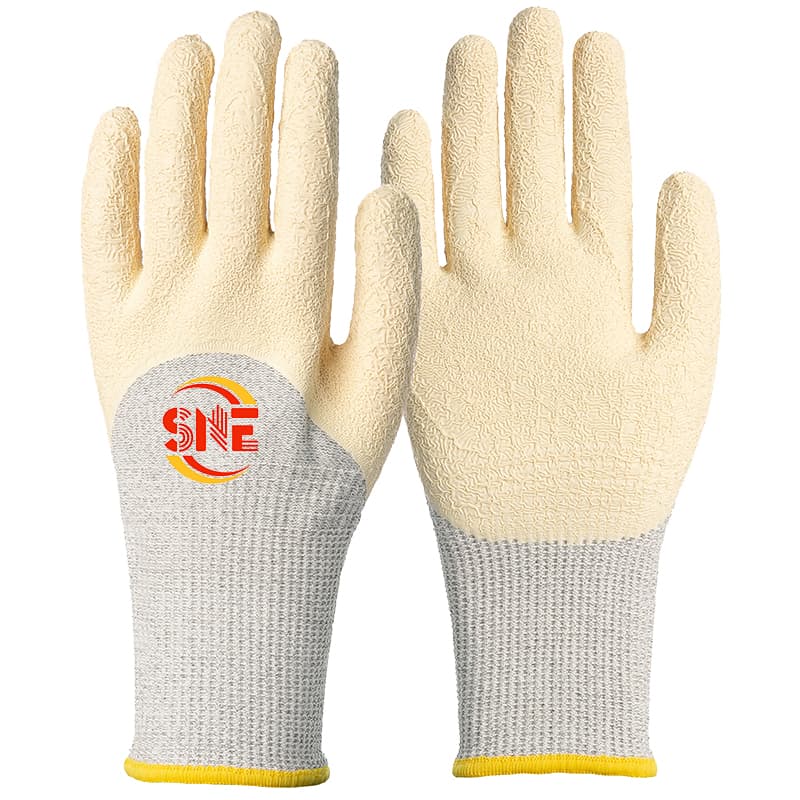
Latex coated gloves remain one of the most widely used categories of industrial hand protection in Germany, valued for their exceptional grip, flexibility, and cost-effectiveness across construction, manufacturing, logistics, and general industry applications. With Germany’s safety gloves market on a strong growth trajectory and rigorous EU PPE regulations governing every procurement decision, selecting the right supplier for latex coated gloves is a critical task for HSE managers and PPE buyers alike.
If you are sourcing latex coated gloves for the German market and need expert guidance on product selection, OEM/ODM custom configurations, or competitive bulk pricing, Kontakt zu unserem Team at Snell Safety. We have extensive experience serving German clients and can recommend the optimal product specifications for your specific workplace scenarios.

Schnelle Antwort
For high-quality latex coated gloves in Germany, consider established local PPE distributors with EN 388-certified product lines and strong regional logistics. Additionally, Chinese manufacturers who specialize in customized products with competitive pricing and full international certifications (ISO 9001/CE) offer excellent value for OEM/ODM and private-label programs. A hybrid sourcing approach — local distributors for quick-turn replenishment and a certified factory-direct partner for custom bulk orders — delivers optimal cost-performance balance.
Marktübersicht
Der Markt für Sicherheitshandschuhe in Deutschland wird voraussichtlich von 1.068,97 Mio. USD im Jahr 2023 auf geschätzte 2.100,86 Mio. USD im Jahr 2032 wachsen, was einer durchschnittlichen jährlichen Wachstumsrate (CAGR) von 7,78% entspricht. Latex coated gloves represent a significant share of this market, especially in construction, general manufacturing, and logistics segments where grip performance and cost-effectiveness are primary procurement criteria. The global latex coated gloves market size is estimated at USD 4.5 billion in 2024 and is expected to reach USD 7.2 billion by 2033 at a CAGR of 6.5%.
Germany’s robust framework for occupational safety regulations significantly drives the demand for safety gloves. The country’s adherence to stringent EU directives, such as Regulation (EU) 2016/425 on personal protective equipment, mandates the use of high-quality safety gloves across industries. Under the Arbeitsschutzgesetz (ArbSchG) and DGUV regulations, employers must conduct workplace risk assessments and provide CE-certified hand protection at no cost to workers — making consistent, standards-compliant supply a non-negotiable requirement.
What Types of Latex Coated Gloves Are Most in Demand in Germany
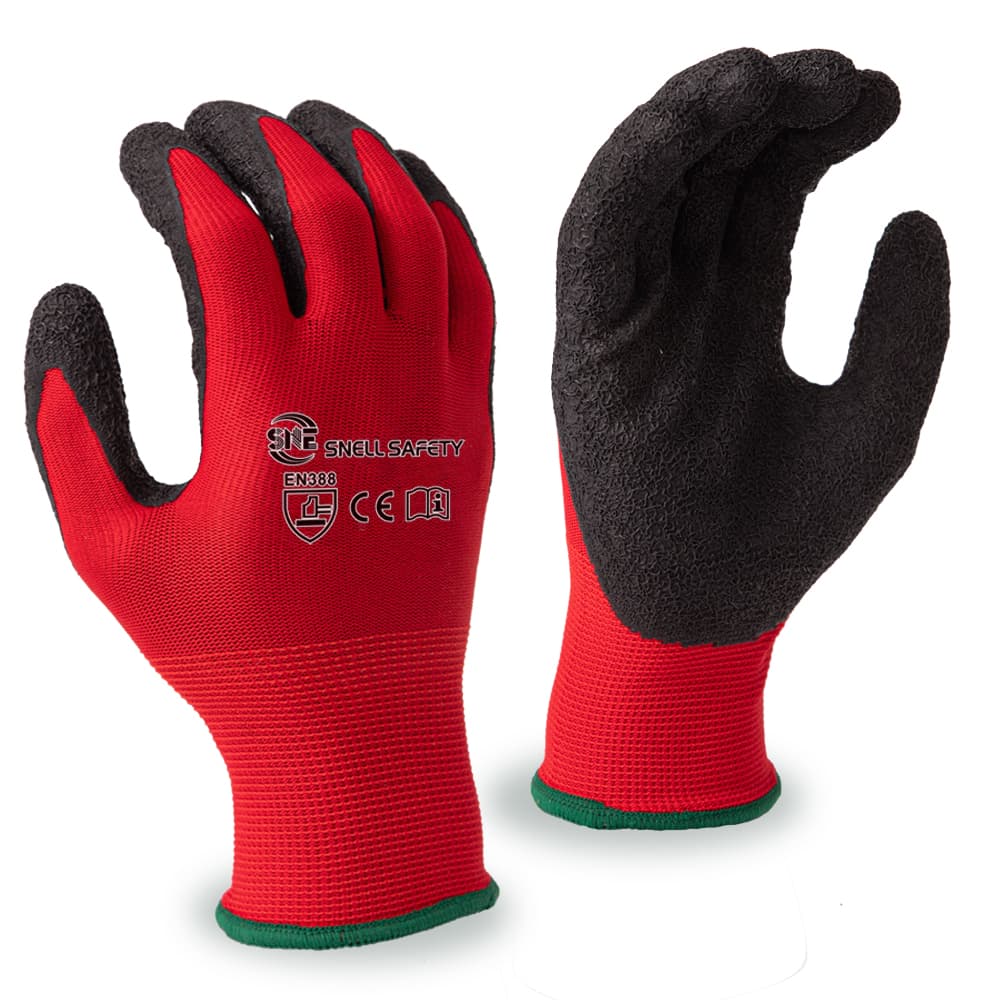
The most popular latex coated gloves in Germany feature crinkle-finish or smooth latex coatings on polyester, nylon, or cotton-blend liners, with EN 388 ratings optimized for mechanical risk protection in construction, manufacturing, and warehouse environments. Based on our experience serving German clients across these sectors, we consistently see demand concentrated around specific configurations that balance grip, durability, breathability, and all-day wearing comfort.
Through years of collaboration with German PPE distributors, HSE departments, and end-user enterprises, we at Snell Sicherheit have identified clear patterns shaped by Germany’s industrial profile and climate. Construction teams in North Rhine-Westphalia and Bavaria favor 10G cotton-polyester liner gloves with heavy-duty crinkle latex palm coatings for wet-condition grip on concrete and masonry. Automotive assembly workers in Baden-Württemberg prefer thinner 13G or 15G nylon liners with smooth or crinkle latex coatings that provide precision handling without sacrificing protection. Germany’s cold, damp winters — often lasting from October through April — drive strong demand for latex coated gloves with thermal liners and waterproof full-dip configurations. Worker hand-feel preferences in Germany lean toward snug-fitting, flexible gloves that do not compromise dexterity, which is why higher-gauge latex coated models are gaining share. Here are the top product types we supply most frequently:
- 10G Cotton-Polyester Liner + Latex Crinkle Palm Coating, EN 388: 2242 — Heavy-duty construction and masonry glove. The crinkle finish provides superior wet and dry grip on rough materials like concrete blocks, rebar, and timber. Ideal for outdoor work in Germany’s damp climate.
- 13G Nylon Liner + Latex Crinkle Palm Coating, EN 388: 2131 — Versatile mid-weight glove for general manufacturing, warehouse operations, and light construction. Excellent balance of dexterity and mechanical protection. Available in sizes S–XXL with high-visibility color options.
- 13G Polyester Liner + Latex Smooth Palm Coating, EN 388: 2121 — Economy general-purpose glove for assembly, packaging, and maintenance tasks. Smooth latex provides comfortable fit and basic grip for dry-environment handling.
- 10G Cotton Jersey Liner + Latex Full Dip (3/4 Coating), EN 388: 2243 — Cold-weather and wet-environment glove providing extended forearm protection. The 3/4 latex coating keeps hands dry during outdoor winter construction work while the cotton jersey liner adds warmth.
- 15G Nylon-Spandex Liner + Latex Foam Palm Coating, EN 388: 3131 — Precision assembly and light manufacturing glove. Latex foam coating delivers breathable, soft-touch grip with excellent dry and slightly oily surface performance. The 15G gauge provides a second-skin fit for tasks requiring high dexterity.
Why These Latex Coated Glove Types Are Recommended
EN 388 is a European safety standard for protective work gloves, providing comprehensive assessment for their resistance to mechanical risks. The standard evaluates gloves based on their performance against abrasion, cut, tear, puncture, and impact. For latex coated gloves in the German market, the EN 388 mechanical hazard profile must align with the tasks, materials, and environmental conditions workers encounter daily.
Latex coatings offer distinct technical advantages that explain their enduring popularity. Natural rubber latex delivers exceptional elasticity, conforming to hand contours for a snug, fatigue-reducing fit over long shifts. The crinkle-finish texture — achieved through a controlled wrinkling process during the dipping and curing stage — creates micro-channels that disperse water and liquid films, maintaining grip in wet conditions that are common on German construction sites and outdoor work environments. Compared to nitrile and PU coatings, latex provides superior flexibility and tactile sensitivity at equivalent thickness, making it the preferred choice for tasks that combine grip demands with fine motor requirements. The cost-effectiveness of latex coated gloves also makes them attractive for high-consumption applications where daily replacement is standard practice.
Key performance metrics to compare when selecting latex coated gloves include:
- Abriebfestigkeit: Crinkle latex on cotton-polyester liners typically achieves EN 388 level 2–4 (500–8,000 cycles), outlasting smooth latex in heavy-duty applications.
- Grip-Leistung: Crinkle and foam latex coatings excel in wet conditions; smooth latex is optimal for dry handling of small parts and components.
- Dexterity rating: 15G and 13G liners with thin latex coatings score EN 420 dexterity level 4–5, essential for precision assembly work in German automotive and electronics manufacturing.
- Atmungsaktivität: Foam latex coatings allow significantly more air circulation than solid crinkle or smooth coatings, reducing perspiration during extended wear in heated factory environments.
| Spezifikation | Liner / Gauge | Art der Beschichtung | EN 388-Bewertung | Abrasionszyklen | Beste Anwendung | Latex Coated Gloves Variant |
|---|---|---|---|---|---|---|
| 10G Cotton-Poly | Cotton-Polyester / 10G | Crinkle palm | 2242 | 2,000+ | Construction, masonry | Heavy-duty wet-grip |
| 13G Nylon | Nylon / 13G | Crinkle palm | 2131 | 1,000+ | General manufacturing | Versatile all-purpose |
| 13G Polyester | Polyester / 13G | Smooth palm | 2121 | 500+ | Assembly, packaging | Economy Latex Coated Gloves |
| 10G Cotton Jersey | Cotton Jersey / 10G | Full dip 3/4 | 2243 | 2,000+ | Cold-weather outdoor | Winter protection |
| 15G Nylon-Spandex | Nylon-Spandex / 15G | Foam palm | 3131 | 3,000+ | Präzise Montage | High-dexterity breathable |
Use this table to match your primary workplace hazard and task requirements to the optimal latex coated gloves specification.

Key Industries for Latex Coated Gloves in Germany
Latex coated gloves serve essential hand protection roles across Germany’s most productive industrial sectors. The market shows significant penetration across major industrial hubs such as North Rhine-Westphalia, Baden-Württemberg, and Bavaria, supported by their robust manufacturing and automotive industries.
- Bauwesen: Germany’s ongoing construction activity — including infrastructure upgrades, residential building, and commercial development — generates massive demand for durable latex coated gloves. Workers handling concrete, rebar, timber, and brickwork need crinkle latex palm coatings for reliable wet and dry grip, with 10G cotton-polyester liners providing abrasion resistance for all-day wear.
- Automobilherstellung: Germany’s automotive supply chain, concentrated in Baden-Württemberg and Bavaria, requires high-dexterity latex coated gloves for parts handling, sub-assembly, and quality inspection. Thin-gauge 13G and 15G nylon liners with smooth or foam latex coatings deliver the tactile sensitivity needed for precision assembly tasks.
- Logistik und Lagerwesen: Germany’s position as Europe’s logistics hub, with major distribution centers in Hamburg, Frankfurt, and the Ruhr Valley, drives steady demand for general-purpose latex coated gloves for parcel handling, pallet loading, and inventory management.
- General Manufacturing and Maintenance: Metal fabrication, machinery maintenance, and plant operations across Germany’s Mittelstand (medium-sized industrial enterprises) consume large volumes of versatile 13G crinkle-latex gloves that protect against abrasion, minor cuts, and general mechanical risks.
- Agriculture and Landscaping: Germany’s agricultural sector and municipal landscaping operations require comfortable, breathable latex coated gloves for planting, pruning, material handling, and equipment operation. Foam latex variants are preferred for their comfort during repetitive tasks.
- Public Works and Government Procurement: Municipal utilities, road maintenance crews, and government infrastructure projects procure latex coated gloves in bulk through standardized tender processes that specify EN 388 compliance and CE certification.
The industrial safety gloves market in Germany is anticipated to experience substantial and promising growth from 2025 to 2034, driven by increasing industrial activities, stricter safety regulations, and a growing emphasis on workplace safety standards. Employers are obligated to provide employees with certified protective equipment, fostering consistent demand for durable and compliant safety gloves. This regulatory environment, combined with Germany’s strong Mittelstand industrial base, ensures sustained year-round procurement of latex coated gloves across all federal states.
Specific Application Scenarios for Latex Coated Gloves
Scenario 1: Concrete Formwork on a Munich High-Rise Project
On a large residential high-rise construction site in Munich, 80 formwork carpenters handle timber shuttering panels, steel reinforcement cages, and wet concrete daily. The primary hazards are splinters from rough timber, abrasion from steel wire ties, and slippery surfaces from rain and wet concrete. Workers wear 10G cotton-polyester liner gloves with crinkle latex palm coating (EN 388: 2242) — the crinkle texture channels water away from the grip surface, maintaining secure handling even when gloves are saturated. The robust 10G liner absorbs impact and resists snagging on wire ties. Each worker consumes approximately 2–3 pairs per week due to the abrasive nature of the work, making cost-effectiveness a critical procurement factor.
Scenario 2: Automotive Parts Inspection in Stuttgart
At a Tier 1 automotive supplier near Stuttgart, 150 quality inspectors handle stamped metal components, plastic trim pieces, and wiring assemblies as part of the final inspection process before shipment to OEM assembly plants. Workers need gloves thin enough to detect surface defects by touch while protecting fingers from sharp stamped edges. The recommended specification is 15G nylon-spandex liner with latex foam palm coating (EN 388: 3131) — delivering EN 420 dexterity level 5 performance with breathable comfort for 8-hour shifts in climate-controlled factory conditions. The latex foam coating provides just enough grip to handle small components without slippage, while the nylon-spandex liner wicks moisture to keep hands dry.
Scenario 3: Cold-Weather Warehouse Operations in Hamburg
In a major logistics center near the Port of Hamburg, 200 dock workers load and unload containers year-round, including through Germany’s cold, damp winter months where temperatures regularly drop below 5 °C with high humidity. Workers handling wet cardboard cartons, plastic-wrapped pallets, and steel-strapped crates need waterproof hand protection with thermal insulation. The recommended specification is 10G cotton jersey liner with 3/4 latex full-dip coating (EN 388: 2243) — the extended latex coverage keeps hands dry up to the mid-forearm, while the cotton jersey interior provides insulation and comfort. The textured exterior of the full-dip coating ensures cartons and pallet wrap do not slip during fast-paced loading operations.
Fallstudien
Case 1: Construction PPE Standardization, North Rhine-Westphalia
A large German general contractor operating across 12 active construction sites needed to consolidate their latex coated gloves supply from 5 different products to a single optimized specification. Working with a factory-direct OEM partner, they developed a custom 10G crinkle-latex glove with company branding, high-visibility orange liner, and reinforced thumb crotch. The unified SKU reduced procurement costs by 18% and simplified site-level inventory management, while improving worker satisfaction scores through consistent fit and grip performance.
Case 2: E-Commerce Brand Launch, Hamburg
A German PPE e-commerce startup identified latex coated gloves as a high-volume entry category for Amazon.de. They commissioned a private-label manufacturer to produce 3 SKUs (economy, standard, and premium) with bilingual DE/EN packaging, individual poly-bag presentation, and full CE documentation. The initial order of 30,000 pairs shipped within 22 days, accompanied by professional product photography, A+ listing content, and certification files — enabling the brand to launch within 4 weeks of order confirmation.
Top 6 Recommended Local Latex Coated Gloves Suppliers in Germany
| Name des Unternehmens | Zentrale Stärken | Service-Regionen | Vorverkaufsunterstützung | After-Sale-Unterstützung |
|---|---|---|---|---|
| RheinGrip Arbeitsschutz | Broad Latex Coated Gloves range for construction and heavy industry | NRW, Hessen, Rheinland Pfalz | Site-specific hazard assessments, bulk sample programs | Dedicated account manager, quarterly performance reviews |
| BayernHand Sicherheit GmbH | Premium dexterity-focused gloves for automotive and precision manufacturing | Bayern, Baden-Württemberg | Ergonomic fit testing, EN 388 compliance guidance | Warranty processing, field quality audits |
| NordSchutz PPE Handel | Multi-category catalog including winter and waterproof Latex Coated Gloves | Hamburg, Niedersachsen, Schleswig-Holstein | Technical data sheets, regulatory import consulting | Express replacement shipping, returns handling |
| SachsenGriff Schutzhandschuhe | Cost-effective bulk supply for construction and municipal procurement | Sachsen, Brandenburg, Thüringen | Unterstützung bei Ausschreibungen durch die Regierung, Abgleich von Spezifikationen | On-site stock audits, batch traceability |
| HansaPPE Distribution | E-commerce-ready packaging with Amazon.de fulfillment integration | Bundesweit über das Drehkreuz Hamburg | Product listing support, certification documentation | Consumer review management, warranty support |
| AlpenSafe Handschutz | Specialized cold-weather and outdoor latex coated glove lines | Bavaria, Alpine construction regions | Climate-specific product recommendations | Seasonal stock planning, field performance tracking |
When evaluating suppliers, always request EN 388 test reports from EU-accredited notified bodies and verify that the supplier can provide a German-language EU Declaration of Conformity and REACH compliance documentation.
Why Choose Snell Safety as Your Global Latex Coated Gloves Partner
Snell Sicherheit brings deep German market expertise built through years of serving PPE distributors, construction companies, and industrial buyers across Germany. We understand which liner materials, latex coating textures, gauges, and color configurations perform best in German workplaces — from the heavy-duty 10G crinkle-latex gloves needed on NRW construction sites to the precision 15G foam-latex models preferred by Stuttgart automotive suppliers. With established local partners and planned overseas warehouse capacity for stock-ready delivery in Germany, we serve both end-user enterprises and distribution channels with products tailored to local working conditions and hand-feel preferences. We are actively recruiting new distributors, agents, and e-commerce brand owners — offering pre-sale empowerment (product selection guidance, technical training, market intelligence), comprehensive after-sale support, dropshipping services, free samples, and marketing material support.
Our manufacturing strength ensures this market knowledge translates into product excellence. With over a decade of production expertise, 6 dedicated lines, and a daily capacity of 150,000 pairs, our vertically integrated process (R&D → material sourcing → knitting → latex dipping/curing → quality inspection → packaging → export) delivers consistent quality at factory-direct pricing. We offer the full spectrum of latex coating technologies — crinkle, smooth, foam, and full-dip — on liners ranging from 7G to 18G in cotton, polyester, nylon, and blended compositions. All products carry ISO 9001 and CE certifications for seamless EU market compliance. Browse our Produktkatalog oder Kontakt zu unserem Team um Muster und ein individuelles Angebot anzufordern.
| Fähigkeit | Einzelheiten |
|---|---|
| Tägliche Produktionskapazität | 150,000 pairs across 6 production lines |
| Latex Coating Technologies | Crinkle, smooth, foam, full-dip (palm, 3/4, full coating) |
| Liner Gauge Options | 7G, 10G, 13G, 15G, 18G |
| Materialien der Auskleidung | Cotton, polyester, nylon, cotton jersey, nylon-spandex |
| Personalisierung | OEM/ODM private label, custom colors, branding, packaging |
| Zertifizierungen | ISO 9001, CE marking (EN 388, EU 2016/425) |
Use this table to evaluate whether Snell Safety’s manufacturing capabilities align with your sourcing requirements for the German market.
FAQ
What EN 388 rating should I look for in latex coated gloves for German construction?
For general construction tasks including masonry, formwork, and material handling, look for latex coated gloves rated EN 388: 2242 or higher. This provides level 2 abrasion, level 2 cut (Coup Test), level 4 tear, and level 2 puncture resistance — sufficient for most mechanical hazards encountered on German building sites.
Which latex coating type provides the best grip in wet conditions?
Crinkle-finish latex coatings provide the best grip in wet and damp conditions because the textured surface creates micro-channels that displace water from the contact area. For fully waterproof applications in rain or standing water, a full-dip latex coating extending to 3/4 of the glove provides both grip and moisture barrier protection.
What certifications are required to import latex coated gloves into Germany?
Latex coated gloves for workplace use must comply with EU Regulation 2016/425 and carry CE marking. They require EN 388:2016+A1:2018 testing by an EU-accredited notified body, a German-language EU Declaration of Conformity, and REACH compliance documentation. Category II PPE (mechanical risk protection) requires EU Type Examination certification.
Wie wähle ich das richtige Messgerät für meine Branche?
For heavy-duty construction and outdoor work, 10G provides maximum durability and padding. For general manufacturing and warehousing, 13G balances protection with comfort. For precision assembly and inspection work in automotive or electronics, 15G or 18G delivers the highest dexterity. Higher gauge numbers indicate finer, thinner knits.
What is the price range for bulk latex coated gloves orders?
For factory-direct OEM orders (typical MOQ 5,000–10,000 pairs), prices range from €0.30–€0.60 per pair for standard 13G crinkle-latex gloves to €0.80–€1.50 per pair for premium 15G foam-latex or 10G full-dip winter models. Custom branding, individual poly-bag packaging, and specialized features add €0.05–€0.15 per pair.
Are latex coated gloves safe for workers with latex allergies?
Natural rubber latex can trigger Type I (immediate) allergic reactions in sensitized individuals. German employers must conduct allergy risk assessments under DGUV guidelines. For workers with confirmed latex sensitivity, nitrile-coated gloves (foam, micro-foam, or sandy nitrile) provide equivalent grip and mechanical protection without allergen risk.
How long do latex coated gloves typically last in industrial use?
Service life depends on application intensity. In heavy construction, expect 2–5 days per pair. In general manufacturing and warehouse operations, 1–2 weeks is typical. For light assembly and inspection work, 2–4 weeks is achievable. Replace gloves immediately when the latex coating shows visible wear-through, tears, or hardening.
What is the difference between latex crinkle, smooth, and foam coatings?
Crinkle latex features a textured wrinkled surface for maximum wet and dry grip — ideal for construction and outdoor work. Smooth latex provides a uniform surface for clean, dry handling tasks. Foam latex is produced by aerating the latex compound before application, creating a porous, breathable coating that offers good grip with superior comfort for extended wear.
Can latex coated gloves be used in food handling applications in Germany?
Standard industrial latex coated gloves are generally not certified for direct food contact. For food handling in Germany, gloves must comply with EU Regulation 1935/2004 on food contact materials and carry specific food-safe certification. Specialized food-grade latex coated gloves are available but require separate testing and documentation.
How should I store latex coated gloves to maximize shelf life?
Store latex coated gloves in a cool, dry environment away from direct sunlight, ozone sources (electric motors, fluorescent lighting), and extreme temperatures. Natural rubber latex degrades when exposed to UV light and ozone. Optimal storage temperature is 10–25 °C with relative humidity below 65%. Under proper conditions, shelf life is typically 3–5 years from manufacture date.
Whether you are an end-user enterprise seeking reliable factory-direct supply of latex coated gloves, a PSE distributor building your German product catalog, or an e-commerce brand developing a private-label hand protection line, Snell Sicherheit is ready to support your requirements with tailored products, competitive pricing, and comprehensive partner empowerment. Reichen Sie Ihre Spezifikationen ein oder fordern Sie noch heute ein Angebot an – inklusive kostenloser Muster, kundenspezifischer OEM/ODM-Lösungen und dedizierter techn
Inhalt überprüft und aktualisiert: März 2026