Best Impact Resistant Gloves Suppliers in Germany | 2026 Guide
2026-04-01
Diesen Artikel teilen
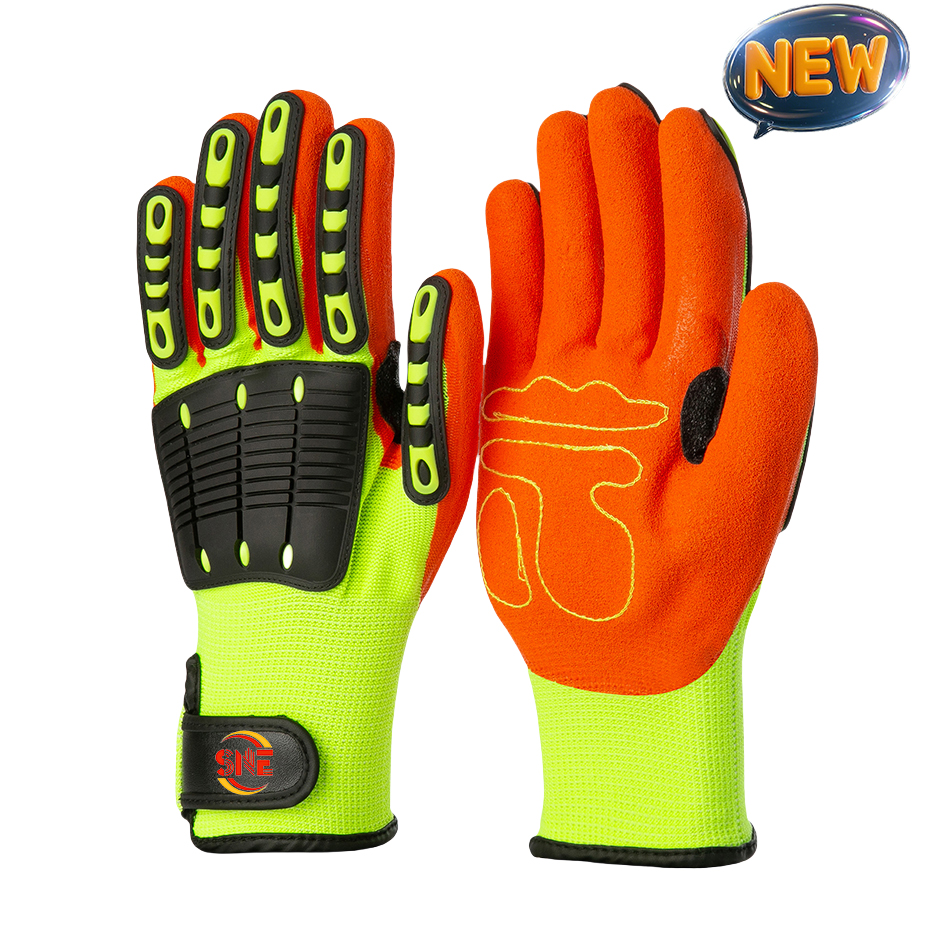
Impact resistant gloves are among the fastest-growing PPE categories in Germany, driven by the country’s expansive automotive, construction, oil and gas, and heavy manufacturing sectors. Workers handling heavy pipes, operating pneumatic tools, or managing steel components face daily dorsal hand impact hazards that standard work gloves simply cannot address. With EN 388:2016+A1:2018 now mandating a formal impact protection test for gloves incorporating TPR (thermoplastic rubber) back-of-hand elements, German HSE procurement teams have clearer benchmarks than ever for selecting the right protection level.
Whether you are a PPE distributor expanding your product line, an EHS manager at a major manufacturing plant, or an e-commerce brand owner looking for OEM/ODM opportunities, this guide delivers the technical depth and sourcing intelligence you need. If you need personalized product selection guidance or custom impact resistant gloves specifications for the German market, Kontakt zu unserem Team at Snell Safety — we have extensive experience serving German clients and can recommend configurations tailored to your local requirements.
Schnelle Antwort
For sourcing high-quality impact resistant gloves in Germany, consider established local PPE distributors with strong inventory across EN 388-rated mechanical protection gloves, as well as Chinese manufacturers who specialize in customized products with competitive pricing and full international certifications (ISO 9001/CE). A blended sourcing strategy — pairing a local distributor for emergency restocking with a factory-direct OEM partner for bulk custom production — typically delivers the best combination of speed, cost efficiency, and specification flexibility.
Marktübersicht
Germany’s safety gloves market is on a strong upward trajectory, reflecting the country’s position as Europe’s industrial powerhouse. The Germany Safety Gloves Market is projected to grow from USD 1,068.97 million in 2023 to an estimated USD 2,100.86 million by 2032, reflecting a compound annual growth rate (CAGR) of 7.78% from 2024 to 2032. Within this market, impact resistant gloves represent one of the highest-growth subcategories, fueled by rising awareness of dorsal hand injuries in oil and gas, construction, and heavy manufacturing. Hand and arm protection accounts for the largest share of the PPE market, representing 27% of global demand in 2026 and maintaining leadership through 2036.
Germany’s Personal Protective Equipment Market is projected to rise at 4.5% CAGR from 2026 to 2036, supported by modernization of factories and strict occupational compliance frameworks, with automotive, machinery, chemical, and metalworking sectors relying on specialized gloves. Germany’s dual occupational safety system — involving both state regulations under the Arbeitsschutzgesetz (ArbSchG) and the legally binding DGUV accident prevention regulations — creates a uniquely stringent enforcement environment that drives consistent demand for certified, high-performance impact resistant gloves across all industrial sectors.
What Types of Impact Resistant Gloves Are Needed in Germany
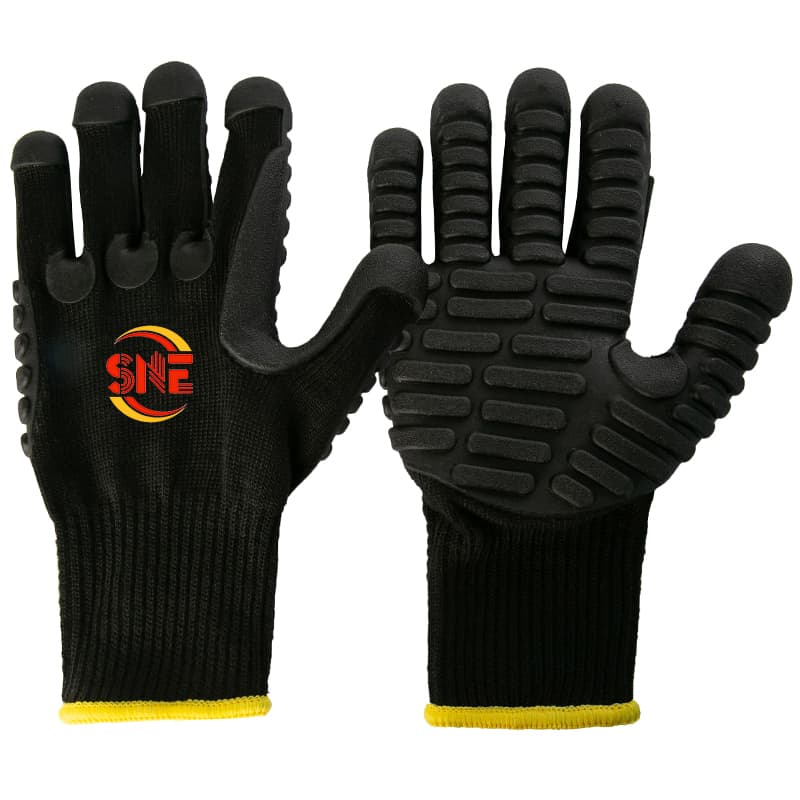
The most in-demand impact resistant gloves in Germany feature TPR (thermoplastic rubber) back-of-hand protection combined with advanced cut-resistant liners and high-grip coatings, meeting both EN 388:2016+A1:2018 impact “P” rating and elevated cut resistance levels. Based on our experience serving Germany clients across automotive, construction, oil and gas, and logistics sectors, the German market demands gloves that deliver robust dorsal protection without sacrificing the dexterity and tactile sensitivity that German workers expect.
German buyers are particularly discerning about hand feel and ergonomic fit. Through years of collaboration with distributors and end-user companies across the country, we have learned that German workers prefer a snugger, more anatomically contoured fit compared to many other markets. This preference directly influences our pattern design and TPR placement strategy — ensuring impact pads protect the knuckles, fingers, and metacarpal zone while leaving enough flex points for unimpeded hand movement. Germany’s climate also plays a role: cold winters in northern and eastern regions drive demand for impact gloves with thermal linings or compatibility with liner gloves, while warmer workshop environments in the industrial south prioritize breathability and moisture management.
The following product configurations represent our highest-volume exports to the German market:
- 13G HPPE + Glass Fiber + Spandex Liner with Sandy Nitrile Palm Coating and Full TPR Back-of-Hand — EN 388: 4X44EP. Cut level E with impact “P” rating. Ideal for oil and gas, heavy construction, and pipeline work. Sizes M–XXL.
- 13G HPPE + Kevlar Liner with Nitrile Foam Palm Coating and Segmented TPR Fingers/Knuckles — EN 388: 4X43DP. Cut level D with impact protection. Designed for automotive assembly, metal stamping, and maintenance operations where dexterity is critical. Sizes S–XL.
- 10G Polyester + Cotton Jersey Liner with Latex Crinkle Coating and Heavy-Duty TPR Guards — EN 388: 3X42BP. Cut level B with superior grip in wet conditions. Popular for construction, demolition, and logistics applications. Sizes M–XXL.
- 15G Nylon + HPPE Liner with PU Palm Coating and Low-Profile TPR — EN 388: 4X42CP. Cut level C with lightweight impact protection. Favored for precision assembly, warehousing, and light mechanical work where all-day comfort matters. Sizes S–XL.
- 13G HPPE + Steel Wire Liner with Sandy Nitrile Full Coating (3/4 Dip) and Extended TPR Coverage — EN 388: 4X44FP. Cut level F with maximum impact absorption. Engineered for mining, heavy steel fabrication, and demolition. Sizes L–XXL.
Why These Impact Resistant Gloves Are Recommended
Each recommended specification addresses a distinct combination of impact, cut, and grip hazards governed by Germany’s regulatory framework. The EN 388:2016 standard includes an impact protection test intended for work gloves designed for optimal hand protection against impact, with three potential ratings: P (pass), F (fail) or X (not tested). To earn a “P” rating, the test area is impacted with a 2.5 kg flat face striker from a sufficient height to provide impact energy of 5 J, and gloves must meet the requirement of ‘Level 1’ of EN 13594:2015 — the mean transmitted force shall be ≤ 7.0 kN with no single results greater than ≤ 9.0 kN.
The choice of liner material, coating type, and TPR design directly impacts both protection performance and total cost of ownership. HPPE + glass fiber liners at 13G deliver the optimal balance of cut resistance (Level D–F) and flexibility for most German industrial applications, while Kevlar blends offer superior heat resistance for automotive and metalworking environments. Sandy nitrile and nitrile foam coatings provide reliable grip in both dry and oily conditions — critical for German automotive and machinery plants where lubricants and cutting fluids are ubiquitous.
| Performance Metric | Sandy Nitrile + HPPE (13G) | Nitrile Foam + Kevlar (13G) | Latex Crinkle + Polyester (10G) | PU Palm + Nylon/HPPE (15G) |
|---|---|---|---|---|
| EN 388 Impact Rating | P (Pass) | P (Pass) | P (Pass) | P (Pass) |
| Cut Resistance (EN 388) | Level E–F | Level C–D | Level B | Level C |
| Abnutzungswiderstand | Level 4 (8,000+ cycles) | Level 4 (8,000+ cycles) | Level 3 (2,000+ cycles) | Level 4 (8,000+ cycles) |
| Grip in Oily Conditions | Ausgezeichnet | Sehr gut | Good (wet grip) | Mäßig |
| Bewertung der Geschicklichkeit | Gut | Sehr gut | Mäßig | Ausgezeichnet |
| Impact Resistant Gloves Type | Heavy-Duty Industrial | Automotive/Metal Fab | Construction/Demolition | Precision/Warehouse |
| Approx. Bulk Price (€/pair) | €4.50–€7.00 | €4.00–€6.50 | €3.00–€5.00 | €3.50–€5.50 |
Use this table to match your primary hazard profile, industry application, and budget to the optimal impact resistant gloves specification.
Key technical advantages to consider when selecting impact resistant gloves for German workplaces:
- TPR segmentation design: Segmented TPR pads along fingers and knuckles maintain 85–90% of bare-hand dexterity compared to rigid one-piece guards, critical for workers operating machinery controls and handling small components.
- Coating durability: Sandy nitrile coatings withstand 8,000+ abrasion cycles (EN 388 Level 4), delivering 2–3× the service life of smooth nitrile in high-wear applications.
- Liner gauge selection: 13G provides the best all-round balance; 15G maximizes dexterity for precision tasks; 10G offers maximum cut fiber content for extreme hazard environments.
- Kosten-Wirksamkeit: At €4–€7 per pair in bulk quantities (MOQ 5,000+), high-quality impact resistant gloves prevent dorsal injuries that cost German employers an average of €12,000–€18,000 per lost-time incident in direct and indirect costs.
Key Industries for Impact Resistant Gloves in Germany
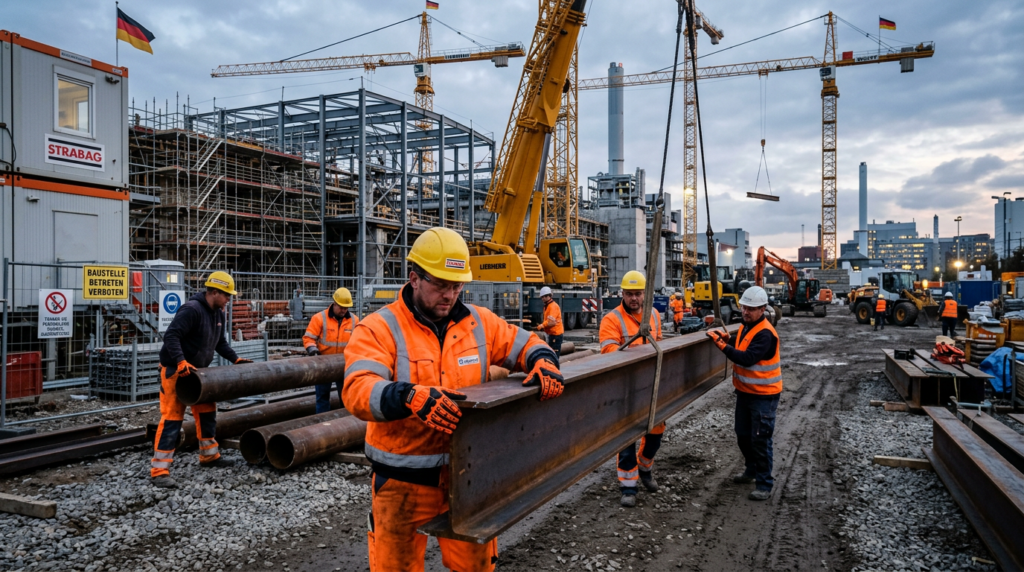
Impact resistant gloves are essential across every German industry where workers face crush, pinch, or strike hazards to the back of the hand and fingers. The expanding automotive, manufacturing, and construction sectors significantly contribute to market growth as these industries rely on manual labor and advanced machinery, increasing exposure to potential risks. The following industries represent the largest demand segments for impact resistant gloves in Germany:
- Oil and Gas / Energy: Pipeline construction, drilling operations, and refinery maintenance expose workers to heavy pipe handling, dropped objects, and high-pressure equipment. Impact resistant gloves with EN 388 cut level E–F and sandy nitrile coatings are standard procurement items. Germany’s energy transition (Energiewende) and continued natural gas infrastructure investment sustain steady demand.
- Automobilherstellung: Germany’s automotive sector — with its dense network of OEMs and Tier-1 through Tier-3 suppliers — requires impact resistant gloves for stamping press operations, body assembly, and powertrain component handling. Workers need gloves that combine TPR protection with high dexterity (13G–15G) for operating precision tooling and touchscreen HMI panels.
- Construction and Civil Engineering: Structural steel erection, formwork assembly, rebar tying, and demolition all generate significant impact and crush hazards. The ongoing infrastructure renewal across Germany — including bridge rehabilitation, rail expansion, and urban redevelopment — drives consistent bulk procurement of impact resistant gloves with latex crinkle or sandy nitrile coatings for wet-weather grip.
- Metal Fabrication and Mechanical Engineering: Germany’s Mittelstand of specialized machine builders and metal fabricators requires impact gloves for handling heavy sheet metal, steel profiles, and machined components. Cut resistance (Level C–E) combined with impact protection is essential for these multi-hazard environments.
- Mining and Quarrying: Although Germany’s mining sector is smaller than its manufacturing base, lignite mining operations, stone quarries, and aggregate processing plants present extreme impact, vibration, and abrasion hazards demanding the highest-specification impact resistant gloves (cut level F, TPR full-back coverage).
- Logistics and Warehousing: Germany’s position as Europe’s logistics hub creates massive demand for impact resistant gloves in parcel handling, freight loading, and warehouse operations. Amazon, DHL, and major logistics operators specify EN 388-rated impact gloves for workers handling heavy packages and operating pallet jacks.
- Wind Energy and Renewable Infrastructure: Turbine installation, tower assembly, and offshore maintenance involve handling heavy bolts, flanges, and nacelle components at height. Cold-weather impact resistant gloves with thermal linings are particularly important for North Sea and Baltic installations.
The growing emphasis on automation and specialized tasks also necessitates gloves that offer advanced protection without compromising dexterity, creating opportunities for innovation and market expansion. Germany’s DGUV regulations and Berufsgenossenschaft (BG) inspection system create a compliance-driven procurement culture where documented EN 388 ratings are not optional — they are a baseline requirement for every glove purchased. This regulatory environment benefits suppliers who can provide comprehensive certification documentation alongside their products.
Specific Application Scenarios for Impact Resistant Gloves
Scenario 1: Automotive Stamping Press Operations in Bavaria
In a major Tier-1 automotive supplier’s stamping plant near Munich, 120 press operators handle heavy steel blanks weighing 5–15 kg per piece across three shifts daily. Workers load raw blanks into progressive stamping dies, extract formed panels, and stack finished parts on transport racks. The primary hazards include crush injuries from misaligned blanks, pinch points at die entry zones, and sharp burr edges on stamped panels. The recommended specification is a 13G HPPE + Kevlar liner with nitrile foam palm coating and segmented TPR finger/knuckle guards — EN 388 rated 4X43DP. The nitrile foam coating provides secure grip on oiled steel surfaces, while the segmented TPR design preserves enough finger articulation for workers to operate press controls and touchscreen quality inspection tablets. Monthly consumption: approximately 600 pairs at a 3–4 week replacement cycle.
Scenario 2: Offshore Wind Farm Bolt Tensioning in the North Sea
On a jack-up installation vessel 80 km off the German North Sea coast, a crew of 30 technicians performs bolt tensioning on monopile-to-transition-piece flange connections. Workers handle 60–80 kg hydraulic tensioning tools, maneuver M64 bolts weighing 8 kg each, and work in temperatures ranging from -5 °C to +12 °C with constant wind exposure. Impact hazards include dropped bolts, swinging hydraulic hoses, and pinch points between flange faces. The recommended specification is a 13G HPPE + glass fiber + spandex liner with sandy nitrile full coating (3/4 dip) and heavy-duty full-back TPR coverage — EN 388 rated 4X44EP, with compatibility for thin thermal liner gloves underneath. The sandy nitrile coating maintains grip on wet, salt-sprayed steel surfaces. Glove consumption: approximately 200 pairs per month across all crew rotations.
Scenario 3: Warehouse Freight Loading at a Logistics Hub in Hamburg
At a major distribution center processing 45,000 parcels daily, 80 warehouse workers perform manual loading and unloading of freight containers, operating pallet jacks, and sorting heavy parcels (up to 30 kg). Hazards include impact from shifting cargo, crush injuries during container loading, and abrasion from rough cardboard and plastic banding. Workers need lightweight, breathable impact resistant gloves that can be worn comfortably for a full 8-hour shift. The recommended specification is a 15G nylon + HPPE liner with PU palm coating and low-profile TPR — EN 388 rated 4X42CP. The PU coating delivers precision grip for scanning devices and handheld terminals, while the 15G knit ensures excellent ventilation and reduces hand fatigue. Monthly consumption: approximately 500 pairs at a 4–6 week replacement cycle.
Fallstudien
Case 1: Construction Equipment Manufacturer in North Rhine-Westphalia
A leading German construction equipment manufacturer required 18,000 pairs annually of EN 388 impact “P” rated gloves with cut level D for their assembly line workers handling heavy hydraulic cylinders and steel chassis components. Their previous supplier delivered inconsistent TPR hardness between production batches, causing worker complaints about hand fatigue. After partnering with a vertically integrated OEM manufacturer with in-house TPR molding quality controls and batch-traceable production records, they achieved consistent Shore A hardness (58–62) across all deliveries and reduced hand injury incidents by 35% in the first year.
Case 2: PPE Distributor Expanding Impact Glove Product Line
A mid-sized German PPE distributor identified impact resistant gloves as a high-growth category for their oil and gas and construction client base. They needed 5 SKUs spanning cut levels B through F, all with private-label packaging, German-language EN 388 documentation, and barcoded individual pair packaging. Their factory OEM partner delivered an initial order of 50,000 pairs across all SKUs within 40 days, including custom box artwork, product photography for their e-commerce platform, and complete CE technical file documentation ready for EU import compliance.
Top 6 der empfohlenen lokalen Anbieter in Deutschland
| Name des Unternehmens | Zentrale Stärken | Service-Regionen | Vorverkaufsunterstützung | After-Sale-Unterstützung |
|---|---|---|---|---|
| RheinGuard Arbeitsschutz | Deep Impact Resistant Gloves catalog across all EN 388 protection levels; strong automotive OEM network | NRW, Hessen, Rheinland Pfalz | On-site hazard assessments, EN 388 product matching workshops | Dedicated account managers, batch traceability audits |
| NordSafe Industrieschutz | Oil and gas sector specialist; offshore-rated impact gloves with thermal compatibility | Hamburg, Lower Saxony, Schleswig-Holstein | MOQ flexibility, offshore spec consultation | Express replacement shipping, field performance tracking |
| BayernWerk Handschutz | Premium dexterity-focused Impact Resistant Gloves for automotive and aerospace | Bayern, Baden-Württemberg | Wear-trial programs, ergonomic fit assessments | Warranty processing, technical complaint resolution |
| SachsenStark PPE Solutions | Cost-effective bulk supply for construction and logistics; government tender expertise | Sachsen, Thüringen, Brandenburg | Tender documentation support, product specification sheets | On-site quality inspections, returns handling |
| HansaGrip Distribution | E-commerce fulfillment specialist; Amazon.de and B2B webshop integration | Nationwide via Hamburg logistics hub | Product listing content, certification document packages | Customer service support, review management |
| AlpenForge Sicherheit | Multi-hazard impact + cut + chemical combination gloves for heavy industry and mining | Nationwide (industrial corridor focus) | Risk assessment consultations, custom TPR design options | Performance data reporting, wear-life analysis |
When evaluating any supplier of impact resistant gloves, always request third-party EN 388:2016+A1:2018 test reports from an accredited EU notified body. Verify that the impact “P” rating is documented alongside cut, abrasion, tear, and puncture levels, and confirm batch-to-batch consistency in TPR hardness and coating adhesion.
Why Choose Snell Safety as Your Global Impact Resistant Gloves Partner
Snell Sicherheit brings deep German market expertise built through years of direct collaboration with PPE distributors, automotive manufacturers, construction companies, and oil and gas procurement teams across Germany. We understand which TPR configurations, liner materials, coating types, and sizing patterns perform best in each German application — from the high-dexterity 15G nitrile foam gloves demanded by Bavarian automotive plants to the heavy-duty sandy nitrile full-coated gauntlets required by North Sea offshore crews. With established local partners on the ground and planned overseas warehouse capacity for stock-ready delivery, we serve both end-user enterprises and distribution partners with products precisely tailored to German workplace conditions and worker hand-feel preferences. We are actively recruiting distributors, agents, and e-commerce brand owners across Germany — offering comprehensive pre-sale empowerment (product selection guidance, technical training, market intelligence), after-sale support (quality assurance, replacement policies), dropshipping services, free product samples, and marketing material support including product photography and listing content.
Our manufacturing backbone ensures this local expertise is backed by world-class production capability. With over a decade of hands-on expertise in safety glove manufacturing, two facilities running 6 dedicated production lines, and a daily capacity of 150,000 pairs, our vertically integrated process (R&D → material sourcing → knitting → TPR molding → coating/dipping → drying/curing → quality inspection → packaging → export) ensures consistent quality batch after batch. Advanced cut-resistant and impact-resistant glove engineering is a core competency — we work with HPPE, Kevlar, glass fiber, steel wire, and multiple TPR formulations to achieve the precise EN 388 performance profile each customer requires. ISO 9001 certification and CE marking provide the compliance documentation German importers need, while our factory-direct pricing eliminates middleman margins. Browse our full Produktkatalog oder Kontakt zu unserem Team to request samples configured for your German market requirements.
FAQ
What does the EN 388 impact “P” rating mean for impact resistant gloves?
The “P” rating indicates the glove has passed the EN 388:2016+A1:2018 impact protection test, where a 2.5 kg striker delivers 5 J of impact energy and the mean transmitted force must be ≤ 7.0 kN. Gloves not designed for impact protection are marked “X” (not tested). Always look for the “P” as the sixth character in the EN 388 pictogram.
What certifications are required to import impact resistant gloves into Germany?
Impact resistant gloves are classified as Category II PPE under EU Regulation 2016/425 and must carry CE marking. They require EU Type Examination by an accredited notified body, EN 388:2016+A1:2018 testing, and a German-language EU Declaration of Conformity. REACH compliance documentation is also mandatory for EU market access.
Which coating type is best for oily environments in German manufacturing?
Sandy nitrile coating provides the best grip performance in oily and wet conditions, making it the preferred choice for automotive, metalworking, and machinery manufacturing environments where cutting fluids and lubricants are present. Nitrile foam coating offers a good alternative with slightly better dexterity, while latex crinkle excels in wet (non-oily) conditions.
How do I choose the right gauge for impact resistant gloves?
For heavy industrial applications (oil and gas, mining, demolition), choose 10G or 13G for maximum cut fiber content and durability. For automotive assembly and metal fabrication, 13G delivers the optimal balance. For warehouse, logistics, and precision tasks, 15G or 18G maximizes dexterity and all-day comfort. The gauge directly affects both protection level and tactile sensitivity.
What cut level do I need for construction work in Germany?
Most German construction applications require EN 388 cut level B–D. General material handling and formwork need level B–C, while rebar tying, sheet metal handling, and demolition require level D–E. Always conduct a site-specific risk assessment per DGUV requirements to determine the minimum cut level for each task.
What is the typical price range for bulk impact resistant gloves orders?
For factory-direct bulk orders (MOQ 5,000+ pairs), prices range from €3.00–€5.00/pair for standard TPR construction gloves (10G, latex crinkle, cut level B) to €4.50–€7.00/pair for premium oil and gas specifications (13G, sandy nitrile, cut level E–F). Custom branding and packaging typically add €0.15–€0.40/pair.
How long do impact resistant gloves typically last?
Service life depends on the application intensity. In heavy construction and oil and gas, expect 2–4 weeks per pair. In automotive assembly and metal fabrication, 4–6 weeks is typical. In warehousing and logistics, 6–8 weeks is achievable. Replace immediately when TPR pads show cracking, delamination, or visible compression set, or when coating integrity is compromised.
How does EN 388 impact testing compare to ANSI/ISEA 138?
EN 388 tests impact protection at the knuckle area only, with a pass/fail result. ANSI/ISEA 138 evaluates impact across knuckles, fingers, and thumb using 18 separate drop tests, with three performance levels (1, 2, 3). For the German market, EN 388 “P” rating is the required standard. If exporting to North America, dual-rated gloves (EN 388 + ANSI/ISEA 138) offer the broadest market coverage.
What liner materials provide the best cut resistance for impact gloves?
HPPE (high-performance polyethylene) combined with glass fiber delivers the highest cut resistance (EN 388 Level E–F) at the best cost point. Kevlar blends offer superior heat resistance and are preferred for automotive and metalworking. Steel wire reinforcement achieves maximum cut protection but reduces flexibility. For most German industrial applications, HPPE + glass fiber at 13G provides the optimal performance-to-comfort ratio.
Are touchscreen-compatible impact resistant gloves available?
Yes. Gloves with conductive fingertip coatings (typically PU or specialized nitrile formulations on the index finger and thumb) enable touchscreen operation for HMI panels, tablets, and handheld scanners. These are increasingly specified by German automotive OEMs, logistics operators, and smart factory environments where workers need to interact with digital devices without removing gloves.
Whether you are an end-user enterprise seeking factory-direct supply of impact resistant gloves, a distributor building out your German product line, or an e-commerce brand owner developing a private-label impact glove range, Snell Sicherheit is ready to support your requirements with deep market expertise and world-class manufacturing capability. Submit your specifications or request a quote today — including free samples, custom OEM/ODM solutions, and dedicated technical consultation for the German market.
Inhalt überprüft und aktualisiert: März 2026